

Did you know that HMRC compliance checks now cover approximately 17% of all R&D claims? For many UK businesses, receiving that initial letter triggers immediate anxiety, particularly as the landscape shifts toward the Merged Scheme and stricter ERIS requirements. It's natural to feel that the HMRC R&D enquiry process is an opaque, time-consuming hurdle that puts your hard-earned capital at risk. You aren't alone in wanting to protect your innovation incentives from unnecessary scrutiny.
This guide will show you how to navigate the HMRC R&D enquiry process with total confidence whilst ensuring your claim remains robust and compliant. We'll provide a clear roadmap through the 2026 regulatory environment, from mastering the mandatory Additional Information Form to implementing forensic-level reporting. By the end, you'll understand how to secure successful capital recovery and achieve zero-penalty closures through a repeatable, professional claiming process.
Key Takeaways
- Master the specific stages and documentation requirements of the HMRC R&D enquiry process to handle compliance checks with professional composure.
- Adapt your technical reporting to meet the unified standards of the 2026 Merged Scheme and the specific intensity thresholds required for ERIS claimants.
- Implement forensic cost-tracking techniques that precisely apportion staff time and material expenses to withstand the highest levels of HMRC scrutiny.
- Gain insights into the "Check of a Tax Return" letter and the proactive steps necessary to secure a swift, zero-penalty enquiry closure.
- Understand how a relationship-first approach to claim preparation can transform your tax relief incentives into strategic assets for long-term business innovation.
Understanding the HMRC R&D Enquiry Process: Why Compliance Matters in 2026
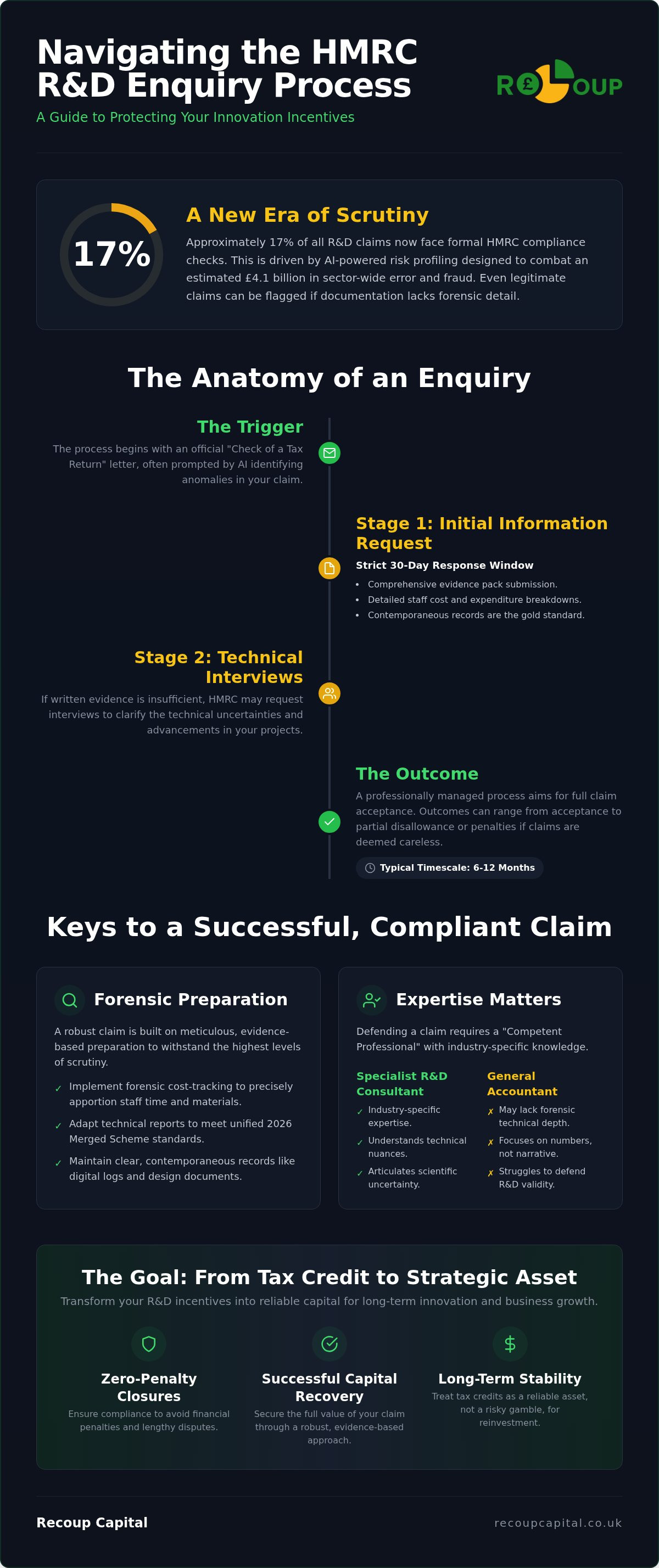
The HMRC R&D enquiry process is a formal compliance check designed to verify the technical and financial validity of a tax relief claim. Whilst it might feel like an interrogation, it's actually a standard regulatory procedure to ensure the integrity of the UK's R&D tax incentive. In 2026, these enquiries are more frequent amongst UK limited companies. HMRC reports that error and fraud reached an estimated £4.1 billion in the years leading up to 2024, prompting a massive shift towards AI-driven risk profiling. This automated system flags anomalies instantly. Even legitimate claims can trigger a check if the documentation lacks forensic detail.
You shouldn't view an enquiry as a sign of wrongdoing or a reason for panic. Instead, treat it as a manageable phase of the corporate tax cycle that requires professional, evidence-based management. The goal is to demonstrate that your innovation meets the statutory definitions of research and development through clear, contemporary records. Professional preparation transforms a potential threat into a routine validation of your business's innovative activities.
The Strategic Importance of Compliance
A well-structured claim isn't just a tax filing; it's a strategic asset for business reinvestment. Aggressive claiming tactics often backfire, leading to lengthy disputes and potential penalties. By contrast, a conservative, evidence-based approach ensures long-term stability and protects your company's reputation. HMRC focuses heavily on high-value sectors like construction and engineering because the technical uncertainties are often complex and the expenditure significant. Maintaining a robust compliance trail allows you to treat your tax credits as reliable capital rather than a risky gamble.
General Accountants vs Specialist R&D Consultants
Many businesses rely on their general accountants for tax advice, but these firms often struggle with the technical nuances of the HMRC R&D enquiry process. Defending a claim requires the input of a "Competent Professional". This is someone with the industry-specific expertise to explain why a project represents a genuine technological advancement. Generalists may understand the numbers, but they often lack the forensic depth to articulate the scientific uncertainties involved. Working with specialists ensures your technical narrative matches HMRC's 2026 standards. If you're still learning the basics of how these incentives function, you can find R&D tax credits explained in our detailed guide. This foundational knowledge is your first line of defence against automated scrutiny.
The Anatomy of an Enquiry: A Step-by-Step Breakdown
Receiving a "Check of a Tax Return" letter is the official starting gun for a process that typically spans six to twelve months. It's a structured timeline. The HMRC R&D enquiry process begins with a formal notice, often triggered by AI-driven risk profiling that identifies anomalies in your technical narrative or cost apportionments. Your response must be prompt and precise. If your documentation fails to align with the criteria in HMRC's official R&D manual, the inspector will initiate a deeper dive into your project records. Outcomes range from full claim acceptance to partial disallowance. In cases where HMRC deems a submission "careless" or "deliberate", financial penalties may apply, making professional management of the timeline essential.
Stage 1: The Initial Information Request
Once the enquiry opens, you usually have a strict 30-day window to provide a comprehensive evidence pack. HMRC will request detailed staff cost breakdowns and project-specific expenditure logs. For those in construction or engineering, this often means proving that on-site labour was directly engaged in resolving technical uncertainties rather than routine production. Contemporaneous records are the gold standard here. Digital logs, meeting minutes, and version-controlled design documents prove that the R&D work actually occurred during the claimed period. Organising these files into a forensic-ready format is a critical first step. If you're unsure about the strength of your current documentation, reviewing your claiming process early can prevent significant delays later.
Stage 2: Technical Interviews and Clarifications
If the written evidence doesn't fully satisfy the inspector, they may request a technical interview. This is a pivotal moment. You'll need to prepare your lead engineers or developers to speak directly with HMRC specialists. The challenge is articulating "Scientific or Technological Uncertainty" without falling back on generic industry jargon. Inspectors want to hear about the failures, the iterations, and the specific reasons why a solution wasn't "readily deducible" by a competent professional in your field. A common pitfall is over-explaining the commercial success of a project whilst neglecting the technical obstacles that define R&D. Successfully navigating the HMRC R&D enquiry process requires your technical team to focus purely on the advancement of knowledge, ensuring every project description mirrors the rigorous standards of the 2026 Merged Scheme.
Navigating the 2026 Landscape: Merged Schemes and ERIS Compliance
The 2026 tax landscape has evolved into a more unified environment. With the Merged R&D Scheme now the standard for most accounting periods starting on or after 1 April 2024, compliance expectations have reached a new equilibrium. This scheme provides a taxable credit of 20% on qualifying expenditure, which nets down to approximately 15% for profitable companies. Because the same rules now apply to businesses of almost all sizes, HMRC has standardised its risk profiling. If your technical narrative doesn't clearly demonstrate how you meet these unified criteria, your submission is significantly more likely to enter the HMRC R&D enquiry process. The mandatory Additional Information Form (AIF) acts as the primary filter for this scrutiny, requiring digital submission before your tax return is even filed.
The Merged Scheme vs ERIS: A Compliance Comparison
For loss-making SMEs, the Enhanced R&D Intensive Support (ERIS) remains a vital, though high-scrutiny, option. To qualify, your R&D intensity must reach at least 30% of your total expenditure. This threshold was lowered from 40% in 2024, but HMRC validates this calculation with forensic precision during an enquiry. Incorrectly categorising total expenditure to artificially meet the 30% mark is a primary trigger for a compliance check. Furthermore, the 2026 rules have fundamentally changed how subcontracted work is handled. In the Merged Scheme, the company that makes the decision to undertake R&D is typically the one entitled to claim, which prevents the "double claiming" issues seen in previous years.
| Feature | Merged R&D Scheme | ERIS (R&D Intensive) |
|---|---|---|
| Gross Benefit | 20% Taxable Credit | 86% Deduction + 14.5% Credit |
| Net Cash Value | Approx. 15% | Up to Approx. 27% |
| Intensity Threshold | None | 30% of total expenditure |
| Primary Enquiry Risk | Subcontractor eligibility | Intensity calculation errors |
The Role of the Senior Officer and Digital Sign-off
In 2026, the HMRC R&D enquiry process focuses heavily on accountability. Every AIF submission requires a named Senior Officer within the claimant company to take legal responsibility for the accuracy of the data. This shift aims to eliminate "ghost-written" claims produced by low-quality providers without internal technical input. HMRC’s digital-first filing system uses sophisticated algorithms to cross-reference your AIF details with previous years and industry benchmarks. If the technical descriptions feel generic or disconnected from your actual business operations, the system flags the claim for a manual review. Ensuring your technical leads are involved in the sign-off process is no longer just good practice; it's a fundamental requirement for a successful, zero-penalty closure.
Forensic Preparation: Minimising Risk Within the HMRC R&D Enquiry Process
In 2026, the best way to survive a compliance check is to prepare as if one is already happening. Forensic cost identification is the meticulous tracking of every qualifying hour and material cost, ensuring that your financial data is inseparable from your technical narrative. This level of detail is your primary shield during the HMRC R&D enquiry process. When apportioning staff time amongst multiple innovative projects, you must avoid "round-number" estimates. HMRC inspectors now look for precise percentages backed by internal logs or project management records. Over-claiming by even a small margin can flag your entire submission for manual review.
Your technical narrative should also embrace the inclusion of modern costs like cloud computing and data sets. These are often overlooked but represent significant qualifying expenditure in 2026. Documenting these requires more than a simple invoice; you must explain how these digital assets were essential to resolving a specific technological uncertainty. Don't be afraid to document failed projects either. Evidence of a project that didn't meet its objectives is often the strongest proof that you were facing a genuine uncertainty that wasn't readily deducible.
Capturing Hidden R&D Costs Safely
For those in construction and engineering, R&D often hides within the design and testing phases. Identifying activities like prototype stress-testing or bespoke software integration for site management can significantly boost your claim value whilst remaining compliant. You can also include Externally Provided Workers (EPWs), provided you can show they were directly supervised by your own competent professionals. For assets that don't qualify as R&D but still represent significant innovation, consider how capital allowances can recover your investment costs through a different tax relief route.
Future-Proofing Your Claims
Forensic preparation is the act of building an enquiry-defence file at the same time as the claim itself. This proactive approach relies on project-level documentation rather than high-level company summaries. Instead of general descriptions, use internal software logs, version-control histories, and project management tool exports as primary evidence. These records prove the timeline of your innovation in a way that retrospective narratives cannot match. If you want to ensure your next innovation claim is built on a foundation of forensic evidence, you can enlist our specialist support today to secure your capital recovery.
The Recoup Capital Advantage: Specialist Guidance and Enquiry Protection
Choosing a partner to manage your innovation incentives is a strategic decision that affects your company's financial resilience. At Recoup Capital, we operate on a success-based fee model. This means there are no upfront costs for our services, which reflects our absolute confidence in the forensic robustness of every claim we prepare. Our team of specialist chartered tax accountants understands that the HMRC R&D enquiry process is a technical challenge that requires more than just basic bookkeeping. We act as a proactive and protective guide, transforming what could be an intimidating regulatory hurdle into a clear opportunity for your business to reinvest and thrive.
We possess a deep-rooted expertise in "hard-to-claim" sectors like construction and engineering. These industries are often the focus of HMRC's AI-driven risk profiling because their technical uncertainties are so complex. Our forensic analysis uncovers qualifying activities that generalist firms frequently overlook, such as bespoke structural iterations or innovative site remediation techniques. By positioning ourselves as a long-term partner rather than a one-off service provider, we ensure your innovation is protected by a solid track record of success and transparency. We don't just process paperwork; we secure your capital.
Our Approach to Enquiry Defence
From the moment we begin a collaboration, we organise your technical narrative to meet the "Competent Professional" standard. This meticulous preparation ensures that your claim is enquiry-ready from day one. We act as an expert buffer between your business and HMRC inspectors, handling all liaison and technical clarifications on your behalf. This protective layer allows your lead engineers and directors to focus on their core work whilst we manage the regulatory complexities. Our primary goal is always a swift, zero-penalty closure that reinforces the validity of your innovation incentives.
Next Steps: Your No-Cost R&D Compliance Assessment
Navigating the 2026 landscape of Merged Schemes and ERIS requirements shouldn't feel like a burden on your internal resources. We provide a low-friction, no-cost assessment to review your current or past claims for potential enquiry risks. It's essential to understand why claim R&D relief in the first place: it's about turning your technical challenges into strategic financial assets. This assessment provides a clear, risk-free pathway to ensuring your innovation remains both rewarded and compliant. We focus on your bottom line so you can focus on the future.
Ready to de-risk your innovation strategy? Book your free R&D tax relief consultation with Recoup Capital today and discover the value of specialist, results-oriented guidance within the HMRC R&D enquiry process.
Turning Regulatory Compliance Into a Strategic Business Advantage
The 2026 landscape demands a shift from reactive filing to proactive, forensic preparation. By mastering the nuances of the Merged Scheme and ensuring your AIF submissions are technically sound, you transform potential risks into verified strategic assets. Successfully managing the HMRC R&D enquiry process isn't just about avoiding penalties; it's about validating the integrity of your innovation and securing the capital your business deserves. Robust documentation and a clear technical narrative are the foundations of long-term financial resilience.
You don't have to face HMRC's automated scrutiny alone. Recoup Capital acts as your protective guide, providing national UK enquiry support backed by specialist chartered tax accountants. Our success-based fee model means our interests are perfectly aligned with the robustness of your claim. With specific expertise in the complex construction and engineering sectors, we ensure your technical narrative stands up to the highest standards. Secure your innovation funding with a free R&D assessment from Recoup Capital and move forward with the confidence that your future growth is protected.
Frequently Asked Questions
What is the HMRC R&D enquiry process?
The HMRC R&D enquiry process is a formal compliance check into the technical and financial validity of a tax relief claim. HMRC uses this structured review to ensure every submission meets the strict statutory definitions of innovation. It often begins with a "Check of a Tax Return" letter and involves a deep dive into technical narratives and cost apportionments to prevent error or fraud within the UK tax system.
How long does an HMRC R&D enquiry typically last in 2026?
Most enquiries in 2026 span between six and twelve months, depending on the complexity of the technical uncertainties. Simple clarifications might be resolved sooner; however, cases involving technical interviews or site visits can take longer. Promptly providing forensic documentation within the initial 30-day window is the most effective way to prevent the timeline from extending further into the next accounting period or delaying your capital recovery.
Can I claim R&D tax relief if my innovation project failed?
Yes, you can claim for failed projects because R&D tax relief is based on the attempt to resolve technological uncertainty, not the commercial outcome. In fact, documenting a failure often provides the strongest evidence for an enquiry. It proves that the solution wasn't "readily deducible" to a competent professional in your field. HMRC values the advancement of knowledge, even if the specific project goal wasn't physically achieved.
What are the penalties for an incorrect R&D tax claim?
Penalties depend on whether the error was deemed "careless" or "deliberate". Careless errors can result in penalties between 0% and 30% of the potential lost revenue, whilst deliberate inaccuracies can reach up to 100%. If you've taken "reasonable care" by consulting specialist chartered tax accountants, you're significantly less likely to face financial sanctions. HMRC prioritises accuracy and transparency in the 2026 compliance landscape to ensure the scheme's long-term integrity.
How does the Merged R&D Scheme affect existing enquiries?
The Merged R&D Scheme unifies compliance standards for accounting periods starting on or after 1 April 2024. For existing enquiries on older claims, HMRC still applies the specific SME or RDEC rules relevant to that period. However, the 2026 HMRC R&D enquiry process uses the same rigorous AI-driven risk profiling across all schemes. You must ensure your technical narrative aligns with the specific legislation active at the time of your expenditure.
What triggers an HMRC R&D enquiry in 2026?
Triggers include inconsistencies in the mandatory Additional Information Form (AIF) or deviations from industry cost benchmarks. HMRC's automated systems flag claims where staff cost apportionments look like round-number estimates rather than forensic tracking. High-value claims in sectors like construction or engineering also face higher scrutiny. An enquiry doesn't always imply an error; it's often a routine check triggered by these automated risk filters to verify the validity of the claim.
Do I need a specialist to handle an HMRC R&D enquiry?
Whilst not legally required, having a specialist manage the HMRC R&D enquiry process is highly recommended due to the technical nature of the defence. Generalist accountants often lack the sector-specific expertise to articulate scientific uncertainties to HMRC inspectors effectively. A specialist acts as a protective buffer, ensuring technical narratives meet the "Competent Professional" standard and handling all liaison to secure a swift, zero-penalty closure for your innovative business.
What documents does HMRC ask for during an R&D compliance check?
HMRC typically requests a comprehensive evidence pack to validate your qualifying expenditure. This usually includes:
- Detailed staff cost breakdowns by project.
- Contemporaneous project records like design logs or meeting minutes.
- Contracts for Externally Provided Workers (EPWs) and subcontractors.
- Invoices for qualifying materials, cloud computing, and data sets.


