

The closest office on your high street might be the furthest thing from what your innovation actually needs. Whilst searching for "r&d tax credit specialists near me" is a natural starting point, the recent merging of the SME and RDEC schemes has transformed the tax landscape into one where technical precision outweighs physical proximity. You likely feel the weight of HMRC's increased scrutiny and the pressure of the new mandatory Advance Notification forms. It's frustrating to spend hours explaining complex engineering or software architecture to a generalist who only sees the numbers, not the breakthrough.
You deserve a partner who speaks your industry's language and protects your claim with rigorous compliance. This guide reveals how to identify a specialist who ensures your claim is both maximised and robust against enquiries, regardless of their postcode. We will explore the critical impact of the 2024 scheme mergers, the importance of mandatory adviser registration, and how a technical-meets-financial approach can secure your capital without disrupting your daily operations.
Key Takeaways
- Understand why sector-specific intimacy and digital compliance are now far more critical than physical proximity when searching for r&d tax credit specialists near me.
- Learn how the "Two Pillars" of a successful claim—technical narratives and financial costing—require the combined expertise of technical analysts and chartered tax accountants.
- Discover how to navigate the recent HMRC compliance shifts, including the mandatory Additional Information Form and the newly merged R&D tax scheme.
- Identify the benefits of a success-based fee model that aligns your consultant's goals with your own to ensure a maximised, compliant result.
- Reframe your R&D tax recovery as a strategic business asset that fuels future innovation without disrupting your daily operations.
Understanding the Search for R&D Tax Credit Specialists Near You
Searching for r&d tax credit specialists near me usually stems from a desire for trust and accessibility. It's a sensible instinct. You want a partner you can reach, someone who understands the local business environment. However, the reality of corporate finance has shifted significantly. In 2026, the value of a tax partner isn't measured by how quickly they can drive to your office, but by how deeply they understand your specific technical niche and HMRC's digital-first compliance regime.
A generalist accountant is essential for your day-to-day books and annual filings, but they often lack the engineering or scientific background required to defend a complex claim. A specialist firm bridges the gap between your shop-floor innovation and the rigid framework of the UK R&D tax incentive. They don't just process numbers; they translate technical breakthroughs into a language HMRC respects. This specialism ensures that every qualifying activity is captured whilst maintaining total alignment with current legislation.
The Evolution of R&D Tax Relief in the UK
The R&D landscape underwent a seismic shift for accounting periods beginning on or after 1 April 2024. The SME and RDEC schemes merged into a single, streamlined system. Whilst this was intended to simplify things, it actually increased the burden of proof for many businesses. Generalist accountants often struggle with the technical narrative requirements that are now mandatory under the new regime. You need a partner who tracks national HMRC trends and understands the nuances of the Merged Scheme's 20% gross credit. This level of insight rarely exists in a local high-street practice that handles a bit of everything.
Sector Expertise vs. Postcode Proximity
If your company operates in construction or engineering, a specialist who understands structural load-bearing challenges or material science is far more valuable than a local generalist. National firms use sector-specific R&D benchmarks to ensure your claim is both maximised and compliant. Physical location has become secondary to technical intimacy. With secure digital portals and video consultation, the best r&d tax credit specialists near me are often the ones with the most relevant industry experience, not the closest postcode. It's about finding a partner who understands your technical risks as well as you do. For a deeper look at how these claims function, you can see our guide on R&D tax credits explained.
Technical Expertise vs. General Accounting: Why Specialism Matters
Whilst your local accountant is likely excellent at managing your annual accounts and VAT returns, R&D tax credits require a different lens. When you search for r&d tax credit specialists near me, you're looking for a team that can bridge the gap between technical innovation and tax legislation. A successful claim is built on two pillars: the technical narrative and the financial costing. If either pillar is weak, the entire claim becomes vulnerable to HMRC scrutiny. Generalist firms often focus purely on the numbers, but without a robust technical justification, those numbers lack the necessary context to satisfy modern compliance standards.
Specialists bring a level of sector-specific insight that most generalists simply don't possess. In industries like construction and engineering, R&D is often hidden within bespoke problem-solving and site-specific workarounds. A generalist might see these as standard project costs, whilst a specialist identifies them as qualifying activities. This distinction is the difference between a modest refund and a significant strategic asset that can be reinvested into your business growth.
The Role of the Technical Analyst
The technical analyst is often the "secret weapon" of a specialised firm. These professionals usually have backgrounds in engineering, software, or science, allowing them to speak the same language as your project leads. They don't need you to simplify your work; they want the complex details. Their job is to extract the nuances of your projects and translate them into the specific language HMRC expects to see in the Additional Information Form.
Technological uncertainty exists when the knowledge of whether a technical objective is achievable, or how to achieve it in practice, is not readily available or deducible by a competent professional in the field. Identifying these uncertainties is the core requirement for a valid claim. By focusing on the technical "why" rather than just the financial "how much", specialists ensure your claim is both maximised and defensible. If you are unsure about your project's technical eligibility, exploring your eligibility with a specialist is the safest first step.
Chartered Tax Accountants and Financial Rigour
The second pillar involves the precise apportionment of costs. HMRC’s guidelines on qualifying expenditure are notoriously complex, particularly regarding the merged R&D scheme and overseas subcontracting. Chartered tax accountants ensure that every penny claimed is backed by evidence and adheres to the latest legislative changes. They manage the intricacies of indirect activities and ensure that staffing costs are correctly weighted against the time actually spent on R&D tasks. This level of financial rigour is essential for Claiming R&D Tax Credits without triggering red flags. Choosing a partner from the pool of r&d tax credit specialists near me means prioritising a team that combines this financial precision with deep technical understanding.
Navigating the New HMRC Compliance Landscape
HMRC has significantly intensified its scrutiny of R&D claims. The era of "submit and forget" is over. As of 2026, HMRC meets its 40-day processing target for approximately 85% of claims, but this speed is coupled with a much higher volume of compliance checks. Searching for r&d tax credit specialists near me is now as much about finding a protective shield as it is about finding a financial advisor. You need a partner who understands that transparency isn't just a preference; it's a survival strategy in a landscape where the Wealthy & Mid-sized Business Compliance (WMBC) team is expanding its reach and utilising AI tools to flag high-risk submissions.
The introduction of the mandatory Additional Information Form (AIF) has changed the submission workflow forever. Every claim must now be accompanied by this digital filing, which requires granular detail on projects, costs, and the specific technological advances being sought. If the AIF is incomplete or lacks technical depth, HMRC may reject the claim before it even reaches a human reviewer. A specialist ensures that this documentation is robust enough to withstand both automated summarisers and manual case worker inspections. This meticulous approach transforms a potentially intimidating regulatory procedure into a manageable opportunity for growth.
Common Red Flags HMRC Looks For
HMRC's review process often triggers an enquiry if certain markers are present. Vague technical descriptions that fail to demonstrate a clear "advance" in science or technology are the most common culprits. If your narrative sounds like standard commercial problem-solving rather than a quest to overcome a specific technological uncertainty, it will likely be flagged. Other red flags include inconsistent costings, such as claiming for administrative staff who aren't directly involved in the R&D process, or failing to identify the "competent professional" whose expertise guided the innovation. Robust documentation is your best defence against these challenges.
How Specialists Minimise Enquiry Risk
Top-tier firms employ a multi-layered quality assurance process before any claim reaches HMRC. This includes internal peer reviews where technical analysts challenge the narrative to ensure it meets the highest standards of evidence. Most importantly, a true specialist provides enquiry defence as a standard part of their partnership. They act as the primary point of contact for HMRC, handling all correspondence and technical queries on your behalf. This ensures minimal disruption to your daily operations whilst providing peace of mind. For a deeper dive into the mechanics of these incentives, you can review our guide on R&D tax credits explained. Our goal is to ensure your claim remains a strategic asset rather than a compliance burden.
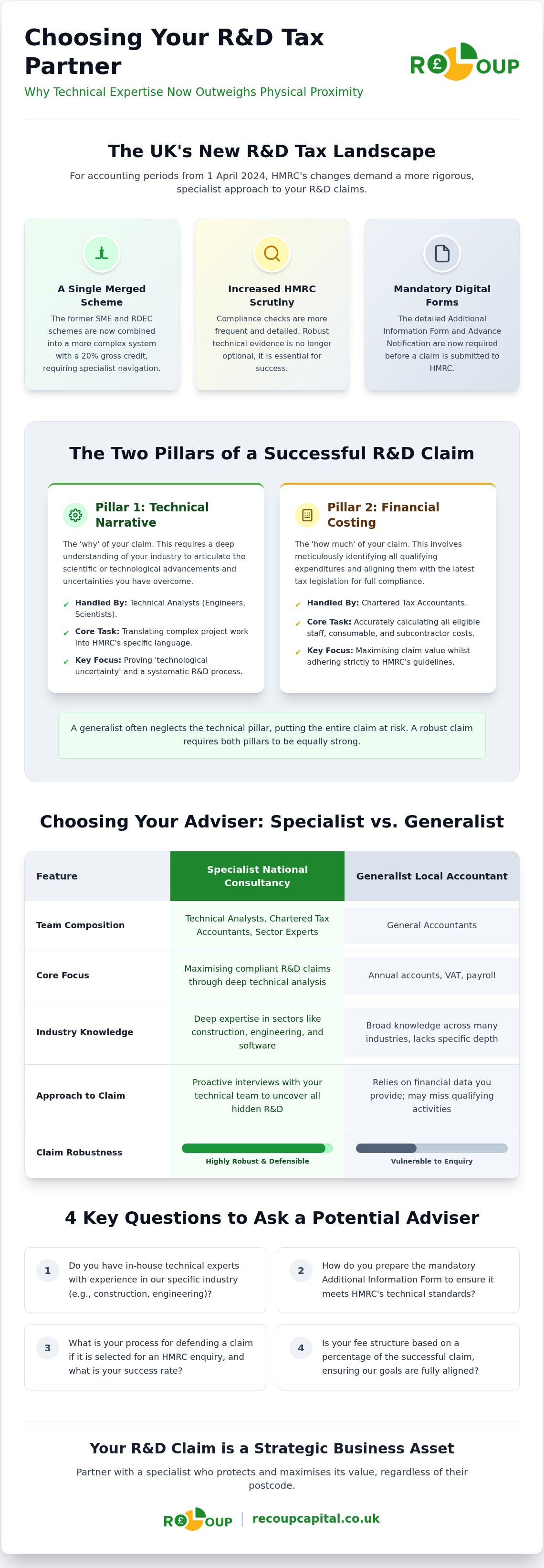
A Framework for Evaluating R&D Tax Credit Consultancies
Selecting a partner from the search results for r&d tax credit specialists near me requires a discerning eye. You're looking for more than a service provider; you're looking for a long-term collaborator who understands the strategic value of your capital. A primary indicator of a high-quality specialist is their fee structure. A success-based model is often the most transparent approach. It ensures the consultant is incentivised to maximise your claim whilst maintaining absolute compliance. If they don't deliver results, you don't pay. This structure lowers the barrier to entry for businesses that might be hesitant about the initial costs of consultancy.
Beyond the fee, look for professional rigour. Ensure the team includes chartered tax accountants who can provide the financial depth HMRC now demands. The difference is stark. There is a significant gap between a firm that merely writes a report and one that provides an end-to-end service. A true specialist handles everything from the initial technical assessment to the final HMRC liaison. This comprehensive support is vital if an enquiry arises. You'll want the experts who prepared the claim to be the ones defending it. If you're ready to see how a professional partnership can transform your innovation into capital, book a technical assessment with our team today.
5 Essential Questions to Ask Your Potential Specialist
Before committing to a partnership, you must vet their technical depth. Start by asking if they have technical specialists with direct experience in your specific industry. It's also vital to understand their process for handling an HMRC enquiry; a vague answer here is a warning sign. Ask how much of your team’s time will be required to prepare the claim. A streamlined process should minimise disruption to your daily operations. Finally, request examples of successful claims they've handled in the construction or engineering sectors to verify their track record in your field.
Red Flags to Avoid in a Consultant
Be wary of aggressive sales tactics or "guaranteed" claim amounts promised before a thorough technical review has even taken place. R&D tax credits are based on specific facts, not marketing promises. A lack of a physical office or professional tax qualifications amongst the leadership team often indicates a lack of institutional stability. Similarly, fees that seem unusually low or "fixed" regardless of claim complexity can be a sign of a "template" approach. This often leads to under-claiming or, worse, submitting a generic narrative that triggers an immediate HMRC enquiry. Professionalism and transparency should always be your benchmarks.
Why Recoup Capital is Your National Partner for Local Innovation
Recoup Capital operates as a proactive partner for limited companies across the UK, bridging the gap between local innovation and national tax standards. Whilst your initial search for r&d tax credit specialists near me might focus on proximity, our value lies in our deep sector intimacy. We specialise in supporting firms within construction and engineering, where R&D isn't always found in a laboratory but on the worksite or in complex structural designs. Our team's unique composition, a calculated blend of technical analysts and chartered tax accountants, ensures that every claim we handle is both technically robust and financially precise.
The Recoup Process is designed to be brisk and efficient, mirroring the streamlined experience you need to keep your business moving. We take the lead on the technical assessment and HMRC liaison, allowing your team to focus on their core projects. This results-oriented approach ensures that we don't just meet the current compliance standards; we anticipate them. By acting as a protective guide through the complexities of the merged R&D scheme, we transform a regulatory requirement into an approachable opportunity for growth.
A Success-Based Approach to Capital Recovery
We believe that value should be demonstrated through results, not traditional sales pitches. This is why we operate on a success-based fee model, aligning our interests directly with yours. It's a low-friction way to explore your eligibility without upfront financial risk. We reframe your financial returns as strategic assets, viewing every successful claim as a tool for future innovation. You can learn more about why claim with Recoup to see how this partnership-first philosophy benefits your bottom line whilst ensuring total HMRC compliance.
Beyond R&D: A Holistic View of Tax Incentives
Innovation doesn't exist in a vacuum, and neither should your tax strategy. Our expertise extends beyond R&D tax credits to include Capital Allowances and Land Remediation Relief. By taking a holistic view of your business operations, we identify multiple relief streams that a generalist might overlook. Whether you're investing in new plant and machinery or cleaning up contaminated land, we ensure your total benefit is maximised. This comprehensive perspective is what defines a true national partner for local innovation, turning complex regulations into strategic business tools.
Transform Your Innovation into a Strategic Asset
The landscape of UK tax incentives has evolved. Finding the right r&d tax credit specialists near me is no longer about geographic convenience; it's about securing a partner who understands the technical nuances of your sector. By prioritising technical analysts alongside chartered tax accountants, you ensure your claim is both maximised and compliant with the latest HMRC standards. This dual-pillar approach protects your business from unnecessary enquiries whilst capturing the full scope of your innovation in construction or engineering.
Recoup Capital is committed to a partnership-first model that removes the traditional barriers to capital recovery. Our success-based fee structure means we're fully invested in your success, acting as a protective guide through the complexities of the merged R&D scheme. We don't just process paperwork; we help you reclaim the capital needed to fuel your next breakthrough. It's time to stop viewing tax relief as a mere refund and start seeing it as a strategic tool for growth.
Ready to discover the true value of your technical projects? Book your no-cost R&D assessment with Recoup Capital today. Let's build a long-term collaboration that supports your vision for the future.
Frequently Asked Questions
What is the difference between an R&D specialist and my regular accountant?
An R&D specialist employs technical analysts who possess deep expertise in engineering or science, whilst a regular accountant typically focuses on general tax compliance and bookkeeping. This distinction is vital because a successful claim requires a robust technical narrative that translates your innovation into HMRC-recognised technological uncertainties. Accountants often lack the sector-specific knowledge to identify hidden R&D activities, which can lead to under-claiming or missed opportunities for your business growth.
Do I need to be located near my R&D tax credit specialist?
You don't need to be physically close to your chosen partner. Whilst many businesses search for r&d tax credit specialists near me, the most effective collaboration depends on sector intimacy and digital compliance rather than a local postcode. Modern communication tools and secure portals allow national firms to provide high-quality, end-to-end service across the UK. Choosing a specialist who understands your specific industry benchmarks is always more valuable than proximity to a high-street office.
How much do R&D tax credit specialists typically charge in the UK?
Most reputable specialists operate on a success-based fee model, which means you only pay if your claim is successful. This approach aligns the consultant's interests with yours and removes the financial risk of exploring your eligibility. It's a transparent way to ensure you receive a maximised, compliant return without upfront costs. Fees are typically calculated as a percentage of the final tax credit or refund secured, providing a low-friction entry point for innovative companies.
Can I claim R&D tax credits if my project failed?
Yes, you can claim for projects that didn't achieve their technical objectives. In fact, technical failure is often the strongest evidence of technological uncertainty, which is a core requirement for a valid claim. HMRC rewards the attempt to advance science or technology, even if the desired outcome wasn't reached. As long as you can demonstrate that a competent professional couldn't easily solve the problem, the qualifying expenditure remains eligible for relief.
How far back can an R&D specialist look for qualifying expenditure?
You can typically submit a claim for the two previous accounting periods. The statutory deadline is exactly two years after the end of the relevant accounting period being claimed for. This timeframe allows a specialist to conduct a retrospective review of your past projects to identify qualifying activities you might have overlooked. Acting quickly is essential, as once this window closes, the opportunity to recover that capital as a strategic asset is lost forever.
What happens if HMRC enquires into a claim prepared by a specialist?
If HMRC initiates an enquiry, a high-quality specialist will handle the entire process on your behalf. This enquiry defence is a standard part of a professional partnership, ensuring minimal disruption to your daily operations. They act as the primary point of contact, providing the technical justifications and financial evidence required to satisfy HMRC's queries. Having the experts who prepared the claim lead the defence significantly reduces the risk of a claim being reduced or rejected.
Is my industry (e.g., construction) eligible for R&D tax credits?
Yes, sectors like construction and engineering are highly eligible, though R&D is often hidden within bespoke problem-solving. When looking for r&d tax credit specialists near me, it's vital to find a team that understands site-specific challenges, such as developing new materials or overcoming complex structural uncertainties. Many businesses in these industries don't realise that their day-to-day technical breakthroughs qualify for significant tax relief, provided they are documented with the necessary technical rigour.
How long does the process take from first meeting to receiving the credit?
The entire process usually takes between eight to twelve weeks from the initial technical assessment to receiving the credit. HMRC currently meets its 40-day processing target for approximately 85% of claims, though the preparation phase is equally important. A specialist firm will work briskly to gather evidence and draft the technical narrative, ensuring the submission is robust. This efficient workflow ensures that your innovation is rewarded with minimal delay to your business capital recovery.


