

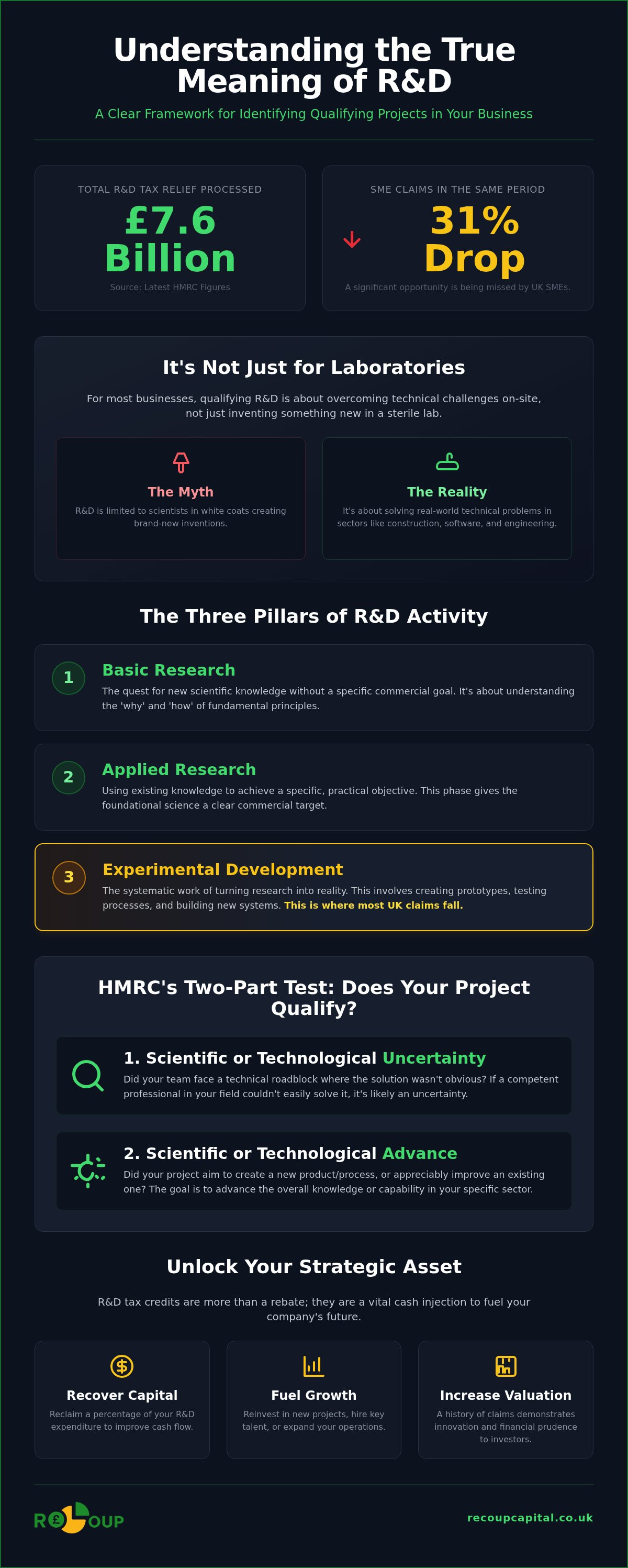
Did you know that whilst HMRC processed £7.6 billion in tax relief in the most recent figures, the number of claims from SMEs actually dropped by 31 per cent? Many directors are stepping back because they're intimidated by shifting regulations or simply don't understand the true r and d meaning within their own industry. You might feel that innovation only happens in a sterile laboratory, but for a UK limited company, it's often found in the gritty, everyday reality of overcoming technical uncertainties on a construction site or during a complex software build.
It's natural to feel cautious about HMRC scrutiny, especially with the 2026 focus on mandatory Additional Information Forms and stricter compliance standards. We're here to show you that qualifying for the merged R&D scheme isn't about reinventing the wheel; it's about identifying where your team pushed boundaries to solve a specific technical problem. This guide provides a clear framework to help you categorise your projects and unlock the tax relief your business deserves. We'll walk you through the current rates, the qualifying criteria, and how to build a robust claim that stands up to professional inspection.
Key Takeaways
- Understand the precise r and d meaning in a corporate context, moving beyond laboratory stereotypes to identify technical problem-solving within your daily operations.
- Distinguish between basic research and "Experimental Development," the latter being the most common path for UK businesses to secure tax relief.
- Master the two-part test of "Scientific or Technological Uncertainty" and "Scientific or Technological Advance" to confidently qualify your projects for HMRC.
- Explore how sector-specific challenges in construction and engineering, such as bespoke automation or land remediation, translate into significant financial returns.
- Reframe R&D tax credits as a strategic asset for capital recovery, providing the cash injections necessary to scale your business and increase its overall valuation.
Defining R&D: What Does Research and Development Actually Mean?
For a UK business, the r and d meaning centres on resolving scientific or technological uncertainty to achieve a specific advance. It is a systematic process where a company seeks to gain new knowledge or create improved products, processes, or services through rigorous experimentation and technical problem-solving that isn't readily resolvable by a professional in the field.
This isn't just a local tax rule. The global standard for Research and development stems from the Frascati Manual, a document published by the OECD. It ensures that when we talk about innovation in the UK, we're using the same rigorous criteria as the rest of the developed world. By aligning with these international benchmarks, the UK government provides a stable framework for businesses to claim relief on their genuine technical breakthroughs.
Crucially, the definition doesn't strictly require a brand-new invention. You might be refining an existing process to make it significantly more efficient, durable, or sustainable. If the solution to your problem isn't obvious to a skilled person in your industry, you're likely operating within the r and d meaning. The core requirement is a "Technical Advance," which simply means you've moved the needle of knowledge or capability within your specific sector.
The HMRC Perspective on R&D
HMRC looks at R&D through a practical lens. They want to know if your team faced a technical roadblock that a "competent professional" couldn't easily fix using standard industry knowledge. This definition is often much broader than directors realise. It covers everything from software architecture hurdles to structural engineering challenges. Understanding how R&D tax credits are explained by specialists helps bridge the gap between your project's technical reality and the tax office's expectations. HMRC isn't looking for academic perfection; they're looking for evidence of a systematic attempt to overcome a difficult technical challenge.
Research vs. Development: Understanding the Difference
The distinction between the two stages is vital for categorising your costs accurately. Both are equally eligible for tax incentives, but they represent different phases of the innovation cycle:
- Research: This is the quest for new knowledge. It involves the "why" and "how" behind a concept, often involving feasibility studies or laboratory testing to prove a theory.
- Development: This is the practical application. It's the process of turning research into a tangible prototype, a functional system, or a scaled-up manufacturing process.
Whether you're in the early stages of testing a new chemical compound or in the final stages of trialling a bespoke automation system, your activity counts. Most UK claims actually fall into the development category, where businesses apply existing science in new, innovative ways to solve real-world commercial problems.
The Three Pillars of R&D: Basic, Applied, and Experimental
To truly grasp the r and d meaning in a commercial setting, you must look at the three distinct stages of innovation defined by the OECD. These pillars represent the journey from a vague theoretical concept to a tangible, market-ready solution. Whilst all three are valid under the UK government's definition of R&D for tax purposes, they serve different strategic functions within a business.
It's a common misconception that you only claim for the "eureka" moment. In reality, the UK's tax regime is designed to reward the entire lifecycle of technical problem-solving. This includes the messy, iterative process of trial and error that defines modern industry. If your team is moving from a hypothesis to a prototype, they're likely engaging in one of these three pillars.
Basic and Applied Research
Basic research is the purest form of inquiry. It's often driven by curiosity or the need to understand fundamental principles without a specific commercial application in mind. In a corporate environment, this might look like a pharmaceutical firm investigating how a specific protein behaves. Applied research takes that foundation and gives it a target. It's the quest for knowledge with a specific practical aim, such as determining if that protein can be used to treat a specific condition. Both stages are vital, but they're often the precursor to where the most significant expenditure occurs.
Experimental Development
This is the "sweet spot" for the majority of UK private sector claims. Experimental development isn't about discovering new laws of nature; it's about using existing knowledge to create new or substantially improved materials, products, or processes. It's where the transition from a theoretical idea to a practical prototype happens. This phase involves heavy iterative testing, refining designs, and overcoming the technical hurdles that appear when you try to scale a solution.
Because this stage is so closely tied to production and real-world application, it accounts for the bulk of qualifying costs in sectors like construction and engineering. If you're unsure where your project sits, having R&D tax credits explained by a specialist can help you map your development costs against HMRC's rigorous standards. Proper documentation of this "experiment" is the key to a successful claim.
One of the most reassuring aspects of the r and d meaning is that success isn't a requirement. In fact, a project that fails to reach its technical goal is often the strongest evidence of "uncertainty." If the outcome was guaranteed, it wouldn't be R&D. HMRC recognises that failed attempts prove you were pushing the boundaries of what's currently possible. If you've spent capital on a project that ultimately didn't work, you shouldn't see it as a total loss. It might still be a strategic asset for capital recovery. You can check your project's eligibility to see if your "failed" innovation still qualifies for significant relief.
Qualifying for R&D: Innovation vs. Standard Business Activity
Drawing the line between day-to-day operations and eligible innovation is where many companies struggle. To grasp the r and d meaning as HMRC sees it, you have to look past the commercial goals of a project. You must focus instead on the scientific or technological hurdles your team faced. The tax office applies a specific two-part test: the "Scientific or Technological Advance" and the "Scientific or Technological Uncertainty."
An advance occurs when your project aims to increase the overall knowledge or capability in a field of science or technology. This standard is grounded in the OECD's Frascati Manual, which defines the global methodology for identifying systematic innovation. It isn't enough for a project to be new to your business. It must represent a step forward for the industry as a whole. This is where the "Competent Professional" test becomes vital. If your most experienced staff couldn't find a solution in existing trade journals or through standard practice, you've likely identified a qualifying uncertainty.
It's also essential to distinguish between commercial and technological uncertainty. Commercial uncertainty asks, "Will this product be profitable?" or "Can we build this at a competitive price?" These are standard business risks and don't qualify. Technological uncertainty asks, "Is this actually possible with current science?" If the answer isn't a guaranteed "yes," you're in R&D territory. Understanding this distinction is a core part of having R&D tax credits explained for your specific sector.
What Counts as Qualifying R&D?
Qualifying activity usually falls into three categories. You don't need a laboratory to meet these criteria:
- Creating a unique product: Developing something with entirely new functional characteristics that have never existed before.
- Significant process improvement: Substantially increasing the performance, reliability, or efficiency of an existing system.
- Non-obvious combinations: Integrating existing technologies in a way that creates a new technical challenge that isn't easily resolved.
What Does NOT Count as R&D?
HMRC is increasingly vigilant about "standard" work being mislabelled. Activities that don't qualify include:
- Routine software maintenance: Basic bug fixes, security patches, or updates that don't involve a technical breakthrough.
- Cosmetic changes: Modifying the look or feel of a product without improving its underlying technical performance.
- Aesthetic design: Work that's purely focused on style or user interface without solving a functional technical problem.
If you're unsure where your project sits, it's worth reviewing the frequently asked questions regarding eligibility. Identifying these nuances early protects your business from HMRC enquiries and ensures your claim is built on a solid foundation of technical evidence.
R&D Examples Across UK Sectors: From Construction to Software
Many directors mistakenly assume the r and d meaning applies only to white-coated scientists in sterile laboratories. This narrow view causes thousands of UK businesses to overlook millions in potential tax relief every year. In reality, innovation is frequently found in the "dirty" industries where technical problems are solved under pressure on a construction site or in a manufacturing plant. It's the practical application of science that drives the majority of claims in the UK private sector.
Innovation in Construction and Engineering
Construction firms often engage in qualifying activity without even realising it. For instance, developing novel techniques for land remediation on contaminated brownfield sites is a primary example of resolving technical uncertainty. This process involves more than just moving soil; it requires engineering new chemical or biological interventions to transform unusable land into a safe foundation for development. When you're dealing with unique soil compositions or hazardous waste, the solution isn't always in the manual.
Engineering companies also find themselves in R&D territory when they create bespoke machinery or automate processes where off-the-shelf solutions fail to meet specific tolerances. A construction firm identifies a technological uncertainty on a complex build the moment standard industry methods cannot guarantee a specific structural or environmental outcome. These projects often involve "hidden" R&D, where the team must adapt materials or designs to overcome unique site constraints that haven't been documented in existing trade literature. If your engineers are scratching their heads over a structural problem, they're likely innovating.
R&D in the Digital and Tech Space
In the software sector, the r and d meaning extends far beyond standard coding or basic app development. Genuine innovation occurs when developers must scale architecture to handle unprecedented data loads that would crash conventional infrastructure. It's often found in the integration of disparate legacy systems where no standard API or protocol exists, requiring the team to build entirely new middleware to bridge the gap. This isn't just "coding"; it's solving a fundamental architectural challenge.
AI and machine learning applications also qualify when they push beyond the capabilities of existing open-source libraries to solve a specific, previously insurmountable technical problem. These projects involve high levels of technical risk and extensive iterative testing, which are the core requirements of a valid claim. If your team is regularly solving "impossible" problems on-site or in the studio, you're likely sitting on a significant strategic asset. You should speak with our specialist team to see how much capital your innovation could recover for your business.
Unlocking the Value of R&D: How Tax Credits Fuel Growth
Understanding the technical r and d meaning is only the first step. The real breakthrough for your business happens when you connect that definition to your balance sheet. By identifying qualifying innovation, you transform what looks like a sunk cost into a powerful financial engine. Having R&D tax credits explained in terms of capital recovery allows you to view your technical challenges as opportunities for growth.
The benefits are immediate and tangible. Successful claims often result in significant cash injections or a substantial reduction in Corporation Tax liabilities. Beyond the immediate liquidity, a history of successful R&D claims can significantly increase your company's valuation. It signals to investors and stakeholders that your business is a proactive innovator with a robust approach to technical problem-solving. This isn't just a tax refund; it's a badge of institutional credibility.
Why Claiming R&D Tax Relief is a Strategic Asset
Many UK firms miss out on these benefits because they maintain a narrow or academic view of the r and d meaning. They see research as an expense rather than a strategic asset. When you shift your perspective to capital recovery, the tax credit becomes a tool to fund your next cycle of innovation. It creates a virtuous loop where yesterday's problem-solving pays for tomorrow's breakthroughs. You can explore more about the long-term advantages of this approach by looking into why claim R&D tax credits? for your specific industry.
Navigating the Claim Process with Recoup Capital
HMRC's transparency standards for 2026 are higher than ever. With the introduction of mandatory Additional Information Forms and the 2024 merger of the RDEC and SME schemes, the margin for error has disappeared. This is where specialist guidance becomes essential. Our team of chartered tax accountants acts as a protective guide, ensuring your technical narrative is both accurate and persuasive. We don't just process paperwork; we act as long-term partners invested in your future success.
We operate on a success-based fee model. This means there is no upfront cost and no financial risk to your business. We only succeed when you do. Our process is designed to be efficient and low-friction, allowing your team to focus on innovation whilst we handle the complexities of the regulatory landscape. To begin identifying your qualifying projects, start by reviewing your technical roadblocks from the past two years. Every uncertainty your team overcame could be a strategic asset waiting to be unlocked.
Transform Your Technical Challenges into Strategic Assets
Innovation is the lifeblood of growth, but it shouldn't be a financial burden. By broadening your understanding of the r and d meaning, you can identify the valuable problem-solving already happening within your teams. Whether you're overcoming structural hurdles on a construction site or developing bespoke software architecture, these technical uncertainties represent significant capital recovery opportunities for your limited company.
Navigating the 2026 HMRC compliance landscape requires precision and specialist insight. Our team of chartered tax accountants brings deep expertise in high-complexity sectors like engineering and construction to ensure your claim is both maximised and robust. We operate on a success-based fee structure; this ensures our goals are perfectly aligned with your business's results. There's no risk to your operation, only the potential to unlock vital funding for your next breakthrough.
Ready to see what your innovation is worth? Book a no-obligation R&D assessment with Recoup Capital today. Let's turn your technical roadblocks into the fuel for your future success.
Frequently Asked Questions
What is the simple meaning of R&D for a business owner?
R&D is the systematic process of resolving a technical or scientific uncertainty that cannot be easily fixed by a professional in your field. It isn't about "new to your business" but rather "new to the industry." It involves rigorous experimentation to achieve a specific advance. If you're trying to make something faster, more durable, or more efficient and the solution isn't obvious, you're likely engaging in qualifying activity.
Does R&D have to take place in a laboratory to qualify for tax credits?
No, R&D happens in factories, on shop floors, and in digital studios just as often as in laboratories. HMRC defines the r and d meaning based on the technical challenge rather than the physical setting. If your team is testing new manufacturing tolerances or trialling a unique chemical process in a production environment, it likely qualifies. Most UK claims originate from practical, "real world" innovation rather than theoretical science or academic research.
Can a small business with no dedicated R&D department still claim?
Yes, you don't need a dedicated department or specific "Scientist" job titles to claim tax relief. R&D is defined by the activity itself, not the department name. As long as your limited company is taking technical risks to improve products or processes, you're eligible. Small businesses often find their innovation is embedded within standard project delivery, such as a bespoke engineering fix or a unique technical solution that required extensive iterative testing.
What is the difference between R&D and standard product development?
Standard development uses existing knowledge to create products, whereas R&D seeks to overcome a technical uncertainty where the solution is unknown. If a competent professional could build the product using standard industry methods, it's development. If they have to experiment, prototype, and experience failure before finding a viable path, it qualifies. The distinction lies in whether you're simply applying known science or pushing the boundaries of what's currently possible in your sector.
How much is the R&D tax credit worth for a UK limited company?
Under the 2026 merged scheme, the standard taxable expenditure credit is 20% of qualifying costs. For profitable companies paying the 25% main rate of Corporation Tax, this provides a net benefit of approximately 15%. Loss-making, R&D-intensive SMEs may qualify for Enhanced R&D Intensive Support (ERIS). This can result in a cash return of up to 27p for every £1 spent, provided at least 30% of the company's total expenditure is on qualifying R&D.
What happens if our R&D project fails to reach its objective?
Failure is actually strong evidence that your project met the r and d meaning criteria. HMRC recognises that if the outcome was certain, it wouldn't be research and development. A failed project proves that a technical uncertainty existed and that you took a genuine risk to overcome it. You can still claim for staff time and materials used during the unsuccessful attempt, provided the original intent was to achieve a technical advance.
Is software development always considered R&D?
No, routine software work like bug fixes, security updates, or standard website builds doesn't qualify. To meet the definition, the project must solve a technical problem that isn't resolvable through standard coding practices. This might include creating new algorithms, scaling architecture for extreme data loads, or integrating systems where no protocol exists. The work must represent a genuine advance in the field of computer science, rather than just a new commercial application.
How do I know if my project meets HMRC’s definition of "technological uncertainty"?
You meet the definition if a "competent professional" in your industry cannot readily see how to achieve the desired result. If your most experienced engineers or developers have to research, trial different methods, and iterate to find a solution, uncertainty is present. It's the point where standard industry knowledge ends and experimentation begins. Documenting these specific roadblocks and the systematic steps taken to resolve them is the key to building a robust, compliant claim.


