

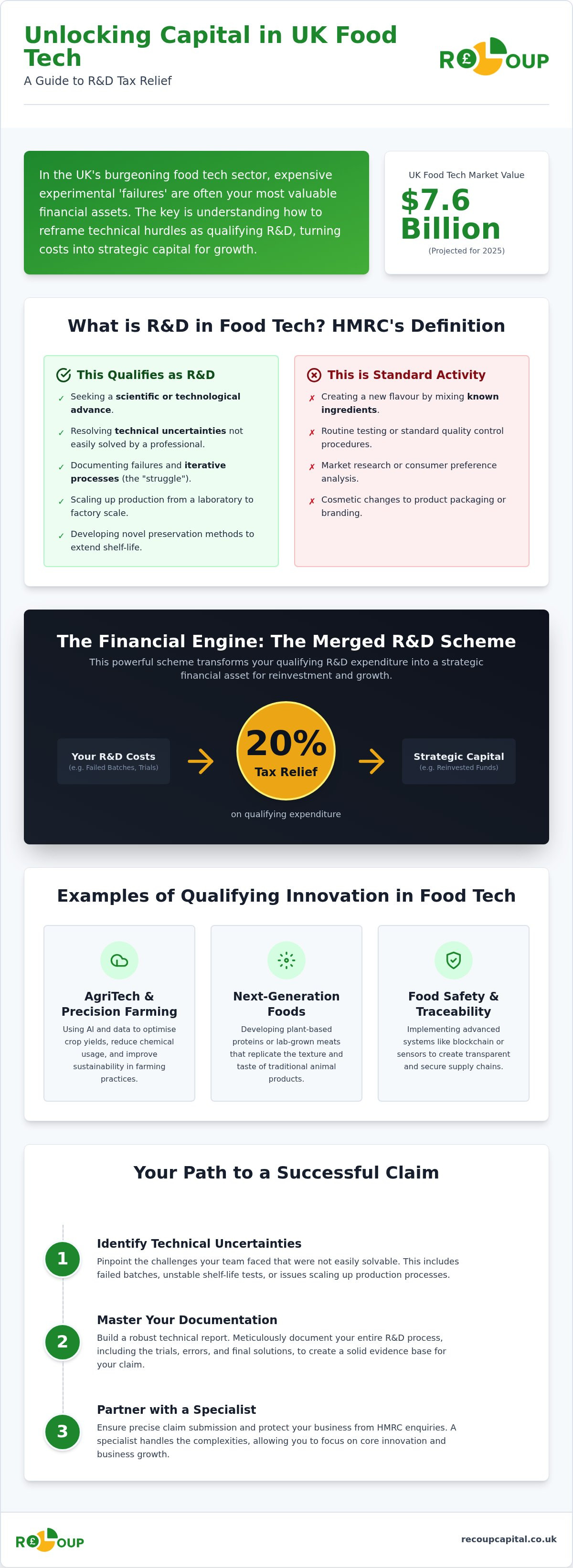
Your most expensive failures in the laboratory might actually be your most valuable financial assets. In the high-stakes world of food tech, the line between a discarded prototype and a breakthrough is often blurred by technical uncertainty. You likely recognise the frustration of sinking capital into trials that don't immediately yield results, especially whilst navigating a UK market valued at $7.6 billion in 2025. Developing new textures or improving shelf life isn't just a culinary challenge; it's a technical struggle that carries significant financial risk.
We understand that the complexity of HMRC's definitions can feel like a barrier to the support your business deserves. This guide promises to clarify exactly how your food tech innovations qualify for significant UK tax relief, turning those technical hurdles into strategic capital. We'll examine the criteria for the 20% merged R&D scheme, explain how to identify qualifying expenditure within your projects, and show you how to navigate the submission process with expert precision. By reframing your tax position as a tool for growth, you can focus on your primary goal: creating the future of food.
Key Takeaways
- Learn how to identify technical uncertainties within your production processes that qualify for significant financial relief.
- Discover the specific scientific and engineering criteria HMRC uses to define innovation within the UK food tech sector.
- Understand the financial mechanics of the 20% merged R&D scheme and how it transforms experimental costs into strategic assets.
- Master the documentation requirements needed to build a robust technical report and protect your business from HMRC enquiries.
- Find out why partnering with a specialist consultant ensures precise claim submission whilst allowing you to focus on core business growth.
Defining Food Tech: The Technological Revolution in the UK Food Sector
Food technology is far more than a simple industry buzzword; it represents the rigorous application of scientific and engineering principles to how we produce, preserve, and distribute what we eat. In the UK, this sector has become a powerhouse of the emerging economy. It drives vital efficiency and sustainability amongst global supply chain pressures and shifting environmental demands. For a business to qualify for tax relief, however, the work must move beyond standard commercial activity. You need to be tackling technical uncertainties that wouldn't be easily solved by a seasoned professional in your field.
Identifying the boundary between routine development and qualifying R&D is often where confusion begins. If your team is simply mixing known ingredients to create a new flavour profile, HMRC likely views this as standard commercial activity. True innovation occurs when you encounter a technical blind alley. This happens when you're unsure if a specific texture can be achieved with a new stabiliser or if a novel preservation method will actually maintain safety standards over several months. Solving these unknowns is what transforms a project into a qualifying R&D claim.
The Diverse Verticals of Food Tech
The scope of food tech is vast, spanning from the soil to the supermarket shelf. We see innovation taking place across several distinct areas:
- AgriTech and precision farming: Companies are using AI to optimise crop yields and drastically reduce chemical usage through targeted, data-driven application.
- Next-generation foods: There's a massive push towards developing plant-based proteins or lab-grown meat alternatives that mirror the texture and flavour of traditional products.
- Food safety and traceability: Implementing blockchain or advanced sensors allows firms to monitor supply chains with unprecedented transparency and security.
These aren't just incremental changes. They represent fundamental shifts in how the industry operates, requiring significant investment in testing and prototyping.
Why Innovation is Essential for UK Food Firms
Innovation isn't a luxury; it's a survival strategy. UK firms face the dual challenge of ensuring national food security whilst maintaining high nutritional standards. Consumers are also driving change. They want cleaner labels and fewer additives. Achieving this without sacrificing shelf-life or taste requires deep technological intervention. If your business is investing in these areas, you're likely sitting on unclaimed value. Understanding how R&D tax credits explained in a technical context apply to your specific projects is the first step toward recovering that capital. By reframing these costs as strategic assets, you can reinvest in the next phase of your growth.
The Mechanism of Innovation: How HMRC Views Food Tech R&D
HMRC's definition of R&D isn't based on how "new" a product feels to the consumer, but rather the scientific or technological advance achieved through resolving uncertainty. Under HMRC's R&D tax relief scheme, your project must aim to create an improvement that isn't readily deducible by a competent professional. This means the solution shouldn't be found in existing textbooks or trade journals. Crucially, the advance must potentially benefit the wider food tech sector, rather than simply being a trade secret unique to your kitchen.
The "struggle" is your strongest asset. HMRC values the iterative process of trial and error. If you've faced failed batches, unstable shelf-life tests, or equipment that refused to process a novel ingredient, you've encountered technical uncertainty. These roadblocks prove that the solution wasn't obvious. Documenting these failures transforms them from operational losses into evidence of innovation. If your team is regularly solving these types of problems, you should consider claiming R&D tax credits to recover the costs of your experimentation.
Overcoming Technical Uncertainties in Production
Scaling a recipe from a five-litre bench trial to a five-thousand-litre production run is a classic example of technical uncertainty. Ingredients behave differently under high pressure or heat. Maintaining texture and flavour stability during this transition often requires complex chemical and physical adjustments. A competent professional might know the basics, but they won't always know exactly how a specific plant-based protein will react in a high-speed industrial mixer. If you're developing new thermal processing techniques to ensure safety without destroying heat-sensitive nutrients, you're likely performing qualifying R&D.
Sustainability and Waste Reduction as R&D
Sustainability is a major driver of modern food tech innovation. Creating biodegradable packaging that matches the barrier properties of traditional plastics is a significant technical challenge. It requires deep research into polymer science and moisture migration. Similarly, developing methods to repurpose food by-products into high-value ingredients involves complex extraction and stabilisation processes. Even innovating in cold-chain logistics to reduce energy consumption whilst preventing spoilage qualifies if it involves a technical leap. These projects represent a strategic investment in the future of the planet and your bottom line.
Qualifying R&D Activities: What Counts as Food Tech Innovation?
Qualifying for tax relief isn't reserved for those creating lab-grown meat in a high-tech facility. Most innovation in food tech happens within the daily operations of established manufacturers and processors. The key distinction lies in whether your New Product Development (NPD) requires genuine scientific experimentation. If you're simply tweaking a flavour profile using off-the-shelf ingredients, it's likely standard commercial activity. However, if you're developing a novel method to stabilise an emulsion at room temperature, you've crossed into R&D territory. The Food and Drink Federation evidence highlights that the sector's commitment to technical advancement is a primary driver of UK manufacturing growth, yet many firms still overlook their eligible work.
Many firms find their strongest claims in shelf-life extension. Moving beyond standard preservatives to implement novel atmospheric packaging or high-pressure processing involves significant technical risk. Similarly, reformulating products to meet government health targets for sugar or salt reduction often compromises structural integrity. Rebuilding that structure through technological intervention is a qualifying activity. If your team is currently tackling these hurdles, it's vital to understand why your business should claim R&D tax credits to sustain that momentum and recover your experimental costs.
Nutritional Fortification and "Free-From" Challenges
Removing gluten or dairy whilst attempting to mimic the original product's mouthfeel is a notorious technical challenge. It isn't just about simple substitution; it's about the chemistry of how proteins and fats interact under heat and pressure. Fortifying foods with micronutrients presents similar barriers. You must ensure the vitamins remain bioavailable and stable throughout the product's entire life. These projects require rigorous scientific methodology and validation, making them prime candidates for relief through the UK's innovation incentives.
Process Automation and AgriTech Integration
Modern food tech often involves the digital layer of production. Integrating machine learning into sorting processes to identify defects at high speeds requires bespoke software development that goes beyond standard programming. Likewise, creating robotic systems capable of handling delicate produce without causing physical damage or contamination is a complex engineering feat. The real struggle often lies in making these new systems interoperable with legacy manufacturing environments, a process rife with technical uncertainty that a competent professional cannot easily resolve.
The Path to a Successful Claim: Documentation and Compliance
Precision is the hallmark of a successful submission. HMRC requires more than just a summary of expenditure; they demand a detailed technical report that explicitly outlines the scientific advance you sought and the specific uncertainties your team faced. This is where many food tech businesses stumble. They often describe the final product's features rather than the technical process required to create it. To build a robust case, you must maintain contemporaneous records. Lab notes, version logs, and trial results aren't just internal documents; they're the primary evidence of your technical struggle.
Transparency is your best defence against an HMRC enquiry. In an era of increased scrutiny, providing a clear, evidence-backed narrative is essential. By documenting your failures as clearly as your successes, you demonstrate the genuine nature of your research. This level of detail transforms a standard tax filing into a strategic record of your company's intellectual property and innovative capacity.
Identifying and Apportioning Eligible Costs
Accurate cost identification requires a granular approach to your business operations. You must allocate staff costs based on the actual percentage of time individuals spend directly on R&D activities. This includes not just your scientists and engineers, but also the production staff involved in running experimental batches. Beyond salaries, you can identify qualifying consumables. In the food sector, this often includes:
- Ingredients used in failed prototypes or test runs that cannot be sold.
- Energy and utility costs directly attributable to the testing and development phase.
- Payments to external researchers or software providers, provided they meet the specific criteria of the merged R&D scheme.
Under the new rules for accounting periods beginning on or after 1 April 2024, understanding how these costs interact with the 20% expenditure credit is vital for maximising your return.
Meeting HMRC’s Transparency Standards
Compliance now involves more than just the CT600 tax return. The introduction of the Additional Information Form (AIF) means that every claim must be supported by a digital submission before the tax return is filed. This form requires a technical narrative that speaks HMRC’s language whilst clearly demonstrating your team's expertise. You must avoid marketing speak and focus on the technical blind alleys you encountered. If you're unsure how to translate your laboratory successes into a compliant filing, following a specialist guide to claiming R&D tax credits can ensure you don't leave money on the table. We recommend reviewing your documentation processes early in the financial year to ensure every qualifying pound is captured with precision.
Strategic Growth: Why Food Tech Firms Partner with Specialists
Viewing R&D tax credits as a simple administrative task is a missed opportunity. For a food tech business, these incentives represent non-dilutive capital that can be immediately reinvested into the innovation pipeline. Partnering with a specialist consultant provides a protective layer of expertise between your firm and HMRC, ensuring that every technical uncertainty you've resolved is translated into financial value. Our success-based fee model aligns our goals with yours; we only succeed when you recover the capital your innovation deserves.
Outsourcing the claim process does more than just secure a refund. it protects your most valuable resource: time. When your technical team is freed from the burden of documenting tax narratives, they can focus on what they do best: innovating. This partnership-oriented approach transforms a complex regulatory procedure into a streamlined opportunity for business growth.
Specialist Consultants vs Generalist Accountants
Generalist accountants are excellent for standard compliance, but they often lack the technical depth required to spot "hidden" R&D within a complex production environment. Identifying the boundary where standard engineering ends and qualifying innovation begins requires a deep understanding of food science and the specific HMRC landscape. A specialist team of chartered tax accountants can manage the end-to-end process, from the initial technical assessment to final HMRC liaison. We understand the nuances of the food tech sector, allowing us to identify eligible costs that a generalist might overlook, such as specific staff time apportionments or niche consumable expenditures.
Maximising the Strategic Value of Your Claim
The capital recovered through a claim should be treated as a strategic asset rather than a one-off windfall. Whether you're using it to fund the next stage of prototyping, hire additional scientific staff, or invest in new laboratory equipment, this liquidity is a powerful tool for growth. In a sector where business confidence was reported at -64% in Q1 2026, securing every available financial advantage is critical for maintaining a competitive edge.
Beyond the immediate refund, these credits can play a vital role in your broader financial strategy. They can strengthen your balance sheet, making your firm more attractive for future investment or debt restructuring. If you're looking to scale rapidly or consider a merger, you might also explore our corporate finance advisory services to see how tax relief integrates with your long-term investment goals. By reframing tax returns as strategic assets, you ensure that your financial structure is as innovative as your products.
Transform Your Technical Hurdles into Strategic Capital
The technical struggles your team faces in the laboratory are not just operational hurdles; they are the very evidence HMRC requires to validate your innovation. By accurately identifying technical uncertainties and maintaining rigorous documentation, you can transform experimental costs into a powerful strategic asset for growth. Navigating the complexities of the merged R&D scheme requires a precise, expert-led approach to ensure no qualifying expenditure is overlooked amongst your development cycles.
As a specialist partner with national UK coverage across our London and Manchester offices, Recoup Capital provides the protective guidance needed to secure the relief your business deserves. Our team of chartered tax accountants possesses the deep sector expertise required to uncover the hidden value in your food tech projects. With a success-based fee model for your peace of mind, we act as a long-term advisor focused on your bottom line whilst you focus on the future of food production.
Discover how much your food tech innovation is worth with Recoup Capital today. Your next breakthrough deserves to be funded.
Frequently Asked Questions
What is the definition of food tech in the context of UK R&D tax credits?
Food technology in the context of UK tax relief refers to the application of scientific and engineering principles to solve technical uncertainties in food production or preservation. It isn't just about the final product; it's about the technical struggle to achieve an advance. This might involve developing novel processing methods or improving nutritional bioavailability in ways that aren't already standard practice within the industry.
Can we claim R&D tax credits for new food recipes?
You cannot typically claim for simple recipe development that involves standard kitchen mixing or flavour adjustments. However, if your recipe requires scientific experimentation to maintain structural integrity, achieve a specific shelf-life through novel preservation, or stabilise an emulsion at scale, it qualifies. The distinction lies in whether the development process encountered technical blind alleys that required a systematic, scientific approach to resolve rather than just culinary skill.
How much can a food tech company expect to receive back from an R&D claim?
The amount varies based on your specific expenditure and which scheme applies to your accounting period. Under the merged R&D scheme for periods starting on or after 1 April 2024, the credit rate is 20% of qualifying expenditure. Loss-making, R&D-intensive SMEs may qualify for Enhanced R&D Intensive Support (ERIS), which provides a higher relief rate. We calculate the value by identifying qualifying costs like staff time, consumables, and software.
What happens if our food tech R&D project was a failure?
Failed projects are often the strongest evidence of qualifying R&D because they prove the existence of technical uncertainty. If the solution were obvious, the project wouldn't have failed. HMRC rewards the attempt to achieve a scientific or technological advance, regardless of the commercial outcome. Documenting your unsuccessful prototypes and discarded iterations is vital, as these failures demonstrate that the technical challenges were significant and not easily resolved.
Do we need to be a large company to qualify for food tech R&D relief?
No, businesses of all sizes can qualify for relief, from small startups to multinational manufacturers. The UK government designed these incentives to foster innovation across the entire food tech sector. Whilst the specific scheme you use depends on your company's size and R&D intensity, the fundamental requirement remains the same: you must be a limited company seeking a technical advance through the resolution of scientific or technological uncertainty.
How far back can we claim for our food technology innovations?
You can generally claim for the two most recent completed accounting periods. This means that if your financial year ends in December, you have until the end of December 2026 to submit a claim for the period ending in December 2024. It's important to act promptly to ensure you don't lose out on significant capital recovery from previous years of intensive development and testing.


