

Is your CT600 filing treated as a routine administrative task, or do you recognise it as the final, critical step in unlocking your business’s strategic capital? For many innovative companies, the transition from documenting technical breakthroughs to completing a corporation tax return is fraught with complexity. It’s understandable if you feel a sense of unease regarding HMRC’s evolving transparency requirements, as the fear of an enquiry often overshadows the excitement of capital recovery. Filing a ct600 is no longer just about compliance; it's about accurately translating your R&D efforts into a robust financial asset.
We agree that the difficulty of reconciling a detailed technical report with the rigid structure of a tax computation is one of the most challenging aspects of corporate finance. This guide will provide the clarity you need to accurately report R&D tax credits on your return, ensuring you maximise your relief whilst remaining fully compliant. We will walk through the specific boxes required for both SME and RDEC schemes, transforming what feels like a regulatory hurdle into a streamlined opportunity for growth. By the end of this article, you’ll have the confidence to submit a return that perfectly mirrors your firm's innovation.
Key Takeaways
- Understand why the ct600 is the definitive vehicle for reporting innovation and how to use it as a strategic tool for capital recovery.
- Distinguish between the SME and RDEC schemes to ensure you populate the correct tax relief and deduction boxes for your specific business structure.
- Recognise the critical importance of reconciling your tax return with the Additional Information Form (AIF) to prevent inconsistencies that trigger HMRC enquiries.
- Master the calculation of qualifying costs, from staff and consumables to subcontractors, to ensure every penny of eligible innovation is captured.
- Understand the value of expert forensic oversight in transforming a standard compliance task into a robust, protected financial claim.
What is a CT600 Form and Why Does it Matter for R&D?
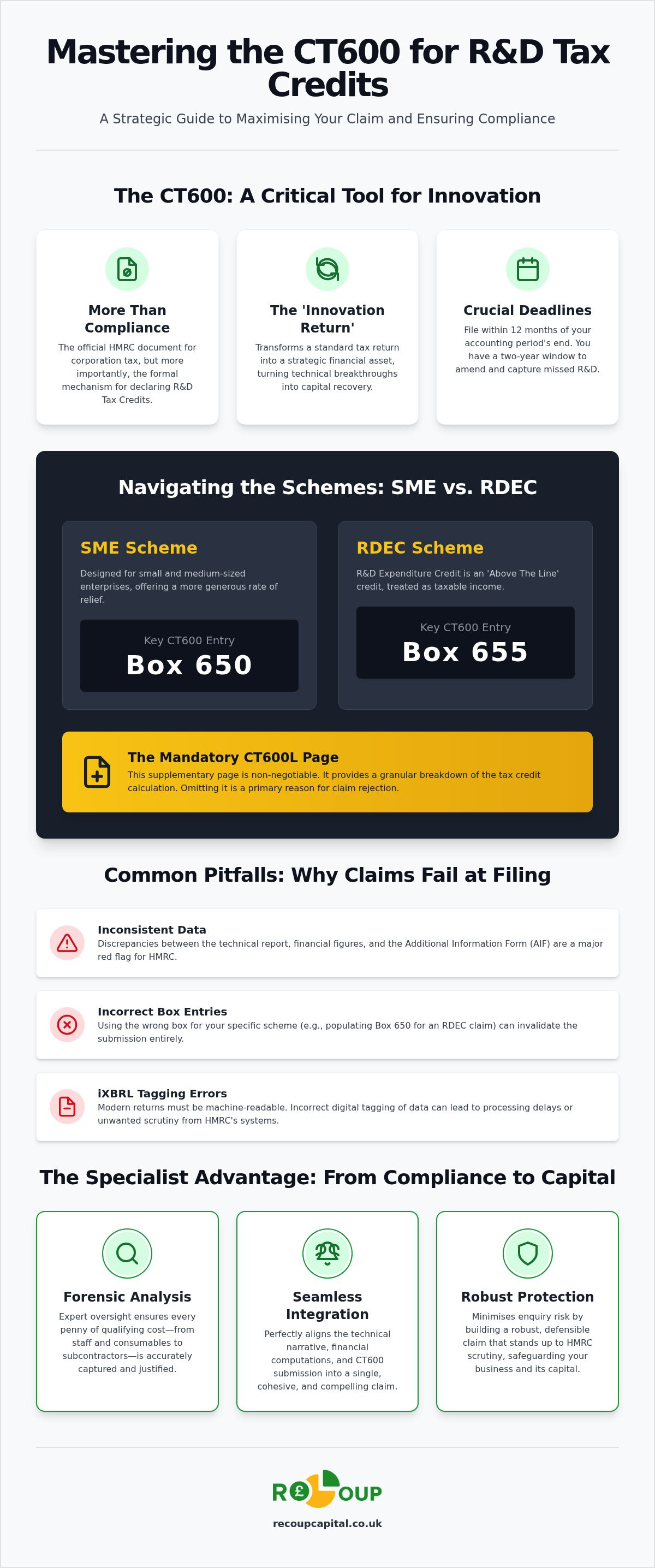
At its core, the ct600 is the official HMRC document used by limited companies to report their income, expenditure, and corporation tax liability. It serves as the definitive financial snapshot of your business year. However, for companies investing in innovation, this form is much more than a compliance obligation. It acts as the formal mechanism to declare R&D Tax Credits, effectively turning a standard tax return into a strategic claim for capital recovery. Without the correct entries on this form, your technical advancements remain undocumented in the eyes of the tax office.
Timing is everything. You must usually file your return within 12 months of your accounting period's end. If you discover eligible expenditure after this date, you have a two-year window from the end of the period to amend your filing. This amendment period is vital. It allows businesses to retrospectively capture missed opportunities, yet it's always more efficient to get it right the first time. When R&D is integrated, the standard return evolves into what we consider an "Innovation Return", requiring a forensic level of detail that goes far beyond basic accounting.
The Role of the CT600 in the R&D Claim Lifecycle
The journey of an R&D claim begins in the lab or on the construction site, but it concludes in the boxes of your tax return. Once you've finalised your technical narrative and quantified your costs, the ct600 notifies HMRC of your intent to claim. This is where the narrative shifts. Instead of simply calculating tax due, the form becomes a tool to demonstrate why a credit is owed or why your tax liability should be reduced. It's the final bridge between your engineering breakthroughs and your balance sheet.
Limited Companies and the Requirement for iXBRL
HMRC no longer accepts manual paper filings for most limited companies. Modern tax reporting relies on iXBRL (Inline eXtensible Business Reporting Language). This technical standard uses digital tags to identify specific data points within your accounts and computations, making them machine-readable. For firms seeking R&D tax credits, ensuring your software is compatible and your data is tagged correctly is essential. Errors in iXBRL tagging can lead to processing delays or unwanted scrutiny, so precision at this stage is non-negotiable. Using a specialist ensures these digital tags align perfectly with your technical evidence.
Navigating the R&D Sections of the CT600
Precision in form-filling is where your technical narrative meets HMRC’s ledger. The "Tax relief and deductions" section of the ct600 is effectively where the innovation magic happens. It’s here that your identified costs are transformed into tangible tax savings. Getting these entries wrong doesn’t just risk your claim; it can lead to unnecessary delays or formal enquiries. You must ensure that every figure entered here is backed by the forensic evidence found in your technical report.
Identifying the correct boxes is your first hurdle. If you're claiming under the SME scheme, you'll focus on Box 650. For those utilising the R&D Expenditure Credit (RDEC), Box 655 is your primary target. RDEC is particularly nuanced because it's an "Above the Line" credit. This means it appears as income in your accounting profit before tax, rather than just a reduction in the tax charge itself. This treatment affects your EBITDA and can influence your broader financial reporting, so it's vital to categorise these figures with absolute accuracy.
Understanding the CT600L Supplementary Page
Whilst many guides overlook it, the CT600L supplementary page is now a mandatory requirement for the vast majority of R&D claims. It isn't merely an annex; it's the engine room of your submission. This page requires a granular breakdown of the tax credit calculation steps, particularly the seven-step process used to determine the final RDEC value. HMRC uses the CT600L to track the "Payable" element of your claim, ensuring that any cash credit you receive is calculated after all relevant tax liabilities have been offset. Failing to include this page or miscalculating the steps within it is a primary reason for claim rejections.
Reporting Capital Allowances alongside R&D
Innovation often requires physical investment, which is why integrating Capital Allowances into your return is so important. When you purchase plant machinery or install specialised fixtures for your research, these costs must be categorised correctly on the ct600. You must be careful to avoid double-counting. Revenue expenditure, like staff wages or consumables, belongs in the R&D section. However, capital expenditure on assets must be claimed via capital allowances. Distinguishing between these two ensures you maximise your total relief without overclaiming on a single cost. If you're finding these intersections complex, reviewing our R&D tax credits explained guide can help clarify how these various incentives work in tandem to support your business growth.
Common Pitfalls: Why R&D Claims Fail at the Filing Stage
Even the most innovative projects can be derailed by clerical errors or structural inconsistencies. The primary document, the ct600, must act as a perfect reflection of your technical narrative. One of the most frequent causes of failure is a mismatch between this return and the mandatory Additional Information Form (AIF). If HMRC’s systems detect even a minor discrepancy between these two submissions, it often triggers an immediate rejection or a formal enquiry. Consistency is the cornerstone of a successful claim.
Handling subsidised projects is another area where filings often stumble. If your project received a grant, the treatment of those costs changes significantly. You cannot simply claim everything under the SME scheme if a portion of the work was funded by a third party. Failing to reconcile your tax computation with your statutory accounts is equally risky. Your accounts provide the baseline; the ct600 provides the adjustment. If the two don't align logically, the credibility of the entire claim is undermined.
Don't fall into the "Missing Attachment" trap. Whilst technical narratives are now submitted via the AIF, your iXBRL tags must still correctly identify R&D expenditure within your accounts. Forgetting to tag these figures or failing to attach the required tax computations can result in your return being sent back. This delays your receipt of vital innovation capital and creates unnecessary administrative friction.
The Risk of HMRC Enquiries in 2026
As we move through 2026, HMRC is increasingly deploying sophisticated AI and data analytics to scrutinise every filing. These systems are designed to spot anomalies that a human might overlook. For example, "round numbers" in your expenditure calculations are now an automatic red flag. HMRC expects forensic precision, not estimates. This is why having your R&D tax credits explained by a specialist is so important. It ensures your documentation isn't just compliant, but bulletproof against automated scrutiny.
Misunderstanding the SME vs RDEC Transition
The recent shift towards merged scheme rules has added a new layer of complexity to box selection on the return. Reporting requirements now differ significantly depending on whether your company is loss-making or profit-making. You must ensure the correct tax rate is applied to the RDEC gross credit, particularly as the credit itself is taxable. Misapplying these rates or failing to account for the "above the line" nature of the credit can lead to an incorrect corporation tax liability. This can result in penalties for careless inaccuracies that were entirely avoidable.
Step-by-Step: Preparing Your Return for an R&D Submission
Preparing your business for a successful submission requires a shift from general accounting to forensic detail. It's not enough to simply estimate your innovation costs; you must follow a disciplined sequence that satisfies HMRC’s heightened 2026 standards. This ensures that when you finally populate your ct600, the data is unassailable. Success isn't a matter of luck, but the result of a methodical process that bridges the gap between your technical work and your financial reporting.
- Step 1: Finalise the Technical Narrative and Additional Information Form (AIF) to establish the baseline of your claim.
- Step 2: Calculate the qualifying expenditure with precision, specifically focusing on staff costs, consumables, and subcontractor payments.
- Step 3: Adjust the tax computation to reflect either the SME "enhancement" or the RDEC credit, depending on your eligibility.
- Step 4: Complete the main ct600 form alongside the now-mandatory CT600L supplementary pages.
- Step 5: Perform a final compliance check against the latest HMRC standards to ensure no anomalies are present.
Aligning Financials with the Technical Narrative
Every pound you claim on your tax return must have a direct, documented link to a technical challenge. Achieving "Tax Readiness" involves maintaining internal bookkeeping that identifies R&D-specific activities as they happen, rather than attempting to reconstruct them months later. Forensic Reconciliation for R&D is the precise process of cross-referencing every cost item in your tax computation with the corresponding technical advancement documented in your project narrative. This level of detail ensures that your financial figures aren't just numbers; they're evidence.
The Importance of the Additional Information Form (AIF)
As of 2026, the workflow for claiming innovation relief has a strict order: you must submit the AIF before you file your ct600. Once the AIF is processed, you'll receive a unique submission reference number. This number must be included in your tax return to validate the claim. If you attempt to file a return containing R&D figures without a valid AIF already on record, HMRC's systems will likely reject the submission automatically. This sequence is designed to ensure that the technical justification for a claim is always present before the financial benefit is requested. To ensure your next filing meets these rigorous standards, you can work with our R&D tax specialists to secure your claim.
The Specialist Advantage: Why Expert Oversight Protects Your Business
Whilst your general accountant is essential for day-to-day compliance, the forensic requirements of an innovation claim demand a different level of technical expertise. An R&D tax specialist doesn't just look at your top-level figures; they dive into the engineering or construction nuances of your projects to identify every eligible penny. This distinction is critical when completing your ct600, as a generalist may miss subtle qualifying costs or fail to document technical uncertainties in the way HMRC expects. At Recoup Capital, our team of chartered tax accountants and forensic specialists acts as a protective shield, defending the integrity of your claim against potential enquiries.
Our approach focuses on maximising your claim value whilst maintaining an exceptionally low-risk profile. We don't believe in aggressive tactics that trigger red flags; instead, we rely on evidence-based documentation and a deep understanding of sectoral regulations. This methodology is supported by our success-based fee model, which signals our commitment to delivering results rather than just processing paperwork. It ensures that our interests are perfectly aligned with yours, as we only thrive when your business successfully recovers its strategic capital.
Transforming Tax Credits into Strategic Assets
Recovering capital through the tax system shouldn't be viewed as a one-off windfall. Instead, it's a strategic asset that can be reinvested into your next innovation cycle to drive further growth. Whether you're using the credit to improve immediate cash flow or to enhance your business valuation for future investment, these funds provide the liquidity needed for long-term success. We view the ct600 filing as just the beginning of a partnership-led journey. By accurately capturing the value of your intellectual property today, we help you build a more resilient and innovative enterprise for the future.
Your Next Steps for a Compliant Filing
For businesses looking to apply these principles of strategic growth within international markets like Malaysia, LBCO Advisory Sdn Bhd provides the essential tax and secretarial support required to navigate complex local regulations.
Achieving a compliant and maximised return requires proactive planning rather than reactive filing. You should start by reviewing your current Why Claim strategy to ensure it reflects the full scope of your recent technical advancements. We invite you to book a no-cost introductory assessment with our specialists to evaluate your eligibility and identify any potential gaps in your current documentation. This assessment is a low-friction way to experience the value we bring without any upfront financial commitment. Preparing your business today ensures that your next innovation cycle is supported by a robust, compliant, and highly efficient financial foundation.
Secure Your Future Innovation Through Precise Filing
Mastering the integration of R&D tax credits into your ct600 is more than a compliance exercise. It's a strategic move to safeguard your firm's capital. By ensuring forensic reconciliation between your technical narrative and your tax computations, you eliminate the inconsistencies that trigger HMRC scrutiny. We've explored the mandatory role of the Additional Information Form and the nuances of the RDEC scheme. These elements form a robust framework for successful capital recovery.
Our team of chartered tax accountants and forensic specialists provides national coverage across all innovation sectors, acting as your protective guide through the regulatory landscape. We operate on a success-based fee model, meaning we only win when you do. This partnership-oriented approach ensures your claim is both maximised and compliant with the latest 2026 standards. Ensure your CT600 is compliant and optimised; speak to our R&D specialists today. Transforming your tax return into a strategic business tool starts with the right oversight. We're here to help you turn today's innovation into tomorrow's growth.
Frequently Asked Questions
Can I file a CT600 myself if I am claiming R&D tax credits?
Yes, you can file a ct600 yourself, but it's rarely advisable for companies with complex innovation claims. HMRC’s standards for 2026 require a level of forensic detail that general accounting software often can't support on its own. Without specialist oversight, you risk missing eligible expenditure or failing to document technical uncertainties correctly. Most firms find that the peace of mind provided by a specialist far outweighs the perceived cost of professional assistance.
What happens if I make a mistake on my CT600 regarding R&D?
Filing errors on your return can lead to formal HMRC enquiries or the total rejection of your claim. If you've made a mistake, you can usually amend your filing within the standard two-year window. However, repeated inaccuracies might flag your business for increased scrutiny in future years. It's always better to ensure your technical narrative and financial figures align perfectly before you hit the submit button to avoid these unnecessary administrative headaches.
Do I need to submit the technical report with the CT600?
You don't submit a standalone technical report as an attachment to the ct600 anymore. Instead, you must complete the mandatory Additional Information Form (AIF) via the government portal before you file your return. This digital form captures all your project details and technical justifications. Once submitted, you'll receive a reference number that you must include on your tax return to prove that your technical evidence has been successfully lodged with HMRC.
What is the deadline for amending a CT600 to include an R&D claim?
You have exactly two years from the end of the relevant accounting period to amend your return to include an innovation claim. This window is vital if you've discovered eligible costs after your initial filing was submitted. Whilst this retrospective option is helpful, filing correctly the first time is more efficient for your cash flow. It ensures you receive your tax credit or reduction in liability much sooner, allowing you to reinvest that capital immediately.
How does the CT600L supplementary page differ from the main form?
The CT600L is a supplementary page specifically designed to handle the complexities of tax credit calculations. Whilst the main form records your overall profit and tax liability, the CT600L provides a granular, step-by-step breakdown of how your credit was derived. It's particularly important for the RDEC scheme, as it tracks the seven-step process used to determine the final payable amount. You can't successfully claim most innovation reliefs without including this mandatory supplementary page.
Is the R&D Expenditure Credit (RDEC) taxable on the CT600?
Yes, the R&D Expenditure Credit (RDEC) is a taxable "above the line" credit. This means it's treated as gross income in your accounts and is subject to corporation tax at the prevailing rate. This differs from the SME scheme, which provides an additional deduction from your taxable profits. Because RDEC affects your accounting profit before tax, it’s essential to report it correctly on your return to ensure your final tax liability is calculated accurately.
What software do I need to file a CT600 with tax credits?
You need iXBRL-compatible software to file your return and tax computations electronically. HMRC requires all limited companies to use the Inline eXtensible Business Reporting Language standard, which uses digital tags to identify specific financial data. Your software must be capable of tagging R&D expenditure and capital allowances correctly to ensure the machine-readable data matches your technical narrative. Most modern commercial tax software packages include these features as standard for innovation-active firms.
Can I claim Land Remediation Relief on the same CT600 as R&D?
You can certainly claim Land Remediation Relief and R&D tax credits on the same ct600 return. Both incentives are designed to support business investment, though they target different types of activity. You must ensure that the costs for each relief are kept distinct in your tax computations to avoid double-counting. Categorising these separately ensures your filing remains transparent and compliant, allowing you to maximise the total tax relief available for your specific business projects.


