

What if the very walls of your commercial property held a hidden financial asset that your standard accounting software simply couldn't see? For many, the complexity of plant and machinery allowances uk feels like a moving target, especially with the 2026 reduction of the main pool Writing Down Allowance to 14%. It's easy to feel overwhelmed by shifting HMRC legislation or the nagging fear of a compliance enquiry. These regulations shouldn't be viewed as mere hurdles; they're actually opportunities for significant capital recovery when viewed through a specialist forensic lens.
We recognise that identifying qualifying expenditure within a building's structure is a daunting task that often leads to missed relief. This guide promises to demystify the 2026 landscape, showing you how to use expert analysis to uncover eligible items and maximise your tax position. We'll explore the new 40% first-year allowance, the £1 million Annual Investment Allowance, and the strategic benefits of full expensing. You'll gain a clear roadmap to building a robust, compliant claim that withstands scrutiny while transforming tax relief into a strategic asset for your future growth.
Key Takeaways
- Understand how the 2026 shift in plant and machinery allowances uk, including the new 40% first-year allowance, creates immediate tax recovery opportunities despite reduced writing down rates.
- Learn to navigate the £1 million Annual Investment Allowance and the permanent full expensing regime to achieve 100% tax relief on qualifying business assets in the year of purchase.
- Discover how to unlock hidden embedded capital allowances within the fabric of your commercial property, such as air conditioning and fire systems, through specialised forensic surveying.
- Explore the powerful synergy between innovation and tax relief by identifying where R&D Capital Allowances (RDAs) offer 100% relief on assets used for business growth.
- Gain a strategy for building a robust, HMRC-compliant claim using a success-based fee model that prioritises your capital recovery without upfront financial risk.
Understanding Capital Allowances in the 2026 UK Tax Landscape
In the UK, Capital Allowances act as a vital statutory mechanism that lets businesses offset the cost of certain assets against their taxable profits. Whilst your accountant might record depreciation in your annual accounts to reflect an asset's wear and tear, HMRC doesn't recognise this as a tax-deductible expense. Instead, businesses must use plant and machinery allowances uk to claim relief. This system ensures that capital investment is incentivised through structured tax deductions rather than arbitrary accounting figures, effectively turning your spend into a strategic financial asset.
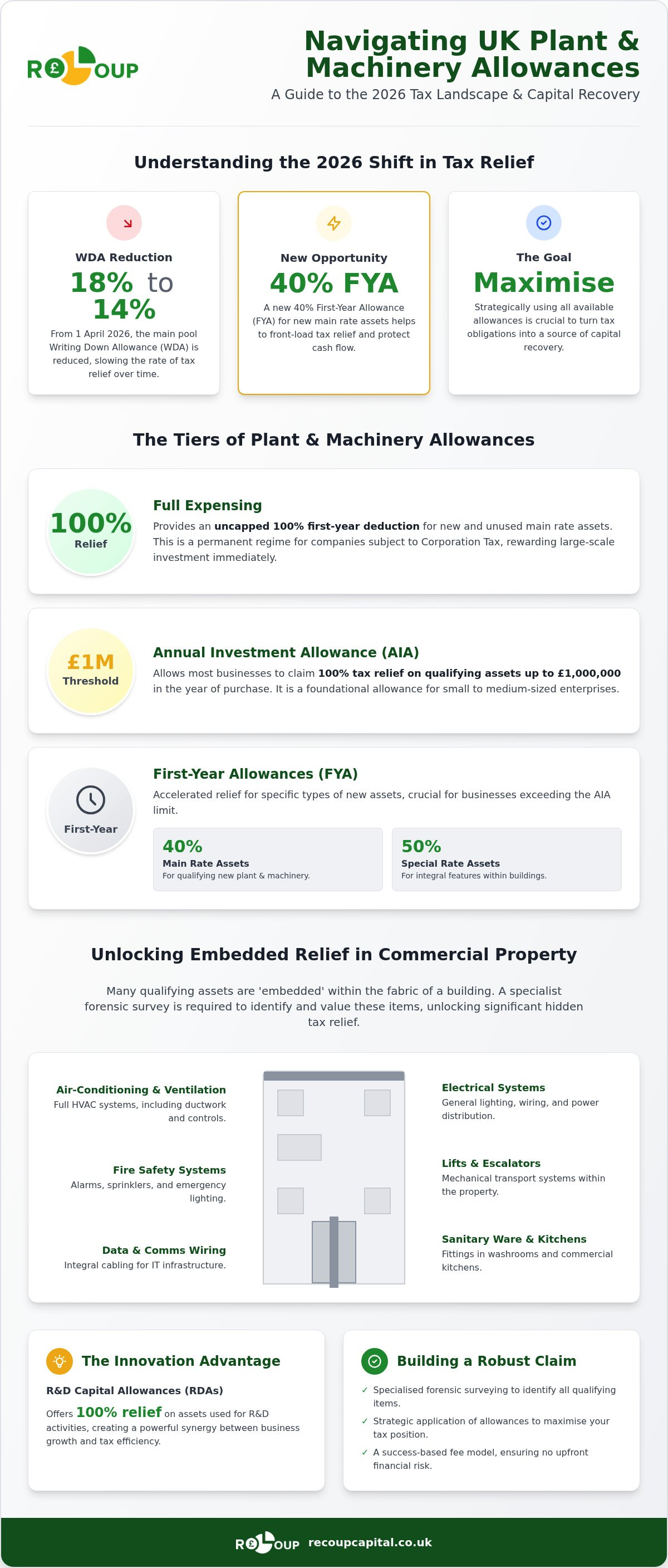
The tax landscape in 2026 is particularly significant for capital-heavy sectors like construction, engineering, and manufacturing. These industries often face high upfront costs for essential equipment. As of 1 April 2026, the main pool Writing Down Allowance (WDA) reduced from 18% to 14% for companies, a change that HMRC estimates will affect approximately 650,000 businesses. To balance this slower relief, a new 40% first-year allowance was introduced on 1 January 2026 for qualifying new main-rate plant and machinery allowances uk. This transition makes it more important than ever to identify qualifying assets early to front-load your tax relief and protect your cash flow.
The Distinction Between Capital and Revenue Expenditure
Understanding where your money goes is the first step toward recovery. Revenue expenditure covers the day-to-day running costs of your business, such as utility bills or minor repairs to existing equipment. Capital expenditure involves purchasing assets that provide long-term value, like heavy production machinery or building fixtures. HMRC requires a clear distinction because revenue costs are usually fully deductible in the year they occur; however, capital items must be processed through the capital allowances regime to ensure accurate corporation tax calculation. Complex assets like HVAC systems often sit on the boundary, requiring forensic analysis to determine which components are repairs and which are qualifying capital enhancements.
Who is Eligible to Claim Plant and Machinery Allowances?
Most UK businesses can benefit from these reliefs, including limited companies, partnerships, and sole traders. There's a specific exception for very small businesses using the "cash basis" of accounting, as they generally deduct capital costs as expenses when paid. To qualify, you must own the asset as a result of the expenditure and use it specifically for your trade. Whether you're a manufacturing firm investing in new lathes, a specialist clinic like The Contour Company acquiring advanced treatment equipment, or a commercial landlord installing integral fixtures, capital allowances remain a cornerstone of strategic financial planning. Our role is to act as a protective guide through these eligibility rules, ensuring that your claim is both robust and compliant from the outset.
Navigating the Tiers of Plant and Machinery Allowances
The 2026 tax landscape offers a tiered structure designed to incentivise different levels of business investment. At the foundation lies the Annual Investment Allowance (AIA), which maintains its robust £1,000,000 threshold for the 2026/27 tax year. This allows most businesses to claim 100% tax relief on the full cost of qualifying assets in the year of purchase. For companies subject to Corporation Tax, the "full expensing" regime provides a permanent, uncapped 100% deduction for new and unused main rate assets, ensuring that large scale investments are immediately rewarded.
A significant addition to the 2026 framework is the 40% first-year allowance (FYA). Introduced on 1 January 2026, this relief is available for qualifying new main rate plant and machinery allowances uk. It serves as a vital bridge for businesses that have already exhausted their £1 million AIA or those that don't qualify for full expensing. Additionally, companies can access a 50% first-year allowance for special rate assets, allowing for accelerated relief on integral building features before the remaining balance enters the standard pools. Correctly Claiming Capital Allowances across these tiers requires a strategic approach to ensure no relief is left unclaimed.
Main Pool vs Special Rate Pool Assets
Asset categorisation is the engine room of a successful claim. Main pool items typically include office furniture, computer hardware, and commercial vehicles. Following the April 2026 adjustments, these assets now attract a 14% Writing Down Allowance (WDA) if not fully relieved through first-year incentives. In contrast, special rate items cover "integral features" such as electrical, solar, and cold water systems, alongside long-life assets. These items sit in a separate pool with a 6% WDA. Distinguishing between these pools is a forensic task, as misclassification can significantly slow down your capital recovery. If you're unsure where your latest investment sits, you might explore our capital allowances expertise to see how we categorise complex assets for maximum impact.
First-Year Allowances (FYAs) and Enhanced Reliefs
Specific incentives exist to drive the transition toward a greener economy. New zero-emission cars and electric vehicle charging points currently qualify for a 100% FYA, providing an immediate tax benefit for sustainable choices. It's vital to remember the "new and unused" rule; most first-year reliefs are strictly reserved for brand new equipment. Second-hand assets generally won't qualify for FYAs and must be placed into the standard WDA pools instead. For expenditure that doesn't meet the definition of plant or machinery, such as the physical shell of a warehouse, the Structures and Buildings Allowance (SBA) provides a steady 3% annual relief over 33 and a third years.
Unlocking Embedded Relief in Commercial Property
Many business owners view their commercial property as a single, solid capital asset. However, a significant portion of the purchase price or construction cost actually relates to "embedded" plant and machinery allowances uk. These are items permanently fixed to the building fabric that qualify for tax relief under current legislation. It's common to find substantial value hidden in plain sight, yet these opportunities are frequently missed. Standard accounting practices often overlook these because they aren't itemised on a simple purchase invoice. A property contract might just list a total price, leaving the "hidden" assets unvalued and unclaimed. To gain a deeper understanding of a property's financial landscape, you can discover REIX to identify the equity gap between a list price and its maximum potential value.
Common qualifying fixtures include:
- Heating, ventilation, and air conditioning (HVAC) systems
- Passenger and goods lifts
- Fire alarm, sprinkler, and security systems
- Electrical, lighting, and power installations
- Sanitary ware and plumbing systems
General accountants typically lack the specialist surveying skills required to break down a building's cost into these specific components. Without an itemised breakdown, the default position is often to claim nothing. This is where UK Government Capital Allowances guidelines become a strategic tool for recovery rather than just a compliance box. Identifying these assets requires a blend of tax expertise and forensic surveying to ensure every qualifying component is captured and correctly valued for HMRC.
The Role of Forensic Surveying in Property Claims
Standard building contracts rarely provide the detail needed for a tax claim. Specialist surveyors bridge this gap by identifying assets that aren't itemised in standard contracts. The process involves a physical site inspection and a detailed analysis of construction drawings or purchase documents. Through forensic surveying, we can accurately value the specific components within the property that qualify for capital allowances. This isn't just about ticking boxes. It's about building a robust, evidence-based claim that can withstand HMRC scrutiny. By integrating this forensic approach into your property acquisition strategy, you transform a fixed asset into a source of reinvestable capital.
Second-Hand Property Purchases and Section 198 Elections
Buying a second-hand commercial property carries significant tax risks if you don't review its history. If the previous owner claimed relief, you must agree on the value of the fixtures being transferred through a Section 198 election. This agreement must be made within a strict two-year deadline from the date of purchase. If you fail to do this, the right to claim plant and machinery allowances uk on those items could be lost forever. We act as a protective guide during these transactions, ensuring your rights are preserved.
Buyers should follow this checklist to protect their interests:
- Request the seller's capital allowance history during due diligence.
- Confirm if a Section 198 election is required and agree on values early.
- Identify any "unclaimed" allowances that the seller never identified.
- Ensure all tax-related clauses in the sale contract are reviewed by a specialist.
Maximising Your Claim: Strategic Compliance and R&D Overlap
Unlocking the full potential of your tax strategy requires looking beyond isolated claims. There is a powerful synergy between R&D tax credits and capital allowances that many businesses fail to exploit. Whilst standard plant and machinery allowances uk often follow a multi-year writing down schedule, R&D Capital Allowances (RDAs) provide an immediate 100% relief on assets used for innovation. This includes laboratory equipment, specialised software, and prototyping machinery. By aligning your innovation spend with your asset procurement, you can significantly accelerate your capital recovery and improve your immediate tax position.
Timing is everything. With the main pool WDA reduced to 14% as of April 2026, the value of front-loading your claims through the £1 million AIA or 100% RDAs has never been higher. Strategic timing prevents you from accidentally pushing qualifying expenditure into a slower tax-relief pool. This proactive approach ensures your business cash flow remains a strategic tool for growth rather than a casualty of poor tax planning. We specialise in identifying these overlaps early in the investment cycle, ensuring that your capital utility is always at its peak.
HMRC Transparency and 2026 Compliance Standards
The 2026 landscape demands a higher level of transparency than ever before. HMRC now expects detailed technical reports that explain exactly how an asset qualifies, particularly for mixed-use items. If a piece of machinery serves both general trade and R&D functions, you must provide a clear, evidence-based apportionment. This level of detail acts as a protective guide against HMRC enquiries, ensuring your claim is robust and compliant. We focus on demonstrating value through results, providing the depth of analysis required to satisfy even the most rigorous scrutiny whilst maintaining your professional reputation.
Record Keeping and the CT600 Filing Process
Your CT600 corporation tax return is only as strong as the evidence behind it. Essential records include itemised invoices, board minutes discussing investment intent, and specialised forensic surveying reports. A professional review can often identify missed opportunities from the last two open tax years. This allows for retrospective claims that inject fresh capital into your bottom line. We use our track record as chartered tax accountants to ensure your filing is both accurate and optimised for maximum recovery. To see how a forensic approach can transform your tax position, book a no-cost introductory assessment with our team today.
The Recoup Capital Approach: Specialised Forensic Consultancy
Maximising the value of plant and machinery allowances uk requires a depth of analysis that goes beyond standard compliance. Recoup Capital doesn't replace your existing accountant; instead, we act as a specialist partner to enhance your tax strategy. We are specialists in high-value construction and engineering claims, where the complexity of building fabric often hides significant relief. Our approach is defined by a commitment to demonstrating value through results, which is why we operate on a success-based fee model. We only charge a fee based on the actual tax savings we identify, ensuring our goals are perfectly aligned with your business growth.
Our end-to-end service manages the entire process from the initial forensic survey through to final HMRC liaison. We understand that regulatory procedures can feel intimidating, so we act as a protective guide to ensure your claim is robust and fully compliant. By transforming complex financial data into a strategic business asset, we help you reinvest recovered capital back into your operations. This partnership-oriented style ensures that you stay focused on innovation whilst we handle the technical intricacies of the capital allowances regime.
Why a Specialist Consultancy Beats a Generalist Accountant
Generalist accountants provide essential broad-spectrum financial care, yet they often lack the forensic surveying capabilities needed to uncover embedded property fixtures. A broader, surface-level approach might miss items like concealed cabling or specialised ventilation systems because they aren't clearly itemised on a builder's invoice. Our advantage lies in our combined team of specialist surveyors and chartered tax accountants. This synergy allows us to identify hidden relief that others might ignore. We take a proactive stance, physically inspecting sites and construction drawings to ensure every qualifying component is captured, rather than simply processing the paperwork provided.
Getting Started: Your No-Cost Initial Assessment
Starting a claim review with Recoup Capital is a low-friction process designed to respect your time. We begin with a discovery phase where we identify potential savings without any upfront costs. This no-cost introductory offer allows us to evaluate your property or asset portfolio to determine the viability of a claim before you commit to the process. If we don't find qualifying expenditure, you don't pay a penny. It's a transparent, risk-free way to ensure you aren't leaving money on the table. If you're ready to explore how forensic analysis can improve your bottom line, contact our team for a confidential, no-obligation consultation today.
Transform Your Tax Relief into a Strategic Business Asset
The 2026 tax landscape presents a unique window for businesses to recover capital through proactive planning. By understanding the shift toward the 40% first-year allowance and the power of forensic surveying, you can unlock significant value hidden within your property's fabric. We've seen how integrating plant and machinery allowances uk with innovation-led reliefs creates a robust financial strategy that supports long-term growth whilst ensuring full HMRC compliance.
Expertise shouldn't be a barrier to entry. Our team of chartered tax accountants and specialised forensic surveyors is dedicated to identifying every qualifying asset through a success-based fee model. We act as a protective guide, managing the end-to-end process so you can focus on what you do best. It's time to stop viewing tax as a cost and start seeing it as a reinvestable asset.
Maximise your tax relief with Recoup Capital’s forensic capital allowances service. We look forward to building a long-term partnership that drives your business innovation forward.
Frequently Asked Questions
What is the difference between capital allowances and depreciation?
Depreciation is an accounting estimate of an asset's wear and tear over time, whereas capital allowances are a statutory tax relief. HMRC doesn't allow depreciation as a deductible expense for tax purposes. Instead, businesses use plant and machinery allowances uk to write off the cost of assets against taxable profits. Whilst depreciation varies by company policy, capital allowances follow strict HMRC rates, such as the 14% main pool writing down allowance.
Can I claim capital allowances on a second-hand commercial property?
Yes, you can claim on the embedded fixtures within a second-hand property purchase. These include items like lighting, heating, and security systems that were part of the building when you acquired it. You must meet the fixed value requirement through a Section 198 election with the seller. Identifying these hidden assets often requires forensic surveying to establish a value that HMRC accepts for your capital recovery.
How far back can I go to claim capital allowances on previous expenditure?
You can generally amend your tax returns for the two most recent open accounting periods to include missed expenditure. You can also claim for assets purchased many years ago, provided you still own them and use them for your trade. These older items are valued at their original cost and pooled in your current return. This historical look-back is a powerful way to inject fresh capital into your business.
What happens to my capital allowances if I sell my commercial property?
Selling a property triggers a disposal event, which may lead to a balancing charge or allowance. If the sale price allocated to fixtures is higher than their tax-written-down value, you might have to pay back some relief. It's vital to agree on the disposal value with the buyer using a Section 198 election. This protects your previous claims whilst providing clarity for the new owner's future tax position.
Can I claim capital allowances on a residential property that I let out?
Standard plant and machinery allowances uk are generally not available for standard residential buy-to-let properties. HMRC excludes dwelling houses from most capital allowance claims. However, exceptions exist for Furnished Holiday Lettings (FHLs) or the common parts of large residential blocks, such as lifts in communal hallways. Landlords should seek specialised advice to see if their specific property type or communal areas qualify for any statutory relief.
Do I need a specialist surveyor to claim capital allowances on my building?
Whilst not a legal requirement, a specialist surveyor is essential for identifying embedded fixtures that aren't itemised on building invoices. General accountants usually focus on visible equipment like laptops or vehicles. A forensic surveyor can identify and value the structural components, such as air conditioning or fire systems, built into the property fabric. This specialised depth ensures your claim is robust, compliant, and maximised to its full potential.
What are R&D Capital Allowances (RDAs) and how do they differ from standard allowances?
R&D Capital Allowances offer 100% tax relief in the year of expenditure for assets used specifically for research and development. Unlike standard plant and machinery allowances uk, which may be spread over several years, RDAs provide an immediate deduction. They also cover a broader range of assets, including the physical buildings used for R&D activities, which wouldn't normally qualify for plant and machinery relief under the standard rules.
How much does it cost to make a capital allowances claim with a specialist?
Specialist consultancies like Recoup Capital typically operate on a success-based fee model. This means there are no upfront costs or fixed hourly rates for the initial forensic survey and assessment. You only pay a fee based on the actual tax savings identified and successfully claimed. This approach aligns the specialist's goals with your own capital recovery, ensuring a low-friction entry point for businesses looking to innovate and grow.


