

The lab coat is no longer the uniform of innovation; in 2026, your most valuable R&D assets are likely hidden within your cloud subscriptions and digital infrastructure. You've likely felt the weight of the recent transition to the Merged Scheme, where identifying qualifying R&D expenditure UK feels more like a forensic challenge than a simple tax exercise. It's understandable to feel cautious about HMRC enquiries when the rules for categorising indirect time and overseas spend have shifted so significantly. You aren't alone in wanting to protect your business whilst still claiming what you're rightfully owed.
We're here to help you master these complexities, ensuring you identify every penny of eligible spend to fuel your future growth. This guide provides a clear list of qualifying categories and a robust framework for tracking internal costs with total precision. We'll explore the updated definitions of digital costs, the restrictions on overseas activity, and the specific documentation required to satisfy the latest compliance standards. This is about transforming a complex regulatory hurdle into a strategic financial asset that empowers your next big breakthrough.
Key Takeaways
- Master the "Innovation Test" to determine if your projects resolve scientific or technological uncertainties, moving beyond traditional lab settings into digital and cloud-based environments.
- Learn how to accurately categorise your qualifying R&D expenditure UK, including staff salaries, NICs, and newly eligible costs like data licences and cloud computing services.
- Understand the critical differences between the 20% gross credit under the Merged Scheme and the enhanced 27% support available through the ERIS pathway for R&D-intensive SMEs.
- Implement a robust framework for internal cost tracking, using time-tracking systems and segregated invoicing to provide the granular evidence HMRC now requires.
- Discover how forensic accounting techniques can uncover eligible innovation spend often overlooked in specialist sectors like construction and engineering.
What is Qualifying R&D Expenditure in the UK?
HMRC defines qualifying R&D expenditure UK as the specific costs incurred whilst a business attempts to resolve scientific or technological uncertainties. It isn't merely about the success of a project; it's about the journey of discovery and the technical challenges encountered along the way. Whether your team is developing a bespoke software algorithm or engineering a more resilient building material, the core of your claim rests on the "Innovation Test." This test determines if your work pushes the boundaries of current knowledge or simply applies existing solutions. Understanding the history of R&D tax incentives reveals how these definitions have evolved to support genuine risk-takers across all sectors.
Accurate categorisation is the bedrock of any successful submission. If you fail to distinguish between the research phase and the commercial production phase, you risk an HMRC enquiry. R&D ends the moment the technological uncertainty is resolved. Any costs incurred after this point, such as mass manufacturing, routine maintenance, or aesthetic tweaks, don't qualify. For a deeper dive into the mechanics of these rules, it helps to see R&D tax credits explained by specialists who handle these forensic distinctions daily. HMRC is particularly vigilant here; they want to see that you've stopped claiming the moment the "uncertainty" became a "certainty."
The Four Pillars of an Eligible R&D Project
To qualify for relief, your project must stand on four specific pillars that demonstrate its technical merit. Without these, even the most expensive project won't meet the criteria for qualifying R&D expenditure UK.
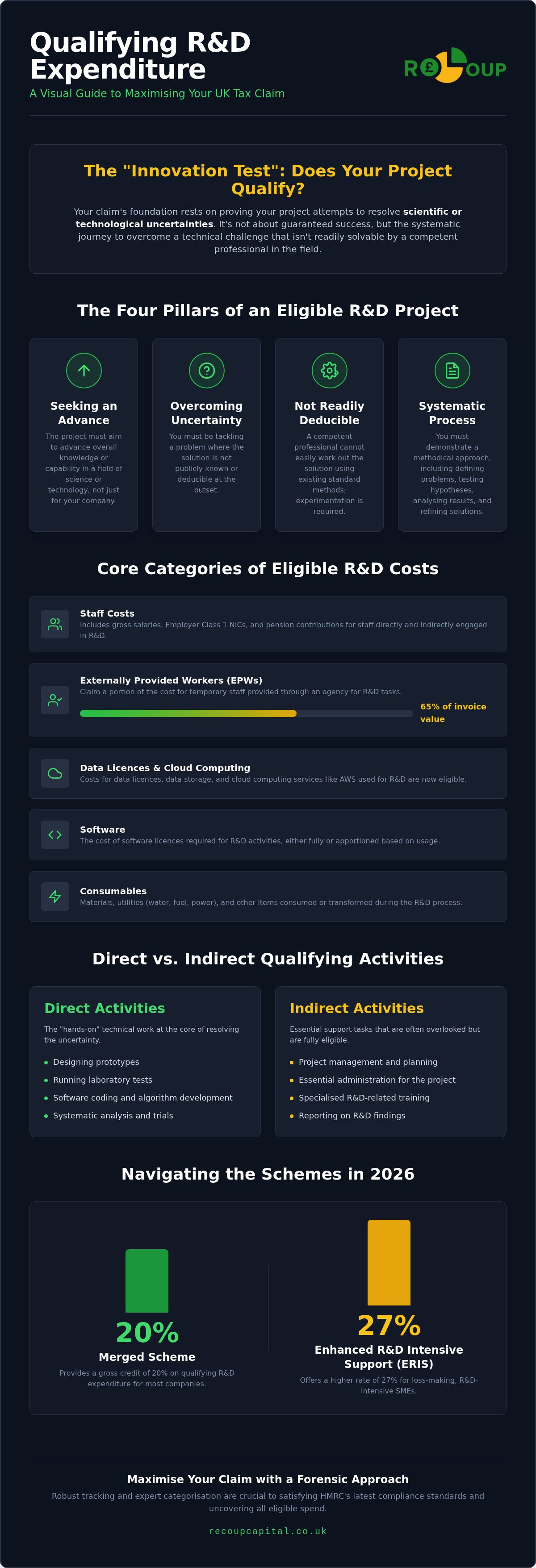
- Seeking an advance: You must aim to improve the overall knowledge or capability in a field of science or technology. This isn't just an advance for your company, but for the industry at large.
- Overcoming uncertainty: You're tackling a problem where the solution isn't known or available at the start. If a solution already exists in the public domain, it isn't an uncertainty.
- Not readily deducible: A competent professional in your field shouldn't be able to solve the problem easily using standard methods. It must require a degree of experimentation.
- Systematic process: You must show a methodical approach. This involves defining the problem, testing hypotheses, failing, and refining your solution based on those failures.
Direct vs Indirect Qualifying Activities
Distinguishing between direct and indirect activities is where many businesses leave money on the table. Direct activities are the "hands-on" elements: designing prototypes, running lab tests, and software coding. These are the obvious candidates for your claim. However, indirect activities are equally valid but frequently overlooked. These include project management, essential administration, and even specific training required for the R&D team to handle new equipment. Identifying these "grey areas" requires a forensic approach. We often find that support staff time, which is vital to the project's success, is missed during internal audits. Capturing these costs correctly transforms a standard claim into a strategic business asset.
The Core Categories of Eligible R&D Costs
Identifying what counts as qualifying R&D expenditure UK requires looking far beyond the obvious. Whilst most firms recognise the technical hours spent on a project, the full scope of eligible spend encompasses everything from energy bills to sophisticated digital infrastructure. Following the official government guidance on eligible R&D costs provides the basic framework, but applying these rules to a live business environment requires a forensic eye. It's about capturing every legitimate penny without overstepping the boundaries set by HMRC.
Forensic Breakdown of Staff Costs
Staff costs typically form the largest portion of any claim. This category includes gross salaries, Employer Class 1 NICs, and pension contributions. For employees who split their time between innovation and routine operations, you must apportion their costs based on actual time spent on R&D activities. Bonuses are generally eligible if they form part of the qualifying staff's remuneration, though benefits-in-kind like company cars or private medical insurance are excluded. If you use Externally Provided Workers (EPWs), you can usually claim 65% of the invoice value, provided they are subject to UK PAYE and NICs under the 2024 restrictions regarding overseas expenditure.
Modern Digital Costs: Cloud and Data
The 2024 reforms significantly modernised the tax landscape by introducing cloud computing and data licences as eligible categories. This change reflects the reality of 2026 innovation. If your R&D involves heavy data processing, complex simulations, or machine learning, these cloud costs are now a strategic asset. You cannot claim for general IT overheads, such as standard email servers or basic office software. The expenditure must be specifically for the R&D project's storage and processing needs. For example, an engineering firm using cloud-based "digital twin" simulations to test structural stress can include those specific processing fees in their claim.
Consumables and Prototypes
Consumables are items transformed or used up during the R&D process. This includes materials, water, fuel, and power. In manufacturing and construction, the "First of Class" rule is particularly beneficial. It allows you to claim the cost of building a full-scale prototype used for testing, even if that prototype is eventually sold, provided its primary purpose was resolving a technological uncertainty. Utility costs like heat and light must be apportioned logically, often using a floor-space or time-usage calculation. If you find these calculations daunting, claiming R&D tax credits becomes a much more streamlined process when guided by specialists who understand these nuances.
For businesses in the life sciences sector, payments to clinical trial volunteers are also a specific qualifying category. This ensures that the human element of testing is recognised alongside the technical materials used in the lab. By categorising these costs correctly from the outset, you build a robust foundation that withstands HMRC scrutiny whilst maximising your potential capital recovery.
Navigating the Merged Scheme and ERIS in 2026
The regulatory landscape underwent a seismic shift for accounting periods starting on or after 1 April 2024. We now operate within a single Merged Scheme for the majority of UK businesses. This unified approach offers a taxable credit of 20% on your qualifying R&D expenditure UK. If your company pays the main corporation tax rate of 25%, this translates to a net benefit of 15% after tax. It's a streamlined system designed to reduce complexity, yet it requires a precise understanding of how subsidised expenditure is now treated. Unlike the old SME scheme, being paid by a customer to perform R&D doesn't necessarily bar you from claiming, provided you meet the "decision maker" criteria.
Subcontracting Rules in the Merged Scheme
The rules for who can claim when work is contracted out have been fundamentally rewired. Under the Merged Scheme, the right to claim usually belongs to the company that "intended" the R&D to take place. If you identify a technological uncertainty and hire a third party to solve it, you are the one taking the risk and, therefore, the one entitled to the relief. This "intended" rule prevents double-claiming and ensures that the innovator, rather than the service provider, receives the benefit. It's a vital distinction that protects your investment in external expertise.
When you engage unconnected specialist consultants or third-party engineers, the 65% rule still applies. You can include 65% of their invoice value in your claim. However, you must ensure the work is performed within the UK. The 2026 landscape is strictly focused on domestic innovation. Overseas subcontracting is now largely ineligible unless you can prove it's "wholly unreasonable" to replicate the conditions in the UK. Managing these contracts with precision is the only way to safeguard your claim from HMRC scrutiny.
The R&D Intensive SME Criteria (ERIS)
For loss-making firms that invest heavily in innovation, the Enhanced R&D Intensive Support (ERIS) remains a critical lifeline. To qualify as "R&D intensive" in 2026, your qualifying R&D expenditure UK must account for at least 30% of your total business expenditure. This threshold was reduced from 40%, making the scheme accessible to a wider range of high-growth start-ups and engineering firms.
The financial impact of ERIS is significant. It offers a payable tax credit of up to 27%, providing vital cash flow for pre-revenue companies. There's also a helpful one-year grace period. If your R&D spend temporarily dips below the 30% mark but you met the criteria in the previous year, you can still claim under ERIS. This stability allows firms to plan long-term innovation cycles without the fear of losing support during a quiet phase. Understanding these nuances is essential for any business positioning its innovation spend as a strategic asset. If you're unsure which path your business falls into, reviewing our FAQs can clarify your eligibility status.
Identifying and Tracking Qualifying Spend
Tracking your qualifying R&D expenditure UK shouldn't be a frantic exercise performed weeks before your tax deadline. It's a real-time discipline that ensures no eligible cost slips through the cracks. By implementing a robust time-tracking system, you move away from guesswork and towards forensic accuracy. Your engineers and developers should record their hours against specific technical uncertainties as they encounter them. This documentation provides the technical "why" behind the financial "how much", which is exactly what HMRC looks for during a review.
Your accounting software is a powerful tool in this process. By segregating R&D-specific invoices at the point of entry, you create a clear and transparent audit trail. Whether it's a specific batch of materials for a prototype or a cloud computing invoice for a simulation run, tagging these costs immediately saves hours of retrospective analysis. We recommend conducting regular project reviews, perhaps monthly or quarterly, to capture spend whilst the technical challenges are still fresh in the team's mind. This proactive approach transforms your claim from a year-end chore into a strategic business asset.
Common Pitfalls and Excluded Costs
Even the most innovative firms can fall foul of HMRC's strict exclusions. General market research, sales activities, and routine quality control never qualify, even if they're related to a successful new product launch. It's also vital to distinguish between revenue expenditure and capital spend. Costs for land or buildings are strictly excluded from R&D tax relief. However, these assets may qualify for Capital Allowances, ensuring you still recover value from your investment through the appropriate channel.
Handling grants and state aid requires particular care in 2026. Under the Merged Scheme, the rules have changed regarding how subsidised expenditure is treated, but you must still declare any outside funding with total transparency. If you've received a grant for a specific project, it's essential to map out how that funding interacts with your overall claim to avoid the risk of over-claiming and triggering an enquiry.
Preparing for HMRC Compliance
The Additional Information Form (AIF) is a mandatory component of every submission. This digital form requires a granular breakdown of your costs and a detailed technical narrative. HMRC expects your technical report to mirror your financial data perfectly. If you claim for five hundred hours of developer time, your narrative must explain the specific technological uncertainties those hours were spent resolving. Discrepancies between the technical story and the financial spreadsheet are the quickest way to flag a claim for manual review.
Consistency is your best defence. If your documentation is fragmented, you increase the risk of a protracted enquiry. Learning how to prepare for an HMRC R&D inquiry is about more than just surviving an audit; it's about building a culture of compliance that protects your business long-term. To ensure your internal tracking systems meet the rigorous 2026 standards, you can organise a specialist cost-tracking audit with our chartered tax accountants.
Maximising Your Claim with Recoup Capital
Identifying qualifying R&D expenditure UK isn't just about ticking boxes. It's about finding the hidden innovation in your everyday operations. Our chartered tax accountants use a forensic methodology to uncover spend that standard accounting often misses. In specialist sectors like construction and engineering, technical challenges are woven into the fabric of the work. You might be solving structural uncertainties on-site or developing bespoke materials without even realising it qualifies for significant relief. We bridge that gap between technical reality and tax legislation, ensuring your claim reflects the true scale of your innovation.
We don't look at R&D in isolation. A truly robust financial strategy considers how these claims interact with Capital Allowances or the Patent Box. This holistic view ensures you aren't just getting a refund; you're building a tax-efficient foundation for your entire business. Our success-based fee model aligns our goals with yours perfectly. We only win when you do, which means we're motivated to capture every legitimate pound of relief whilst maintaining total compliance. This transparency is why so many firms trust us as their guide through the complexities of the UK tax landscape.
A Partnership-First Approach to Innovation
We aren't just here to process paperwork. We act as long-term strategic partners who understand the rhythm of your industry. By building a relationship from the outset, we can help you implement the tracking systems mentioned earlier in this guide. We offer a time-limited, no-cost initial consultation to assess your eligibility without any financial risk. It's an approachable opportunity to explore our R&D tax credit services and see exactly where your business stands in the 2026 landscape.
Strategic Reinvestment of Recovered Capital
Tax relief is more than just a back-dated refund. We reframe these returns as strategic assets. This capital can be reinvested into your next innovation cycle, effectively accelerating your growth and keeping you ahead of the competition. We help you plan for the future, ensuring your next project is set up for maximum recovery from day one. Our role is to act as a protective guide, transforming potentially intimidating regulatory procedures into a clear path for business expansion. Contact us today to organise your technical assessment and transform your innovation spend into a powerful tool for growth.
Transforming Innovation into Strategic Capital
Navigating the 2026 tax landscape requires more than just a passing knowledge of rules; it demands a forensic approach to your business operations. By mastering the nuances of the Merged Scheme whilst implementing robust tracking for digital and staff costs, you ensure every penny of qualifying R&D expenditure UK is accounted for. This isn't just about tax compliance. It's about reclaiming capital to fuel your next technical breakthrough and securing your firm's competitive edge in sectors like construction and engineering.
Our chartered tax accountants lead every claim, ensuring that your technical narratives and financial data meet the highest standards of HMRC scrutiny. We act as your protective guide, turning complex regulations into a clear opportunity for growth. Ready to see what your innovation is worth? Book your no-obligation R&D tax credit assessment with Recoup Capital today. Your future breakthroughs deserve the best possible financial foundation, and we're here to help you build it.
Frequently Asked Questions
What is qualifying R&D expenditure for UK companies in 2026?
Qualifying R&D expenditure UK includes specific costs incurred whilst your business seeks an advance in science or technology by resolving technical uncertainties. These costs must relate to your company’s trade and are typically categorised into staff costs, software, consumables, and certain types of subcontracted work. The expenditure must be revenue-based rather than capital-based. Identifying these costs requires a forensic approach to distinguish between routine commercial activity and genuine innovation.
Can I claim R&D tax credits for software development and cloud costs?
Yes, you can claim for software development and modern digital infrastructure. Since the 2024 reforms, cloud computing and data licence costs are eligible if they're used directly for R&D processing or storage. This change is particularly beneficial for engineering firms using cloud-based simulations or digital twins. You can't include general IT overheads, like standard email servers, but specific subscriptions used to resolve technological uncertainties are now a strategic asset for your claim.
How are staff costs calculated in an R&D tax claim?
Staff costs include gross salaries, Employer Class 1 NICs, and pension contributions for employees directly or indirectly involved in the R&D process. You calculate these by apportioning the percentage of time each staff member spends on qualifying activities. If a lead engineer spends 60% of their month tackling technical uncertainties, you include 60% of their total payroll cost. Benefits-in-kind and dividends are excluded, making precise time-tracking essential for a compliant submission.
What is the difference between the Merged Scheme and ERIS?
The Merged Scheme provides a 20% gross credit for most companies, resulting in a net benefit of 15% for those paying the 25% main rate of corporation tax. Conversely, ERIS (Enhanced R&D Intensive Support) is a specialised pathway for loss-making SMEs whose R&D spend accounts for at least 30% of their total expenditure. ERIS offers a more generous payable credit of up to 27%, acting as a vital cash flow lifeline for innovative UK start-ups.
Can I include subcontractor costs in my qualifying expenditure?
You can usually include 65% of the invoice value for subcontracted R&D work, provided the activities take place within the UK. Under the 2026 rules, overseas subcontracting is largely ineligible unless it's proven wholly unreasonable to perform the work domestically. The right to claim typically rests with the company that intended the R&D to happen. This ensures the innovator taking the financial risk receives the benefit rather than the service provider.
Are there any costs that are strictly excluded from R&D tax relief?
HMRC strictly excludes capital expenditure, such as land, buildings, and heavy machinery, which may instead fall under Capital Allowances. Other excluded costs include general market research, sales and distribution activities, and routine quality control that doesn't involve resolving a technical uncertainty. Production costs for mass-marketed goods are also ineligible. It's vital to stop claiming the moment your technical uncertainty is resolved to avoid the risk of an HMRC enquiry due to incorrect categorisation.
How far back can I claim for qualifying R&D expenditure?
You can generally claim for qualifying R&D expenditure UK for your two most recent completed accounting periods. This window is based on the date you file your Corporation Tax return, which must be within two years of the end of the relevant accounting period. If you haven't claimed before, you must also remember the mandatory six-month advance notification requirement if you haven't made a claim in the previous three years.
Do I need to be a loss-making company to claim R&D tax credits?
No, profitable companies can and should claim R&D tax credits. Under the Merged Scheme, profitable firms receive an expenditure credit that either reduces their corporation tax liability or is paid as a cash credit if no tax is owed. Whilst loss-making SMEs might access the higher ERIS rates, profitable businesses in sectors like construction and engineering still recover significant capital that can be used as a strategic tool for future innovation cycles.


