

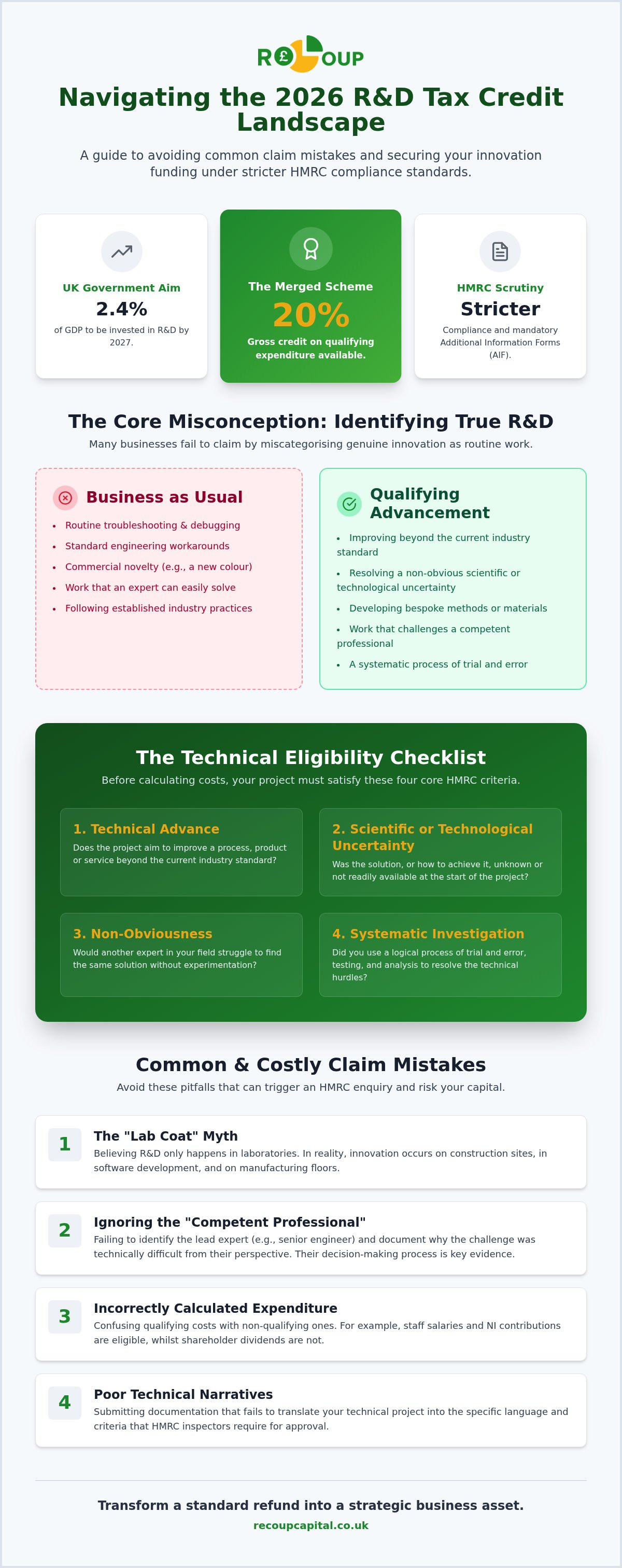
In 2026, the greatest threat to your innovation funding isn't a lack of ambition; it's a failure to document the "technical headache" through the eyes of a competent professional. Whilst the UK government aims to boost R&D investment to 2.4% of GDP by 2027, HMRC has simultaneously tightened the net on compliance. Many businesses unknowingly fall into common R&D tax credit claim mistakes by treating their technical challenges as "business as usual" rather than qualifying advancements. This oversight doesn't just risk your potential 20% gross credit under the Merged Scheme; it actively invites the scrutiny of a costly HMRC enquiry.
We understand that the transition to the Merged Scheme and the mandatory Additional Information Form (AIF) can feel like a regulatory minefield. It's frustrating when genuine innovation is sidelined by administrative complexity. This article identifies the most frequent pitfalls and provides a clear roadmap to meet HMRC’s 2026 compliance standards. You'll gain a clear understanding of qualifying versus non-qualifying costs and the confidence to handle digital submission requirements whilst protecting your vital business capital. We'll examine the specific documentation needed for 2026 and how to assess your claim's validity with absolute certainty.
Key Takeaways
- Learn how to distinguish genuine scientific advancement from routine problem-solving to ensure your projects meet strict 2026 HMRC criteria.
- Discover how to accurately calculate qualifying expenditure, specifically the distinction between staff salaries and ineligible dividend payments.
- Avoid common R&D tax credit claim mistakes by mastering the mandatory Additional Information Form (AIF) and digital submission standards.
- Understand how to draft technical narratives that translate complex engineering challenges into the specific language HMRC inspectors expect.
- Explore how a specialist-led technical audit can uncover "hidden" innovation, transforming a standard refund into a strategic business asset.
Understanding R&D Tax Credit Eligibility (and the Mistakes that Cloud it)
R&D tax credits are a vital HMRC incentive designed to reward UK limited companies for taking technical risks. By 2026, the UK's R&D tax incentive has shifted towards a Merged Scheme, offering a 20% gross credit on qualifying expenditure. This capital isn't just a refund; it's a strategic tool for growth and reinvestment. However, many businesses miss out because they misinterpret the "Science or Technology" hurdle. They assume their work is just standard practice.
One of the most common R&D tax credit claim mistakes involves a fundamental misunderstanding of what constitutes an "advance". HMRC defines this as an improvement in overall knowledge or capability in a field of science or technology. It's not enough for a project to be new to your company; it must seek to resolve an uncertainty that a professional in your field couldn't easily solve. In the 2026 compliance environment, having a documentation-first mindset is essential to prove these advances.
Debunking the "Lab Coat" Myth
Many directors believe R&D is reserved for white-room laboratories and test tubes. This is a costly misconception. In reality, innovation frequently happens on building sites, in software houses, and across manufacturing floors. For example, a construction firm developing a bespoke method to integrate sustainable materials into a load-bearing structure is likely performing R&D whilst appearing to do routine work. Assuming that software patches or engineering workarounds are "standard work" is amongst the most frequent common R&D tax credit claim mistakes we encounter.
The "Competent Professional" Test
HMRC places significant weight on the opinion of the "competent professional". This is the person who leads the project, such as a lead engineer or a senior developer. You must identify this individual and document their expertise to satisfy a compliance check. A frequent error is failing to explain why the uncertainty they faced was "scientifically or technologically" challenging from their expert perspective. Organise your technical records by linking them directly to this professional's decision-making process. To understand the nuances of these roles, you can find more information on how R&D tax credits explained can help define your technical authority. Documenting their thought process during the project is the best way to safeguard your claim capital.
The Technical Eligibility Checklist: Avoiding Identification Errors
Identifying eligible projects is the first line of defence against HMRC scrutiny. In 2026, the Merged Scheme requires a more rigorous approach to what qualifies as innovation. Many businesses fail to secure their capital because they confuse commercial novelty with technical advancement. To avoid common R&D tax credit claim mistakes, your project must meet four specific criteria before you even consider the financial calculations. You need to verify if the project sought an advance in overall technical knowledge, faced a non-obvious uncertainty, required a process of experimentation, and would challenge a competent professional in your field.
- Technical Advance: Does the project aim to improve a process or product beyond the current industry standard?
- Scientific or Technological Uncertainty: Was the solution unknown at the start of the project?
- Non-Obviousness: Would another expert in your field struggle to find the same solution?
- Systematic Investigation: Did you use a process of trial and error to resolve the technical hurdles?
Defining Scientific or Technological Uncertainty
There is a vast difference between a commercial risk and a technical "headache". A commercial uncertainty is wondering if a product will sell; a technical uncertainty is wondering if it is physically or digitally possible to build. One of the most frequent common R&D tax credit claim mistakes is claiming for routine troubleshooting. If a senior developer can fix a software bug using standard documentation, it isn't R&D. However, if you are developing bespoke middleware to synchronise legacy databases with real-time cloud analytics where no standard API exists, you are likely facing a qualifying uncertainty. HMRC provides a detailed list of common errors in R&D tax relief claims that highlights how often businesses misidentify these technical boundaries.
The "Appreciable Improvement" Standard
HMRC has moved beyond accepting minor tweaks or aesthetic updates as R&D. In 2026, an appreciable improvement is defined as a significant enhancement to a product or process that pushes technical boundaries beyond what is already available in the public domain or easily deducible by a competent professional. For example, changing the colour of a composite material for a construction project is an aesthetic choice. Developing a new chemical bonding process that allows that same material to withstand 30% higher thermal stress is an appreciable improvement. If you are unsure whether your project hits this high bar, it may be beneficial to understand the strategic value of a professional technical audit before submitting your narrative.
Financial Pitfalls: Errors in Calculating Qualifying Expenditure
Calculating the financial value of a claim requires surgical precision. Under the 2026 Merged Scheme, most companies receive a taxable credit of 20% on qualifying expenditure. Reaching this figure correctly is where many businesses encounter common R&D tax credit claim mistakes. Staffing costs usually form the bulk of a claim. You should include gross salaries, employer National Insurance contributions, and pension contributions. However, you cannot include dividends, non-cash benefits, or travel and subsistence expenses. Mistakenly padding the cost pool with these ineligible items is a major red flag for inspectors.
With HMRC clamping down on R&D claims, ensuring every penny is accounted for correctly is essential for protecting your business capital. If you use Externally Provided Workers (EPWs), remember the 65% rule. You generally only claim 65% of the invoice value to account for the provider's profit margin. Additionally, you can claim for consumables like materials transformed by the R&D process, or the specific proportion of light and heat used during the work. Failing to apportion these costs accurately can lead to an overvaluation that triggers a compliance check.
Subcontracted Activities: The 2026 Rules
The 2026 rules have clarified the "contracted out" landscape. A common error involves double-claiming between a contractor and a client. Only the entity that intended for the R&D to take place and bore the financial risk typically holds the right to claim. Additionally, new restrictions on overseas expenditure mean that payments to subcontractors performing work outside the UK are generally ineligible unless specific exceptions apply. You can learn more about qualifying costs to determine which party in a contract is eligible for the incentive.
The Impact of Grants and Subsidies
Receiving a government grant no longer automatically disqualifies an SME from claiming under the main scheme, as the Merged Scheme has simplified the treatment of subsidised expenditure. However, technical nuances remain. Mistakenly assuming a project is ineligible because it received partial funding is a missed opportunity for many innovators. Whilst the Merged Scheme provides a single pathway for most, R&D-intensive SMEs may still access Enhanced R&D Intensive Support (ERIS) if their R&D spend exceeds 30% of total expenditure. Navigating this transition requires a clear understanding of how these incentives interact with your overall funding strategy.
The Documentation Gap: Failing HMRC’s New Compliance Standards
In 2026, the "how" of your claim is just as important as the "what". The Additional Information Form (AIF) is now a mandatory digital requirement for every submission. If you fail to submit the AIF before or on the same day as your Company Tax Return (CT600), HMRC will reject the claim instantly. This is one of the most avoidable common R&D tax credit claim mistakes. It requires specific data, including a granular breakdown of costs and detailed project descriptions. It also demands senior officer sign-off. This ensures board-level accountability for the technical and financial accuracy of the submission.
Describing technical advances requires a specific dialect. You must avoid marketing speak and focus on the technical baseline. Explain exactly where the industry standard ended and where your experimentation began. For companies with more than three projects, the AIF requires descriptions for a selection that covers at least 50% of the qualifying expenditure. Precise time-tracking is equally vital. HMRC no longer accepts broad estimates like "everyone spent 50% of their time on R&D". You need evidence to prove the proportion of staff time spent on qualifying activities versus general duties.
Avoiding the HMRC Enquiry: Compliance Red Flags
Generic project descriptions are a magnet for HMRC audits. If your narrative looks like a "boilerplate" template, it signals a lack of technical depth. Many businesses make the mistake of failing to update their claim methodology following the 2024/2025 reforms. This proactive approach helps you avoid common R&D tax credit claim mistakes that often lead to protracted enquiries. Using a specialist R&D tax accountant helps pre-empt these questions. We act as a protective guide, ensuring your narrative is robust enough to withstand scrutiny.
Record-Keeping Best Practices
This requirement for specialist oversight is mirrored across many regulated industries. For instance, healthcare providers often seek similar expert support to maintain high standards of care, and you can learn more about CQC Consultancy to see how they assist with these critical regulatory requirements.
Organising technical documentation contemporaneously throughout the year is the only way to ensure accuracy. Don't wait until year-end to reconstruct project timelines. Interestingly, capturing "failed" experiments is often the best proof of R&D. A failure demonstrates that the outcome was not easily deducible, which is a core requirement for eligibility. You can see why documentation is key to your claim when trying to build a defensible case for capital recovery. If you are concerned about your current records, our team can provide a technical documentation review to ensure your 2026 claim meets every digital standard.
Maximising Your Claim: Moving from Mistakes to Capital Recovery
A checklist serves as an excellent defensive tool. It helps you dodge common R&D tax credit claim mistakes such as miscalculating staff time or missing the mandatory AIF deadline. However, truly maximising your claim involves a shift from mere compliance to strategic capital recovery. A specialist technical audit does more than just tick boxes. It identifies the subtle "technical headaches" in your projects that you might have dismissed as routine work. This proactive approach ensures you aren't leaving vital capital on the table.
The Recoup Capital Approach
To support this strategic approach, businesses often utilise external expertise such as VULPIN Capital to provide specialised project management and auditing, ensuring that every innovative venture is meticulously tracked and capitalised.
Our in-house Chartered Tax Accountants specialise in sectors like construction and engineering. In these industries, innovation is often embedded within complex project delivery rather than a laboratory setting. Generalist accountants often lack the technical depth to articulate these advances to HMRC effectively. We manage the entire end-to-end process. This begins with an initial technical assessment and concludes with a final HMRC submission. Because we understand the nuances of engineering challenges, we typically identify higher claim values than generalist firms. We act as your protective guide, ensuring every narrative is robust and every cost is defensible.
We operate on a success-based fee model. This "no win, no fee" approach means our interests are perfectly aligned with your business success. It removes the financial risk for SMEs who may be skeptical of the R&D process or fearful of HMRC scrutiny. Our primary goal is to transform your past technical challenges into reinvestable capital for your 2027 projects. By reframing these returns as strategic assets, we help you fuel further innovation and business growth.
Ready to Secure Your Innovation Funding?
The first step toward recovery is a no-cost introductory review. We'll assess your eligibility and risk profile without any upfront commitment or aggressive sales pressure. Our team organises the documentation process to minimise the burden on your technical staff. This allows your engineers and developers to stay focused on their core work whilst we handle the regulatory complexities. We believe in demonstrating value through results. This partnership-oriented approach turns an intimidating procedure into an approachable opportunity. If you want to avoid common R&D tax credit claim mistakes and secure your capital, start with an expert evaluation. You can book your free R&D eligibility assessment with Recoup Capital to begin your journey toward successful capital recovery.
Securing Your Innovation Capital for 2027
Mastering the technical narrative and ensuring meticulous financial calculation are the foundations of a robust claim. By aligning your documentation with the 2026 Merged Scheme standards, you transform regulatory hurdles into a predictable stream of reinvestable capital. Avoiding common R&D tax credit claim mistakes requires more than just a checklist; it demands a deep understanding of how HMRC views technical uncertainty in sectors like construction and engineering. Our in-house team of Chartered Tax Accountants specialises in these complex fields, ensuring your technical advances are captured with absolute precision.
We believe in demonstrating value through results. This is why we operate on success-based fees; we only get paid when your claim is successful. It's a risk-free way to ensure your business capital is protected whilst you focus on what you do best: innovating. Ready to turn your technical headaches into strategic assets? Check your R&D eligibility with a free specialist review. Your innovation deserves the strongest possible protection, and we're here to act as your guide through the evolving tax landscape. Let's build your future together.
Frequently Asked Questions
Can I claim R&D tax credits if my project was a technical failure?
Yes, you absolutely can claim for projects that didn't reach their intended goal. In fact, technical failure is often the strongest evidence that a scientific or technological uncertainty existed. If the solution was obvious, you wouldn't have failed. HMRC rewards the attempt to innovate, not just the success. Documenting what went wrong helps you avoid common R&D tax credit claim mistakes where projects are incorrectly dismissed as routine work.
Is there a minimum spend requirement for R&D claims in 2026?
There is no statutory minimum spend requirement to make an R&D claim in the UK. However, you should consider the administrative time and costs involved in preparing a robust submission. Whilst a small claim is legally valid, the complexity of the 2026 digital standards means the effort must be balanced against the potential credit. We help businesses identify hidden costs to ensure their claim value justifies the professional documentation required by HMRC.
How far back can I go when claiming R&D tax relief in the UK?
You can generally claim for the two previous accounting periods. This means you have a two-year window from the end of the accounting period in which the R&D expenditure was incurred to submit your claim. It's vital to keep track of these deadlines, as missing them is one of the most common R&D tax credit claim mistakes. Acting promptly ensures you don't lose the opportunity to recover significant capital for your business.
What is the "Additional Information Form" and is it mandatory?
The Additional Information Form (AIF) is a mandatory digital submission that must accompany every R&D claim in 2026. Introduced to combat fraud, it requires detailed project descriptions and a full breakdown of qualifying costs. You must submit this form before or on the same day as your Company Tax Return. Failure to provide this digital evidence will result in HMRC automatically rejecting your claim, making it a critical step in the compliance process.
Can I claim for R&D if I am a subcontractor in the construction industry?
Yes, subcontractors in construction can often claim, provided they are performing qualifying R&D and meeting the 2026 "contracted out" rules. If your firm is tasked with solving a specific technical challenge where the solution isn't clear, you may be eligible. The key is determining who holds the technical risk and the rights to the innovation. We specialise in helping construction firms navigate these specific contractual boundaries to secure their rightful tax relief.
How long does it typically take for HMRC to process a 2026 R&D claim?
HMRC typically aims to process R&D tax credit claims within 40 days of submission. However, the increased scrutiny and the requirement for the Additional Information Form can lead to longer wait times if the documentation isn't perfect. Ensuring your claim is "enquiry-ready" from the start is the best way to prevent delays. Our end-to-end support focuses on streamlining this process to get your capital back into your business as quickly as possible.
What is the difference between the Merged Scheme and the ERIS scheme?
The Merged Scheme is the standard pathway for most UK companies in 2026, offering a 20% gross credit on qualifying spend. The Enhanced R&D Intensive Support (ERIS) is a more generous scheme specifically for loss-making SMEs where R&D expenditure constitutes at least 30% of total spend. ERIS allows for a higher 186% deduction and a 14.5% credit rate. Choosing the wrong scheme for your financial profile can significantly impact your total recovery.
Do I need a specialist R&D consultant if I already have an accountant?
Whilst your general accountant handles your day-to-day finances, a specialist R&D consultant brings technical expertise that generalists often lack. We employ in-house Chartered Tax Accountants who understand the specific engineering and scientific hurdles that qualify for relief. Specialists typically identify more qualifying expenditure by uncovering "hidden" innovation. Our success-based model ensures you receive expert technical narrative support without adding a fixed financial burden to your business operations.


