

An accurate R&D tax credit calculation UK is no longer just a year-end accounting task; it's a forensic exercise in capturing hidden innovation. You've likely felt the weight of HMRC's shifting goalposts, especially with the consolidation of the Merged Scheme and the specific nuances of Enhanced R&D Intensive Support (ERIS). It's natural to feel concerned about the increased scrutiny surrounding the mandatory Additional Information Form (AIF). If you're worried that a miscalculation might trigger a frustrating enquiry or leave thousands of pounds on the table, you aren't alone.
We're here to help you navigate this transition with confidence. This guide will empower you to master these complexities, transforming "grey area" costs into audit-ready figures that maximise your capital recovery with absolute precision. We'll provide a clear framework to distinguish between the 20% taxable expenditure credit and the 186% enhanced deduction available to R&D-intensive SMEs. By the end of this article, you'll understand how to categorise everything from cloud computing to overseas subcontracting whilst ensuring your claim remains fully compliant with 2026 regulations. Let's turn your technical breakthroughs into the strategic financial assets your business deserves.
Key Takeaways
- Understand the critical differences between the Merged Scheme and Enhanced R&D Intensive Support (ERIS) to ensure you apply the most beneficial rate for your 2026 claim.
- Master a forensic approach to your R&D tax credit calculation UK by accurately categorising staff costs, pension contributions, and externally provided worker expenses.
- Implement a structured five-step framework to aggregate qualifying technical costs whilst maintaining the high levels of documentation required for HMRC compliance.
- Identify and avoid common calculation pitfalls, such as the incorrect treatment of subsidies or grants, which can trigger unwanted regulatory scrutiny.
- Reframe your recovered capital as a strategic asset for business growth by uncovering qualifying expenditures that traditional accounting methods often miss.
Understanding the UK R&D Tax Credit Landscape in 2026
The UK's innovation landscape has undergone its most significant transformation in a decade. For any limited company, mastering the R&D tax credit calculation UK is no longer a simple box-ticking exercise; it's a strategic requirement. Since the 2024 transition, the separate silos for SMEs and large companies have largely vanished. They've been replaced by a streamlined, unified system designed to reward genuine technical risk-taking across every sector from engineering to food technology.
The Merged Scheme: A Unified Approach to Innovation
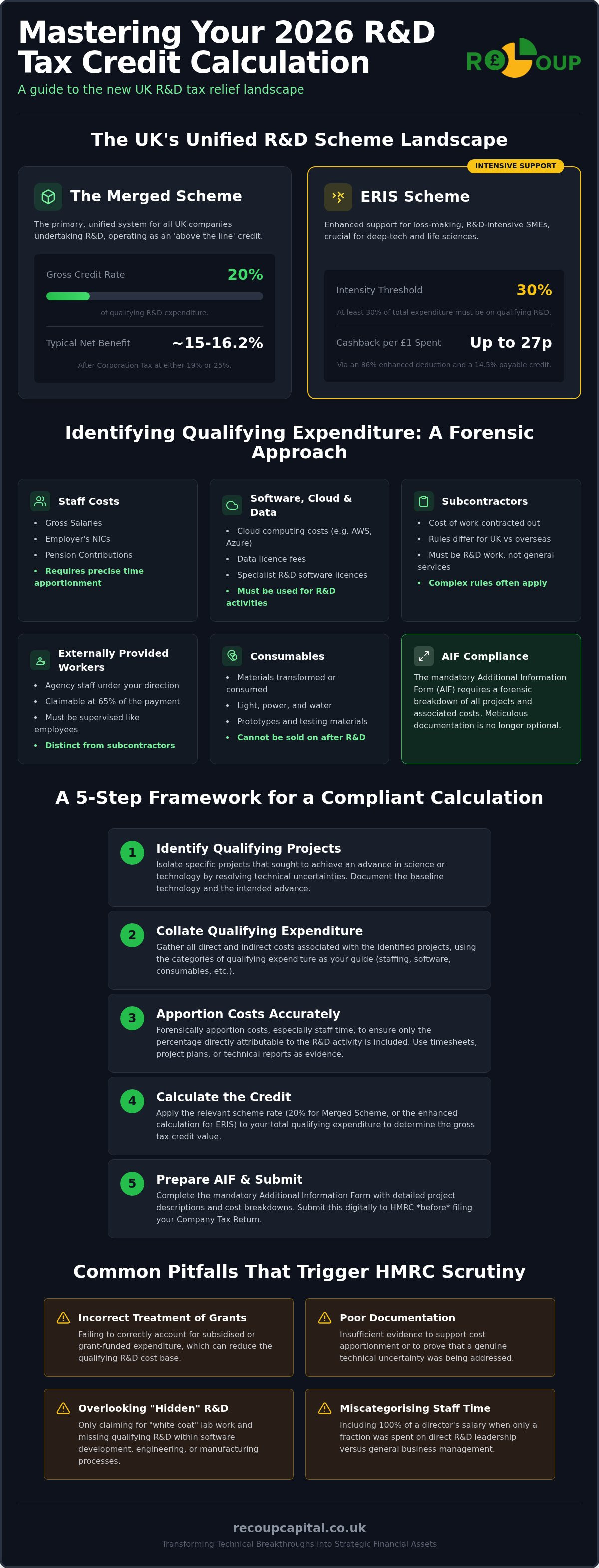
The Merged Scheme serves as the primary vehicle for UK corporate innovation, offering a cohesive framework for businesses of all sizes. It operates on an "above the line" model, which means the credit appears as income in your accounts before tax, rather than just a tax reduction at the bottom. This shift is vital for your corporate balance sheet, as it directly improves your EBITDA and makes the business more attractive to investors. The headline gross credit rate is 20% of your qualifying expenditure. After accounting for Corporation Tax, the net benefit typically sits between 15% and 16.2%, depending on whether you're paying the 19% small profits rate or the 25% main rate.
ERIS: Support for R&D Intensive Small Businesses
Whilst the Merged Scheme covers the majority, the Enhanced R&D Intensive Support (ERIS) provides a vital lifeline for deep-tech and life science sectors. To qualify in 2026, loss-making SMEs must meet a 30% intensity threshold, meaning at least 30% of their total relevant expenditure is dedicated to R&D. If you hit this mark, the relief is significantly more generous. You can claim an 86% enhanced deduction and a 14.5% payable tax credit on surrenderable losses. This can result in a net benefit of up to 27p for every £1 spent. It's a protective measure for those pushing the boundaries of what's possible, even before they reach profitability.
Accuracy in your R&D tax credit calculation UK is now governed by the mandatory Additional Information Form (AIF). HMRC requires this digital submission before they'll process any claim, demanding a forensic breakdown of your technical projects and costs. Understanding the historical evolution of UK R&D tax credit schemes helps contextualise why these regulations have tightened. By aligning your internal tracking with these 2026 standards, you ensure your innovation is protected and your capital recovery is maximised. We view these returns not just as a refund, but as strategic assets for your future growth.
Identifying Qualifying Expenditure: The Forensic Foundation
Building a robust R&D tax credit calculation UK requires moving beyond surface-level accounting. It's a process of forensic identification, ensuring every penny spent on resolving technical uncertainty is captured whilst remaining strictly within HMRC's boundaries. Many businesses leave significant value on the table by only considering the most obvious costs. A truly strategic claim examines the entire lifecycle of a project, from initial concept to the final prototype.
Staff Costs and Apportionment
Staff costs often form the largest portion of a claim, yet they're frequently under-calculated. You should include gross salaries, Employers’ National Insurance Contributions (NICs), and pension contributions. Accuracy here depends on precise time-tracking. You must be able to demonstrate exactly how much time each employee spent on qualifying activities versus their general commercial duties. For smaller firms, this requires a forensic approach to apportioning director time. Directors often wear multiple hats; separating their strategic technical leadership from general administrative management is essential for a compliant claim. Even support staff, such as lab assistants or certain members of the administrative team, can be included if their work directly supported the R&D process.
Software, Cloud, and Data Costs
The modern R&D toolkit has evolved. Since the recent legislative updates, your calculation can now include cloud computing expenditure and data licence costs, provided they're used specifically for R&D projects. This is particularly relevant for businesses involved in AI development or big data analytics where vast processing power is required. You must distinguish between software used for general business operations, like your CRM or standard accounting packages, and the specialised tools used to overcome technical challenges. If a software package serves both purposes, a reasonable and justifiable apportionment must be applied to the costs.
Managing subcontracted R&D and Externally Provided Workers (EPWs) requires careful navigation of the 65% rule. Typically, you can only claim 65% of the relevant payments made to these external parties to account for their own overheads and profit margins. Under the Merged Scheme, the rules regarding who can claim for subcontracted work have tightened; the right to claim usually sits with the company that intended for the R&D to take place. You should also be aware that relief for overseas subcontractors is now heavily restricted. Following the official government guidance is a good starting point, but the nuances of these restrictions often require specialist interpretation. If you're unsure how these rules apply to your specific supply chain, you might find it helpful to explore our specialist claiming process to ensure no qualifying costs are overlooked.
Consumables represent another vital category. This includes materials, fuel, and utilities transformed or consumed during the R&D process. Whether it's chemicals used in a lab or the materials for a physical prototype that's eventually scrapped, these costs add up. By maintaining a forensic mindset across all these categories, you transform a standard tax filing into a strategic asset that fuels your company's future innovation.
How to Calculate Your R&D Tax Credit: A 5-Step Framework
Performing an accurate R&D tax credit calculation UK requires more than just a spreadsheet of invoices. It's a structured process of aligning your financial data with technical realities. Whilst many competitors suggest simply entering a total spend, a forensic approach identifies qualifying indirect activities often missed by generalist accountants. These include tasks like technical maintenance or specific quality control measures that directly support an R&D project.
Follow this 5-step framework to ensure your claim is both maximised and compliant:
- Step 1: Aggregate all qualifying technical costs. Combine staff, software, and consumables identified in previous sections.
- Step 2: Apply the relevant scheme rate. Determine if you fall under the Merged Scheme or ERIS based on your intensity ratio.
- Step 3: Adjust for Corporation Tax liability. The credit's net value depends on your specific tax rate.
- Step 4: Cross-reference with the Additional Information Form (AIF). Ensure the numbers in your tax return match the narrative in your digital submission.
- Step 5: Final review for Technical Uncertainty. Verify that every cost is linked to a documented technical challenge.
Calculating the Net Benefit of the Merged Scheme
The Merged Scheme uses a "Gross-Up" method where the 20% credit is treated as taxable income. To find your net benefit, you must subtract the Corporation Tax you'll pay on that credit. If your company is subject to the 25% main rate, your net cash benefit is 15%. For those on the 19% small profits rate, it's 16.2%. For instance, a £100,000 qualifying spend generates a £20,000 gross credit. This results in a £15,000 net cash benefit for a profit-making firm at the main tax rate. You can find more detail on these specific rates in our frequently asked questions.
Step-by-Step ERIS Calculation for Intensive SMEs
If your business meets the 30% intensity ratio, the ERIS framework offers a more substantial return. You apply an 86% enhancement to your qualifying expenditure, bringing the total deduction to 186%. For loss-making intensive SMEs, this surrenderable loss can be converted into a payable tax credit at a rate of 14.5%. This calculation is highly sensitive to your total relevant expenditure. Even a small shift in non-R&D spending can push you below the intensity threshold, drastically altering your final claim value. It's vital to monitor this ratio throughout the accounting period to protect your status and ensure your innovation remains a strategic asset.
Common Calculation Pitfalls and HMRC Compliance
HMRC's approach to compliance has evolved into a data-led operation. With the mandatory submission of the Additional Information Form (AIF), your R&D tax credit calculation UK is now cross-referenced against industry benchmarks with forensic precision. One of the most frequent pitfalls is the failure to distinguish between genuine technical innovation and standard industry practice. If a competent professional in your field could've resolved the challenge using existing knowledge, HMRC will likely view the expenditure as non-qualifying. Aggressive calculations that attempt to sweep in every operational difficulty often trigger enquiries that could've been avoided with a more disciplined approach.
A robust claim also includes Qualifying Indirect Activities (QIAs). These are the support functions like technical maintenance, administration, or health and safety specifically required for the R&D project. Whilst these costs are valid, they're often the first to be scrutinised by inspectors. You must ensure they're apportioned with the same level of detail as your primary staff costs. Simply guessing a percentage for support staff is no longer acceptable in the 2026 compliance landscape.
Navigating Subsidies and Grant Funding
The interaction between grants and R&D relief has changed under the Merged Scheme. Previously, a single Innovate UK grant could push an entire project into the less generous RDEC scheme. In 2026, the "no double dipping" rule remains paramount. You cannot claim R&D tax credits on the specific portion of expenditure already covered by a grant. However, the Merged Scheme allows for a more integrated approach to project funding. Strategically categorising these costs requires a clear audit trail to show which pounds were grant-funded and which were company-funded. This prevents the risk of over-claiming whilst ensuring you don't miss out on legitimate relief.
The Importance of Contemporaneous Records
Your financial calculation is only as strong as the technical evidence supporting it. HMRC expects to see a direct link between the costs in your spreadsheet and the "Technical Uncertainty" described in your reports. You should document the resolution process as it happens, rather than trying to reconstruct it months later. This includes recording failed experiments and dead ends; these are often the strongest proof of genuine R&D. To ensure your documentation meets these rigorous standards, you can learn more about the R&D claiming process. Establishing this relationship-first approach to documentation protects your claim from being reframed as a mere refund. Instead, it becomes a verified strategic asset. If you want to ensure your calculation stands up to HMRC's 2026 standards, discover how our forensic methodology protects your business.
Maximising Your Return with Recoup Capital
General accountants often view R&D as a standard tax line item. In reality, a truly effective R&D tax credit calculation UK requires a deep dive into technical workflows that traditional ledgers simply don't capture. Evidence from our technical reviews suggests that generalists can miss up to 30% of qualifying costs. This happens because they often lack the technical background to identify innovation hidden within day-to-day operations. We bridge this gap by acting as your protective guide through the complexities of the 2026 regulatory landscape.
Our Forensic Approach to Capital Recovery
We pair technical specialists with chartered tax accountants to ensure every calculation is both maximised and compliant. In sectors like construction or engineering, R&D isn't always found in a laboratory. It's frequently embedded in bespoke site solutions or process optimisations. Our team identifies these nuances, transforming overlooked activities into tangible capital. Explore why businesses choose to claim with a partner who understands the technicalities of your specific industry.
Securing Your Future Innovation
We operate on a success-based fee model. This ensures our interests are perfectly aligned with your business growth. You don't face the pressure of upfront costs; our value is demonstrated through the results we deliver. This partnership-first approach extends to HMRC liaison. We manage technical enquiries on your behalf, removing the stress of regulatory procedures. Our team provides the forensic analysis necessary to defend your claim whilst you focus on your core operations.
We reframe your returns as strategic assets for reinvestment rather than mere tax refunds. This shift allows you to fund future projects with confidence. Our focus remains on long-term collaboration, helping you navigate the evolving UK tax system whilst you focus on what you do best: innovating. We believe that every technical breakthrough should be reflected in your bottom line. Contact Recoup Capital for a no-obligation R&D assessment to see how forensic precision can fuel your next breakthrough.
Transforming Innovation into Strategic Capital
Mastering the 2026 landscape involves more than just plugging numbers into a spreadsheet. It requires a forensic understanding of the Merged Scheme's "above the line" model and the specific intensity thresholds that define ERIS eligibility. By identifying hidden qualifying expenditures and maintaining contemporaneous documentation, you protect your business against HMRC scrutiny whilst ensuring your technical breakthroughs are properly valued. Refining your R&D tax credit calculation UK is the final step in turning project risks into reinvestable assets.
We're committed to your long-term growth through a partnership-first approach. Our success-based fee model ensures our interests are perfectly aligned with yours, whilst our team of technical specialists and Chartered Tax Accountants provides the protective expertise needed for complex construction and engineering claims. We manage the technical enquiries so you can stay focused on your next breakthrough. Maximise your R&D claim with Recoup Capital today. Your innovation is your greatest strength; let's ensure it's fully rewarded.
Frequently Asked Questions
How do I calculate R&D tax credits for the 2026 tax year?
Start by identifying all qualifying costs from April 2024 onwards. Apply the 20% gross credit rate under the Merged Scheme. For profit-making companies, this credit is taxable, typically resulting in a net benefit of 15% or 16.2% depending on your Corporation Tax rate. Ensure your R&D tax credit calculation UK is supported by a detailed technical narrative and submitted via the mandatory Additional Information Form to remain compliant with HMRC's latest standards.
Can I still claim R&D tax relief if my company is making a loss?
Yes, loss-making companies can still access significant support. Under the Merged Scheme, you receive a payable tax credit at the same gross rate as profit-making firms. If your business is R&D intensive, you may qualify for the Enhanced R&D Intensive Support (ERIS) scheme. This allows loss-making SMEs to claim a higher payable credit of 14.5% on their surrenderable losses, providing a vital cash injection for future innovation and technical growth.
What is the difference between the Merged Scheme and ERIS?
The Merged Scheme is the standard vehicle for most UK companies, offering a 20% gross credit. ERIS is specifically designed for loss-making SMEs where R&D expenditure accounts for at least 30% of their total relevant spending. Whilst the Merged Scheme provides a net benefit of around 15%, ERIS is more generous, offering up to 27p for every £1 spent. This targeted support ensures that high-intensity research businesses receive the capital they need.
How much can I claim back for subcontracted R&D work?
You can typically claim 65% of the qualifying payments made to subcontractors. This reduction accounts for the subcontractor's own overheads and profit margins. Under the 2026 rules, the right to claim generally rests with the company that initiated the R&D activity. It's important to remember that relief for overseas subcontracting is now restricted, so you should focus your R&D tax credit calculation UK on work physically performed within the United Kingdom.
Do I need to submit an Additional Information Form (AIF) with my calculation?
Yes, submitting the Additional Information Form is a mandatory requirement for all claims. This digital form must be sent to HMRC before you file your Company Tax Return. It requires a forensic breakdown of your qualifying expenditure and a clear explanation of the technical uncertainties you encountered. Failure to provide this form will result in your claim being automatically rejected, making it a critical component of your overall compliance strategy.
What costs are excluded from an R&D tax credit calculation?
Several common business expenses cannot be included in your claim. Excluded costs include capital expenditure, land costs, and the production and distribution of goods or services. Additionally, general administrative overheads, such as rent, rates, and non-technical legal fees, are ineligible. You also cannot claim for the cost of patents or trademarks. Focusing strictly on technical staff, consumables, and qualifying software ensures your calculation remains robust and avoids unnecessary HMRC enquiries.
Can I claim R&D tax credits and Capital Allowances on the same project?
Yes, you can utilise both incentives, but they cover different types of expenditure. R&D tax credits apply to revenue costs like salaries and consumables. Capital Allowances, specifically Research and Development Allowances (RDAs), apply to capital expenditure such as machinery, equipment, or specialised facilities used for R&D. By combining these reliefs, you can maximise your total capital recovery, treating your technical investments as strategic assets for long-term business reinvestment.
How long does HMRC take to process an R&D tax credit claim in 2026?
HMRC generally aims to process 95% of payable tax credit claims within 40 days. However, this timeline can be extended if your claim is selected for a technical enquiry or if the Additional Information Form is incomplete. Ensuring your documentation is audit-ready from the outset helps prevent these delays. Working with specialists who understand the current 2026 processing landscape can help streamline the experience and ensure a predictable flow of capital back into your business.


