

What if the biggest hurdle to scaling your dev team isn't the talent market, but the way you're documenting your software sprints? Under the current HMRC landscape, the strength of your technical narrative is now just as vital as your accounting. For many, securing r&d tax credits for tech companies uk has become a source of anxiety rather than an opportunity for growth. You might feel the weight of the 2026 Merged Scheme transition or the pressure of stricter evidence requirements for software projects.
It's understandable to feel cautious about the risk of enquiries or the administrative burden of tracking technical uncertainties in real-time. We believe that reclaiming your innovation costs should be a strategic asset, not a compliance headache. This guide will show you how to navigate the latest regulations to secure maximum relief whilst maintaining a robust, audit-ready position that protects your business.
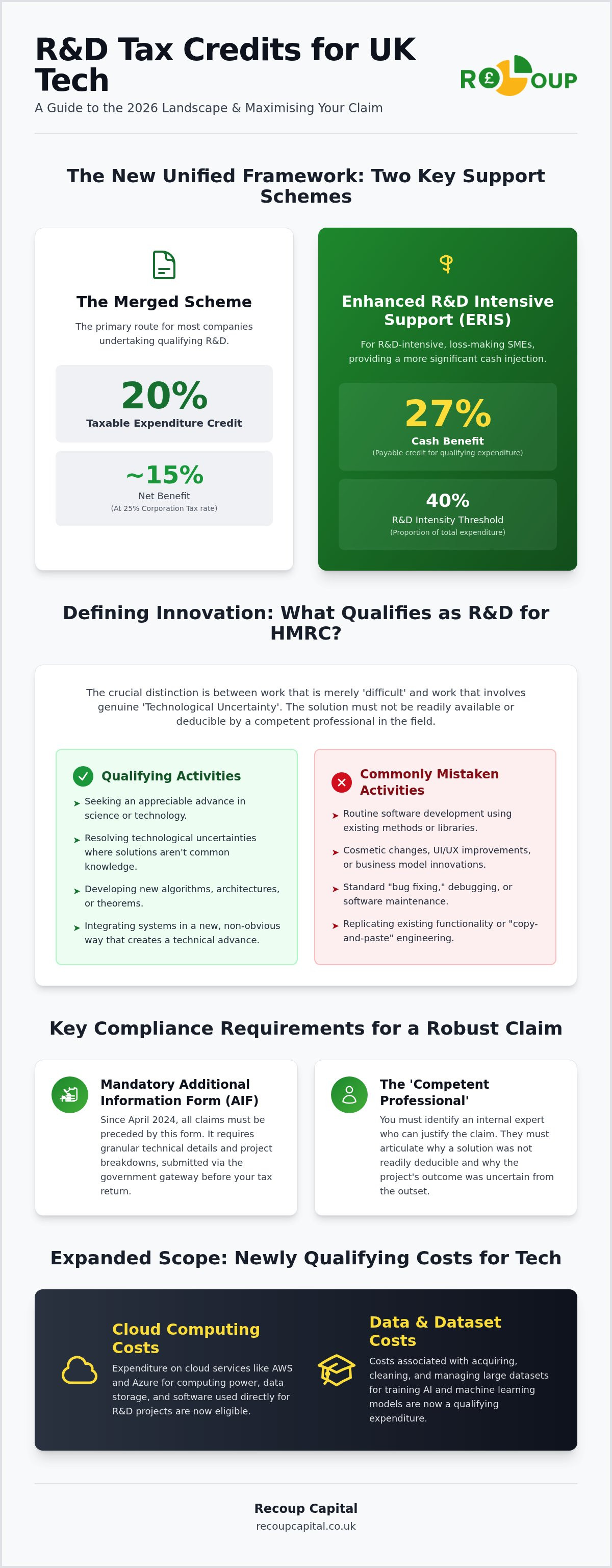
We'll break down the specific criteria for the 20% Merged Scheme and the 27% cash benefit available via Enhanced R&D Intensive Support (ERIS). You'll discover a streamlined methodology for capturing qualifying costs as they happen, ensuring your tech business stays funded and focused on building the future.
Key Takeaways
- Navigate the 2026 regulatory shift by distinguishing between the 20% Merged Scheme and the 27% benefit available via Enhanced R&D Intensive Support (ERIS).
- Identify qualifying innovation for r&d tax credits for tech companies uk by focusing on the resolution of technological uncertainties rather than routine software development.
- Build a robust technical narrative that acts as a protective shield against HMRC enquiries whilst ensuring your claim is fully compliant.
- Implement a real-time methodology for capturing R&D costs to eliminate the administrative burden and secure a vital cash injection for your dev team.
- Reframe your tax relief from a simple refund into a strategic asset that drives long-term growth and scales your innovation capacity.
Navigating the 2026 R&D Tax Landscape for UK Tech Companies
The UK's approach to innovation funding has undergone its most significant transformation in decades. For years, the system relied on a binary split between the SME scheme and RDEC. However, the 2026 landscape is defined by the Merged Scheme, a unified framework designed to streamline claims for mid-market firms while tightening the rules around what actually constitutes "innovation." Understanding the history of R&D tax credits helps clarify why these changes were necessary to maintain the UK's competitive edge. By consolidating the schemes, HMRC aims to reduce complexity, yet the burden of proof has shifted firmly onto the claimant.
Tech companies remain the primary engine of these claims. Whether it's a fintech startup or an established SaaS provider, the sector accounts for a vast proportion of successful applications. This is why securing r&d tax credits for tech companies uk is more than just a tax break; it's a vital injection of capital that fuels the next sprint. Under the Merged Scheme, companies receive a 20% taxable expenditure credit. For those paying the main rate of Corporation Tax at 25%, this results in a net benefit of 15%.
But with accessibility comes accountability. HMRC has significantly increased its focus on software development claims this year. They're no longer accepting vague descriptions of "coding" or "bug fixing." They want evidence of technical advancement. Securing r&d tax credits for tech companies uk now requires a meticulous approach to documenting technical milestones as they happen.
The Shift Toward Compliance and Transparency
Since April 2024, the Mandatory Additional Information Form (AIF) has become the cornerstone of every claim. You must now provide granular technical details before your corporation tax return is even submitted. HMRC's stance is clear: "standard" software development using existing libraries or proven methods doesn't qualify. You must identify a "Competent Professional" within your team. This individual should possess the relevant expertise to explain why a specific technical challenge was genuinely uncertain, rather than just difficult to implement. They must be prepared to justify why the solution wasn't readily deducible by another expert in the field.
Why 2026 is a Pivotal Year for Tech Innovation
This year marks a turning point because the definition of qualifying expenditure has finally caught up with modern tech stacks. Data-driven projects and cloud computing costs are now firmly within the scope of R&D relief. If your project involves training complex machine learning models or managing massive datasets for AI applications, the expenditure credit offers significant capital recovery. By aligning your development roadmap with these tax-efficient categories, you can transform your R&D claim from a retrospective exercise into a proactive financial strategy. This ensures that every pound spent on cloud infrastructure for testing counts towards your final credit.
For tech companies aiming to stay ahead of international trends in machine learning, click here to view a guide to global AI asset management conferences in 2026.
Defining Innovation: What Qualifies as R&D in the Technology Sector?
Innovation is a ubiquitous buzzword in tech boardrooms, yet for HMRC, it carries a narrow and strictly technical definition. To successfully claim r&d tax credits for tech companies uk, your project must seek an appreciable advance in science or technology. A clever new business model or a slick user interface might be commercially groundbreaking, but they don't count as R&D unless they resolve a "Technological Uncertainty." This means your team encountered a problem where the solution wasn't readily available or deducible by a competent professional working in that field.
The distinction between "difficult" and "uncertain" is where most claims are won or lost. If your developers spent months on a project simply because it was labour-intensive, that's generally considered routine copy-and-paste engineering. However, if they spent that time testing hypotheses because no established architectural pattern existed for your specific scale or latency requirements, you're likely in R&D territory. HMRC wants to see where you pushed the boundaries of what's currently possible, not just what's currently profitable.
Software Development and IT Challenges
In 2026, HMRC is looking far beyond basic API integrations or standard cloud migrations. Qualifying activities now include fine-tuning Large Language Models (LLMs) for niche industrial applications where standard weights fail to perform. It also covers developing novel encryption protocols for decentralised finance or optimising legacy monolithic codebases to run efficiently on edge computing architectures. Conversely, standard website builds using established frameworks or minor UI/UX tweaks won't qualify. The "Competent Professional" test is the benchmark here. If a peer with similar experience would find your solution obvious, it isn't R&D. If you're unsure where your project sits, a no-cost initial assessment can help clarify your eligibility.
Hardware, Engineering, and IoT Innovation
Innovation isn't restricted to the screen. Many UK tech firms are pushing boundaries in micro-electronics and sensor integration where physical constraints create significant hurdles. Overcoming heat dissipation issues in high-density IoT devices or reducing the energy footprint of data centres through novel cooling algorithms represents significant R&D. The qualifying phase ends only when the technical uncertainty is resolved, not necessarily when the product is commercially launched. Securing r&d tax credits for tech companies uk often hinges on documenting these iterative testing phases, where each prototype is designed to eliminate a specific technical unknown.
The Financials: Calculating Claim Value under the Merged Scheme and ERIS
Quantifying the value of your innovation requires a precise understanding of the two primary paths available in 2026. For most established tech firms, the Merged Scheme is the standard route. It offers a 20% gross expenditure credit, which is treated as taxable income. For a company paying the main Corporation Tax rate of 25%, this translates to a net cash benefit of 15% on every qualifying pound. If your business pays the small profits rate of 19%, that net benefit increases slightly to 16.2%. These figures represent a significant strategic asset that can be reinvested directly into your next development cycle.
However, the landscape for overseas expenditure has shifted dramatically. Under the current rules, costs for R&D conducted outside the UK are largely excluded. To qualify, the work must be UK-based, which encourages tech firms to build and retain local talent. Identifying these nuances is essential when securing r&d tax credits for tech companies uk, as HMRC now requires a clear distinction between domestic and international spend in your Additional Information Form. For firms that maintain global operations or are considering relocating staff to hubs like Lisbon, Crown Portugal provides the necessary immigration consultancy to manage these transitions effectively.
The Merged Scheme vs. ERIS: Which Applies to You?
Loss-making tech startups may find a more lucrative lifeline through Enhanced R&D Intensive Support (ERIS). To qualify, your business must meet the "R&D Intensity" threshold, meaning your qualifying R&D expenditure must be at least 30% of your total expenditure for the period. If you meet this criteria, you can claim a payable tax credit of 14.5% on your surrenderable losses, resulting in a total cash benefit of up to 27%. This is particularly valuable for pre-revenue companies where cash flow is the primary driver of growth. Calculating this ratio can be complex if you're part of a larger group, as you must account for the total expenditure across all connected entities.
Identifying Every Qualifying Pound
Maximising your claim involves looking beyond the obvious salary costs of your lead developers. You should apportion the time of QA testers, project managers, and even CTOs, provided their work directly supports the resolution of technical uncertainty. The 2026 rules also include cloud computing and data costs, which is a major win for big data and AI-heavy projects. If you're paying for server instances specifically for testing or training models, those costs are now eligible. For smaller, founder-led firms, be mindful of the "PAYE Cap," which limits the payable credit to £20,000 plus three times the company's total relevant PAYE and NIC liabilities. You can find more detail on these specific limits in our guide to r&d tax credits explained.
Compliance and Documentation: Preparing Your Tech Claim for HMRC Scrutiny
In the current 2026 climate, your spreadsheet of costs is secondary to your technical story. HMRC has moved away from simply checking the numbers; they're now deeply invested in the "how" and "why" of your development process. A successful claim for r&d tax credits for tech companies uk relies on a technical narrative that clearly demonstrates an advance in the field. If your report reads like a marketing brochure or a list of standard features, it's likely to trigger an enquiry. You must bridge the gap between complex code-level challenges and the statutory requirements for tax relief.
The anatomy of a robust tech report follows a specific logic: define the baseline of existing technology, identify the specific uncertainty you faced, detail the work undertaken to resolve it, and state the outcome. This structured approach provides the transparency HMRC demands. Many firms struggle with the administrative burden of documenting these phases months after the work is done. By implementing real-time tracking, you can capture these insights whilst the technical challenges are still fresh in the minds of your developers.
Building Your Technical Narrative
Describing code-level hurdles requires a delicate balance. You need enough detail to prove the challenge was non-trivial, but not so much that you overwhelm the inspector with irrelevant syntax. Focus on architectural decisions, data bottlenecks, or integration failures. In fact, documenting failed iterations is one of the strongest proofs of R&D. If a project worked perfectly the first time, there was likely no technical uncertainty. For a deeper look at how to frame these arguments, you can explore our guide to R&D tax credits explained, which breaks down narrative frameworks for software teams.
Surviving an HMRC Enquiry
The 2026 enquiry landscape is more rigorous than ever. HMRC is increasingly asking for contemporaneous evidence to back up the narrative. This includes JIRA tickets, Git commit histories, and even photos of whiteboard sessions. They want to see the "messy" middle of the development cycle. If you're faced with a challenge, having a specialist consultant acts as a protective guide. We defend your claim by speaking the language of both tax law and technology, ensuring your innovation is recognised and protected. If you're concerned about your current documentation levels, you can start a no-cost assessment to identify any gaps before you submit.
Strategic Reinvestment: How Recoup Capital Maximises Your Innovation Funding
Securing r&d tax credits for tech companies uk shouldn't be viewed as a one-off administrative task. We reframe these financial returns as strategic assets that drive your long-term roadmap. Whilst generalist accountants might capture the obvious costs, our team of chartered tax accountants and technical specialists looks deeper into your tech stack to identify missed opportunities. Whether it's complex system integrations or the hidden R&D involved in maintaining legacy software at scale, we ensure no qualifying expenditure is left on the table. We also look at how these credits integrate with other reliefs, such as the Patent Box, to create a comprehensive tax strategy that protects your margins.
This holistic approach transforms a simple refund into a powerful tool for corporate finance. By identifying every qualifying pound, we provide the liquidity necessary to sustain high-pressure development cycles without diluting equity. Our role is to act as your protective guide, ensuring that every claim is both maximised for value and fortified against HMRC scrutiny.
A Partnership Built on Results
Our end-to-end process is designed to be as low-friction as possible. We handle everything from the initial technical discovery sessions to the final HMRC liaison. This allows your dev team to stay focused on shipping code whilst we build the robust technical narrative required for compliance. Because we operate on a success-based fee structure, our goals are perfectly aligned with your business growth. We only succeed when you secure the capital your innovation deserves. You can explore why claim with a specialist partner to see how we transform tax compliance into a proactive growth strategy.
Fueling the Next Phase of Growth
The capital recovered through r&d tax credits for tech companies uk can be a catalyst for significant corporate milestones. We've seen clients use these cash injections for debt restructuring, providing the liquidity needed to clean up a balance sheet before a major move. Others use the funds as a war chest for acquisition funding, allowing them to buy out smaller competitors or niche IP. Beyond the immediate cash flow, a track record of successful, compliant R&D claims significantly improves your valuation during future investment rounds. It demonstrates to investors that your innovation is both technically sound and fiscally optimised. For a strategic review of your innovation pipeline, you can contact Recoup Capital to discuss how our corporate finance expertise can support your next phase of expansion.
Transforming Innovation into a Strategic Asset
The 2026 landscape for r&d tax credits for tech companies uk has evolved into a rigorous test of technical documentation and transparency. Success now hinges on your ability to articulate technical uncertainty whilst maintaining a meticulous audit trail. By moving beyond simple accounting and embracing a robust methodology for capturing costs, you turn a complex regulatory requirement into a powerful engine for reinvestment and long-term growth.
Our team of specialist Chartered Tax Accountants acts as your protective guide, identifying the qualifying work in your tech stack that generalists often miss. We operate on a success-based fee model, ensuring our expertise is accessible and focused entirely on your bottom line. It's about more than just processing a claim; it's about building a partnership that supports your vision for the future of UK technology.
Book your free, no-obligation R&D assessment with Recoup Capital today and discover how we can help you secure the maximum relief you're entitled to. Let's ensure your next breakthrough is fully funded and audit-ready.
Frequently Asked Questions
Do software startups qualify for R&D tax credits if they are loss-making?
Yes, loss-making software startups can absolutely qualify for r&d tax credits for tech companies uk. Under the 2026 ERIS framework, eligible companies can receive a payable tax credit of 14.5% on their surrenderable losses. This often results in a cash benefit of up to 27% of the qualifying expenditure. It's a vital lifeline for pre-revenue firms that are investing heavily in technical breakthroughs before they've reached commercial profitability.
Can we claim for R&D if our tech project eventually failed?
You can definitely claim for projects that didn't reach commercial success. HMRC views technical failure as strong evidence that a genuine technological uncertainty existed. If the solution was easy to achieve, there wouldn't have been a risk of failure. Documenting your failed iterations and the reasons why a specific technical approach didn't work is often the most persuasive part of a robust R&D narrative for software teams.
What is the "R&D Intensive" threshold for tech companies in 2026?
The R&D Intensive threshold is currently set at 30% for accounting periods starting on or after 1 April 2024. To qualify for the enhanced ERIS rates, your qualifying R&D expenditure must make up at least 30% of your total relevant expenditure. This calculation includes any connected group companies. It's designed to provide extra support to high-growth tech firms where innovation is the primary driver of their overall spending.
How far back can a UK tech company claim R&D tax credits?
UK tech companies can typically submit retrospective claims for their two most recently completed accounting periods. This means if you haven't claimed before, you might be able to recover costs from up to two years ago. It's a significant opportunity to secure a retrospective cash injection. We recommend reviewing your previous development cycles to ensure no qualifying r&d tax credits for tech companies uk were overlooked during those periods.
Can we claim for developers based outside the UK under the 2026 rules?
Under the 2026 rules, expenditure on overseas subcontractors and externally provided workers is largely excluded. HMRC now requires the R&D activity to take place within the UK to qualify for relief. There are very limited exceptions for unavoidable geographical or environmental factors, but standard software development conducted abroad generally won't make the cut. This shift emphasizes the importance of building and maintaining your core engineering team on British soil.
Is standard web development or app design eligible for R&D relief?
Standard web development or routine app design rarely qualifies for R&D tax relief. Using established frameworks, libraries, or APIs to build a functional product is considered routine work by HMRC. To qualify, your project must seek an advance in the underlying technology itself. This might involve creating a novel algorithm, solving a complex data latency issue, or building a unique integration that hasn't been achieved before in your specific technical context.
How long does it take for HMRC to process a tech R&D claim?
HMRC generally aims to process R&D tax credit claims within 28 to 40 days of submission. However, this timeline can vary depending on the complexity of your claim and the current volume of applications. It's also important to account for the time needed to prepare your Additional Information Form (AIF). Ensuring your technical narrative is audit-ready from the start is the best way to prevent delays or follow-up questions from tax inspectors.
What happens if HMRC decides to enquire into our tech R&D claim?
If HMRC opens an enquiry, they'll ask for more detailed evidence regarding your technical uncertainties and qualifying costs. This isn't necessarily a sign of wrongdoing, but it does require a professional response. They'll examine your Competent Professional's justifications and look for contemporaneous proof like Git logs or JIRA tickets. Having a specialist partner to defend your claim during this process ensures your technical arguments are presented with the necessary authority.


