

What if the project costs currently straining your balance sheet are actually the hidden keys to your firm’s survival? Many directors find themselves trapped between mounting HMRC liabilities and the persistent drain of retention payments. It’s a precarious position where cash flow gaps feel impossible to bridge. When uk construction companies financial distress becomes a daily reality, the fear of losing Gross Payment Status under CIS often looms large, threatening the very core of your operations.
You aren't alone in feeling that the traditional routes to recovery are narrowing. We believe that financial pressure is frequently a symptom of unrecognised capital assets rather than a lack of operational skill. This article promises to help you identify the critical early warning signs of distress whilst showing you how to leverage untapped tax incentives to stabilise your firm. We will explore how R&D tax credits and Capital Allowances can be transformed into strategic assets; providing the immediate liquidity needed to protect your business from administration and secure a prosperous path through 2026.
Key Takeaways
- Learn to distinguish between "significant" and "critical" distress to accurately assess your firm's recovery timeline in the current market.
- Identify the six primary factors contributing to uk construction companies financial distress, including the hidden risks of over-reliance on asset finance.
- Understand the vital importance of protecting your CIS Gross Payment Status and how to prevent HMRC reviews from triggering a liquidity crisis.
- Discover how to unlock immediate cash by reframing R&D Tax Credits and Capital Allowances as strategic assets for debt restructuring.
- Explore how a success-based consultancy model can integrate corporate finance and tax recovery to stabilise your business without upfront costs.
The Current Landscape of UK Construction Companies Financial Distress
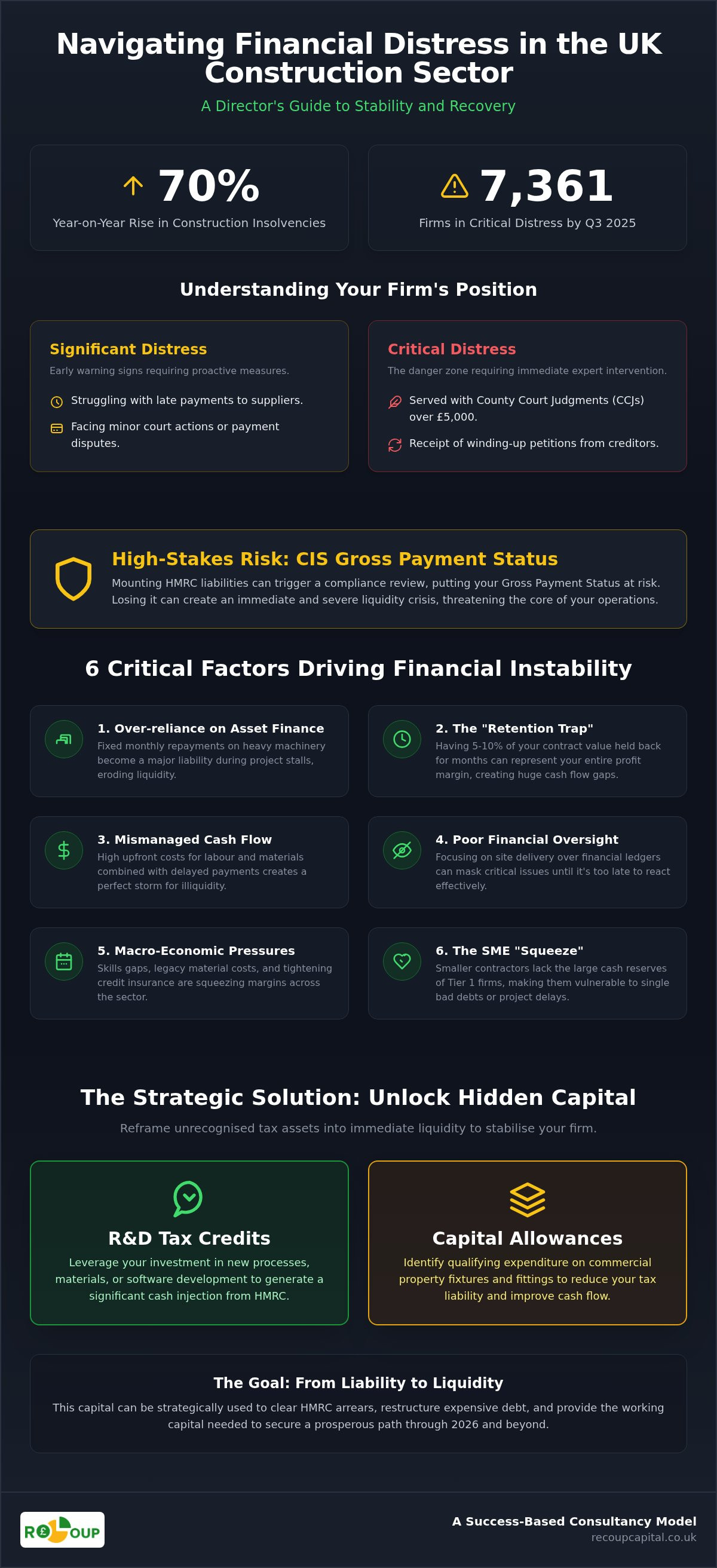
2026 has arrived with a sobering reality for the building sector. Recent data indicates a 70% year-on-year rise in insolvencies, a trend that shows little sign of slowing. By Q3 2025, reports highlighted that 7,361 firms had reached a state of critical distress. This isn't just a statistic; it's a loud warning for every director. Understanding the nuances of uk construction companies financial distress is now a prerequisite for survival in an increasingly volatile market.
Distinguishing between "significant" and "critical" distress is vital for choosing the right recovery strategy. Significant distress often involves firms struggling with late payments to suppliers or facing minor court actions. Critical distress is the danger zone. It's typically marked by County Court Judgments (CCJs) exceeding £5,000 or the arrival of winding-up petitions. Specialised design firms and domestic building subsectors are currently bearing the brunt of these pressures, often lacking the diversified portfolios of larger contractors.
Proactive screening using "Red Flag" alerts helps identify deteriorating financial ratios before they become terminal. Monitoring liquidity ratios, interest cover, and debt-to-equity levels provides a much clearer picture of institutional health than a simple bank balance. For many, these alerts serve as the final opportunity to restructure or seek expert advice before a formal insolvency process becomes unavoidable.
Macro-Economic Pressures on the Building Sector
The UK construction industry overview reveals a sector facing a perfect storm of external challenges. Persistent skills gaps have driven up labour costs, directly squeezing project margins on every site. Whilst material costs have stabilised compared to previous peaks, the legacy of soaring prices has eroded the profitability of long-term, fixed-price contracts signed years ago. Simultaneously, the tightening of credit insurance has restricted the flow of capital through the supply chain. This makes it harder for firms to secure the materials they need on favourable terms, further straining already thin cash reserves.
The SME "Squeeze" in 2026
Smaller contractors often operate much closer to the wire than Tier 1 players. They lack the massive cash reserves needed to weather significant project delays or disputes. When a major project stalls, the impact on turnover and retained profits is often immediate and devastating. SME directors must remain vigilant; a single bad debt or a delayed retention payment can push a stable business into a spiral of uk construction companies financial distress. Financial distress in the UK construction sector is currently defined by a volatile combination of high-interest debt, shrinking margins, and an unprecedented rate of formal insolvency filings. Improving site efficiency is one way to combat this; for example, you can learn more about DovRepairs and how their restoration services help avoid the high cost of replacement.
6 Critical Factors Driving Financial Instability
Identifying the root causes of uk construction companies financial distress is the first step toward a strategic recovery. It's rarely a single event that topples a firm; instead, it's usually a cumulative effect of several structural weaknesses. One of the most prevalent issues is an over-reliance on asset finance for heavy machinery and vehicles. Whilst leasing provides access to modern equipment, the fixed monthly repayments become a significant burden during a recent construction downturn. If projects stall or site access is delayed, these liabilities remain, rapidly eroding any remaining liquidity.
The "Retention Trap" remains another systemic threat to stability. Having 5% or 10% of your contract value held back for 12 to 24 months often represents your entire profit margin. This effectively means you're funding the client's project with your own working capital. When multiple projects reach this stage simultaneously, the resulting cash flow gap can be impossible to bridge without external intervention. Poor financial oversight often masks these issues until they become critical, as directors focus on site delivery rather than the underlying ledger.
Mismanaged Cash Flow: The Industry Killer
Construction operates on a high-risk model defined by high upfront costs and delayed payments. You pay for labour and materials weeks or months before the first valuation is cleared. This creates a "perfect storm" where even a profitable firm can run out of cash. Accurate payroll and supplier cost monitoring are not just administrative tasks; they're survival skills. Using forensic accounting to spot liquidity gaps before they widen allows you to take corrective action, such as exploring corporate finance options to restructure debt and inject fresh capital into the business.
Regulatory and Compliance Burdens
The landscape of 2026 is defined by the heavy costs of the Building Safety Act and evolving green standards. These aren't just technical hurdles; they're financial ones. Meeting these requirements often involves significant administrative weight and specialised consultancy fees that weren't factored into older tenders. However, there's a strategic silver lining here. When you're forced to innovate new processes or materials to meet evolving building safety standards, these regulatory hurdles can be reframed as qualifying activities for R&D tax relief, turning a compliance burden into a strategic asset. Managing these factors effectively is the only way to reverse the trend of uk construction companies financial distress and secure your firm's future.
The CIS Gross Payment Status: A High-Stakes Risk
Gross Payment Status (GPS) is the lifeblood of cash flow for any subcontractor. It allows you to receive payments from contractors in full, without the standard 20% Construction Industry Scheme (CIS) deduction at source. When margins are already squeezed by rising costs, receiving 100% of your invoice value is often the only thing keeping your firm operational. Managing the risk of losing this status is essential for avoiding terminal uk construction companies financial distress.
HMRC regularly reviews the compliance of GPS holders. These reviews are often triggered by late tax filings or outstanding liabilities. If your firm is struggling, even a minor delay in paying VAT or PAYE can lead to a sudden withdrawal of your status. The impact is catastrophic. A 20% deduction on your gross turnover, which includes material costs and labour, can effectively wipe out your entire working capital in a single month. It's a high-stakes mechanism that frequently turns a temporary cash flow gap into an insolvency event.
Negotiating with HMRC requires a proactive approach. If you anticipate a compliance failure, you must communicate early. Proposing a formal Time to Pay (TTP) arrangement can sometimes protect your status, provided you can demonstrate a viable path to recovery. Protecting this status isn't just about tax; it's about preserving the liquidity required to stay on site.
Compliance as a Survival Strategy
Common errors in CIS returns, such as failing to verify new subcontractors or miscalculating deductions, are red flags for HMRC. These administrative slips suggest a lack of internal control, often leading to wider enquiries. Timely filings are a non-negotiable part of business viability. Engaging specialist tax advisory services can provide the necessary oversight to manage HMRC relations effectively. They act as a protective guide, ensuring your compliance record remains clean whilst you focus on project delivery.
Mitigating the 20% Deduction Impact
If GPS is withdrawn, you must act immediately to fill the resulting liquidity hole. Transparency with your lead contractors and stakeholders is vital to maintain trust and prevent project removals. You'll need to explore alternative funding options to bridge the 20% gap. Seeking Corporate Finance Advisory during this period can help you restructure debt or secure bridge financing. This strategic intervention is often the only way to sustain operations whilst you work to reinstate your status or appeal an HMRC decision. Addressing these risks head-on is a critical component of navigating uk construction companies financial distress in 2026.
Unlocking Hidden Capital: R&D and Capital Allowances
Whilst the statistics on uk construction companies financial distress are daunting, they often overlook the significant capital sitting dormant on your own balance sheet. Many directors view tax solely as a liability to be managed; however, for the innovative firm, it's a strategic asset waiting to be deployed. By identifying unrecognised incentives, you can inject non-dilutive liquidity back into your operations without the need for expensive external borrowing. This capital recovery is often the turning point for businesses that feel they've exhausted their traditional credit options.
Reframing these tax refunds as strategic assets allows you to approach debt restructuring with a much stronger hand. Instead of solely relying on high-interest asset finance, you can use these lump-sum recoveries to clear pressing liabilities or settle outstanding HMRC arrears. This proactive approach is a powerful tool for reversing uk construction companies financial distress and rebuilding the institutional stability required to win new tenders in 2026.
R&D Tax Credits in Construction
Innovation in construction isn't limited to laboratories; it happens on-site every day. Whether you're developing modular building techniques, solving bespoke structural engineering challenges, or integrating advanced sustainability features to meet green standards, these activities likely qualify. You can claim R&D tax credits even if the specific project failed to reach its technical objective, as the attempt to overcome uncertainty is what HMRC rewards. Depending on the specific scheme and your firm's tax position, you can typically recover between 18% and 33% of qualifying project expenditure. If your firm deals with contaminated sites, Land Remediation Relief offers a further 150% tax deduction for the costs of cleaning up the ground, turning a costly environmental obligation into a vital funding source.
Capital Allowances on Commercial Property
Property assets often hold "embedded" capital that standard accounting frequently misses. Identifying hidden savings in HVAC systems, lighting, and security installations requires a specialist eye that goes beyond basic bookkeeping. Forensic surveyors play a vital role in maximising capital allowance claims by uncovering qualifying fixtures within commercial buildings that were previously overlooked. These allowances don't just reduce your future Corporation Tax; they can trigger significant rebates of tax already paid, providing a much-needed boost to your immediate cash flow. This immediate injection of liquidity can be the difference between continuing a project and facing a formal insolvency process.
If you suspect your firm is sitting on unclaimed capital, assess your eligibility today to secure the liquidity your business needs to thrive.
Strategic Turnaround with Recoup Capital
Moving from a state of constant firefighting to long-term financial resilience requires more than just temporary cost-cutting; it often involves a forensic look at operational spending. For instance, Expense To Profit helps organisations assess and reduce non-labour expenses to facilitate business growth even in challenging periods. It demands a fundamental shift in how you view your firm’s relationship with the tax system. For directors managing uk construction companies financial distress, the primary barrier to recovery is often the lack of liquid capital to fund a restructure. This is why our "Success-Based" fee model is a cornerstone of our partnership approach. By removing upfront cost barriers, we ensure that specialized financial consultancy is accessible when you need it most, aligning our success directly with your firm’s recovery.
We don't simply process paperwork. Instead, we integrate corporate finance advisory with deep tax recovery expertise to facilitate a holistic turnaround. This dual approach allows us to identify immediate cash injections through R&D or Capital Allowances whilst simultaneously advising on debt restructuring and institutional stability. Reframing these financial returns as strategic assets gives you the breathing space to negotiate with creditors and secure your site operations for the years ahead.
A Partnership-Oriented Approach
General accountants provide an essential service, but they frequently miss the specialized construction tax incentives that require forensic surveying and technical engineering knowledge. Our team consists of chartered tax accountants and forensic surveyors who understand the complexities of the building sector. We act as a protective guide through HMRC procedures, ensuring your claims are robust and fully compliant. In one instance, a firm facing significant uk construction companies financial distress was able to clear its HMRC arrears entirely by uncovering three years of unclaimed R&D expenditure related to bespoke structural engineering challenges. This wasn't just a refund; it was a lifeline that prevented administration.
Taking the First Step Toward Recovery
Recovery begins with a clear understanding of your current position and your untapped potential. We offer a no-cost introductory assessment to identify which capital recovery mechanisms are most suitable for your specific circumstances. During this health check, we review your project history and financial technicalities to build a viable recovery roadmap. To prepare for this assessment, you'll simply need to provide an overview of recent project challenges and your current tax filings. It’s a low-friction process designed to demonstrate value through results rather than traditional sales pitches. If you're ready to move beyond distress and start innovating again, secure your business future with a no-cost capital recovery review today.
Securing Your Firm's Future in a Volatile Market
Navigating the complexities of the current building sector requires a shift from reactive firefighting to proactive capital management. We've explored how identifying the early warning signs of uk construction companies financial distress and protecting your CIS Gross Payment Status are vital for maintaining liquidity. By reframing R&D tax credits and Capital Allowances as strategic assets, you can unlock the non-dilutive funding necessary to restructure debt and stabilise your operations.
Our specialist team of chartered tax accountants and forensic surveyors is dedicated to your long-term success. We operate on a success-based fee structure, ensuring that our interests are perfectly aligned with your recovery goals. This results-driven approach removes the financial barriers to expert consultancy when you need it most. You don't have to face these regulatory landscapes alone; we're here to act as your protective guide. Book your no-cost capital recovery assessment with Recoup Capital to discover the hidden strength in your balance sheet. Let's work together to transform these challenges into a foundation for innovation and growth.
Frequently Asked Questions
How do I know if my construction company is in critical financial distress?
Your firm is likely in critical distress if it faces County Court Judgments exceeding £5,000 or the threat of winding-up petitions. These are clear signals that your debt obligations have become unmanageable. Monitoring these specific indicators is essential for identifying uk construction companies financial distress early. Acting at this stage allows for strategic restructuring before formal insolvency proceedings begin to compromise your company's long-term viability.
Can a company in financial distress still claim R&D tax credits?
Yes, you can still claim R&D tax credits as long as your firm is a going concern and hasn't entered formal liquidation. These credits act as a non-dilutive funding source that can be used to restructure debt or clear outstanding HMRC liabilities. Reframing your innovation as a strategic asset provides an immediate cash injection, which is often the turning point for a successful recovery.
What happens if we lose our Gross Payment Status (GPS) under CIS?
Losing GPS triggers a mandatory 20% tax deduction from your gross turnover at source, which effectively removes your profit margin and working capital. This deduction applies to the entire payment, including the cost of materials you've already paid for. Such a significant loss of liquidity often accelerates uk construction companies financial distress, making it nearly impossible to meet weekly payroll or supplier obligations.
How long does it typically take to receive an R&D tax credit payment from HMRC?
HMRC currently aims to process most construction R&D claims within 40 to 60 days, though complex cases may take longer. In 2026, ensuring your technical documentation is forensic and precise is the best way to avoid delays. Working with a specialist team helps streamline the process, ensuring that the much-needed capital reaches your bank account as quickly as possible to support your recovery.
Are Capital Allowances only for new building projects or existing properties too?
Capital Allowances are available for both new builds and the purchase or refurbishment of existing commercial properties. You can claim for embedded fixtures such as air conditioning, lifts, and fire safety systems that are often overlooked in standard accounting. A forensic surveyor can identify these qualifying assets in older buildings, often resulting in substantial tax rebates and a reduction in future Corporation Tax.
What is the difference between debt restructuring and corporate finance advisory?
Debt restructuring involves renegotiating terms with creditors to manage immediate liabilities, whilst corporate finance advisory focuses on the overall health of your capital structure. Advisory services identify new ways to inject liquidity, such as through tax incentives or asset refinancing. This holistic approach ensures you aren't just surviving day-to-day but are building a resilient financial framework for future growth and project delivery.
Is Land Remediation Relief available for developers working on derelict sites?
Land Remediation Relief is specifically designed for developers and companies cleaning up contaminated or derelict sites for commercial use. It offers a 150% tax deduction on qualifying costs, such as removing hazardous waste or treating natural contaminants like radon. This incentive is a powerful tool for improving project margins on difficult sites, turning an environmental liability into a significant financial asset for your business.
How can a success-based fee model help a company with limited cash flow?
A success-based fee model ensures that you don't pay any consultancy costs until your tax relief or funding has been successfully secured. This removes the risk of adding further pressure to your cash flow during a difficult period. It allows you to benefit from expert chartered tax accountants and forensic surveyors without the burden of upfront fees, creating a partnership focused entirely on results.


