

In 2026, the difference between a successful construction r&d tax relief claim and a costly HMRC inquiry isn't just about doing something new; it's about proving the technical uncertainty you overcame. You're likely already pushing boundaries on site, whether you're developing bespoke modular components or engineering around unforeseen ground conditions. Yet, the pressure on cash flow in today's high-cost market makes the fear of a tax credit clawback feel like a risk you can't afford to take. It's frustrating when genuine innovation is dismissed as "standard practice" by those who don't understand the technical complexities of your build.
We understand that you need more than just a refund; you need a strategic asset that supports your firm's growth without inviting regulatory scrutiny. This guide will show you exactly how to identify qualifying activities and build a technical narrative that meets HMRC's evolving standards. We'll explore the specific uncertainties that lead to successful claims and how a robust, evidence-based approach protects your business whilst maximising your capital recovery. By the end, you'll have a clear roadmap to securing the relief your innovation deserves.
Key Takeaways
- Understand the 2026 regulatory landscape and how to correctly navigate the mandatory Additional Information Form (AIF) to ensure your claim is HMRC-compliant from the outset.
- Learn to distinguish between technical and commercial uncertainty to accurately identify qualifying construction r&d tax relief activities that go beyond standard industry practice.
- Discover the "Technical Uncertainty" test and why proving what a competent professional could not easily solve is the foundation of a robust claim.
- Identify the full scope of eligible expenditure, including staff costs, consumables, and subcontractors, to ensure you are capturing the maximum value of your innovation.
- Explore how a technical-first, success-based partnership model can protect your firm from the risk of clawbacks whilst providing a strategic asset for future growth.
The State of Construction R&D Tax Relief in 2026
Construction r&d tax relief isn't a grant; it's a powerful fiscal tool. It rewards UK firms for overcoming technical hurdles that standard methods simply cannot solve. Despite the industry's reputation for traditional methods, it's actually a hotbed for genuine innovation. Many firms don't realise that solving a bespoke structural challenge or developing a new onsite safety system qualifies as research and development. In this sector, innovation often happens in the mud and the rain, not just in a laboratory.
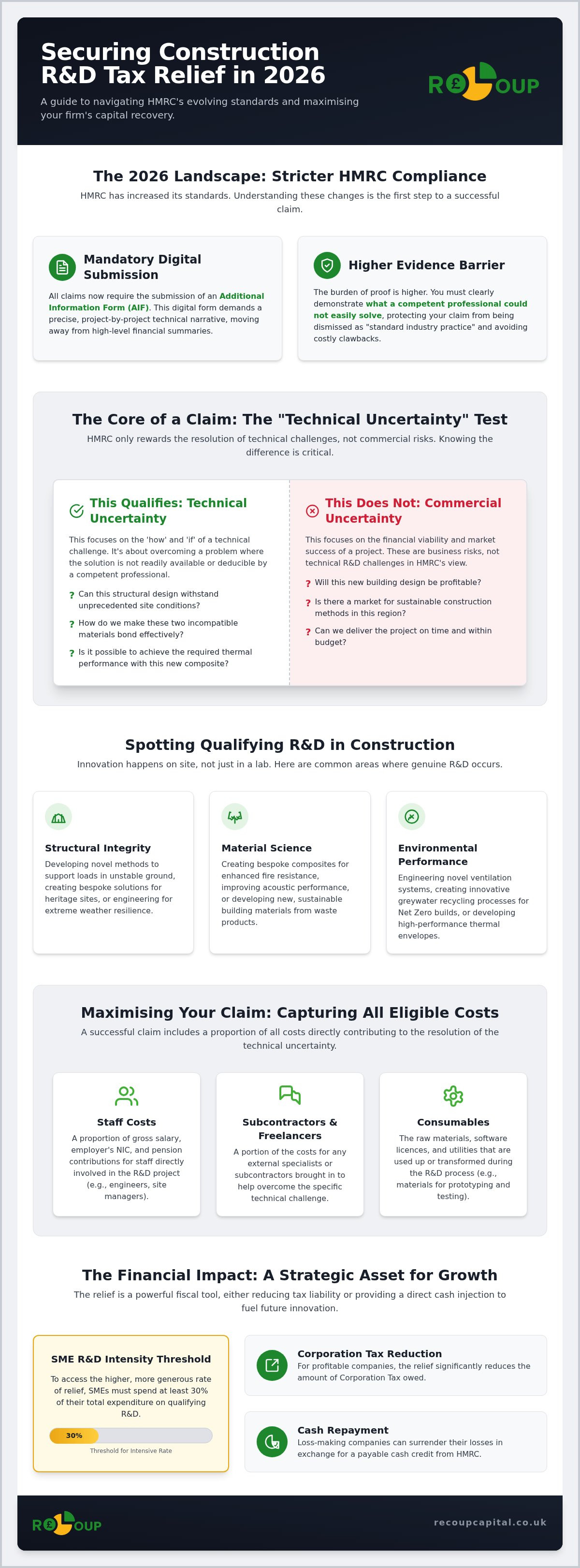
The 2026 landscape is defined by increased transparency and rigorous standards. HMRC now requires the Additional Information Form (AIF) for every claim submitted. This digital disclosure demands a precise technical narrative. You can't just submit high-level figures anymore. You must prove exactly where the technical uncertainty existed and how your competent professionals worked to resolve it. This shift makes it essential to distinguish between standard construction practice and qualifying innovation from the very start of a project.
Why 2026 is a Pivotal Year for Building Innovation
The Financial Impact: Credits vs. Deductions
The benefit usually comes in two forms: a reduction in your Corporation Tax liability or a cash repayment. For SMEs in 2026, the R&D intensity threshold remains a critical metric; companies must spend at least 30% of their total expenditure on qualifying R&D to access the higher intensive rate of relief. Understanding how R&D tax credits explained by specialists can help you reinvest that capital is vital for long-term planning. These funds shouldn't be viewed as a simple refund. They are strategic assets that can be funnelled back into the next project's innovation phase, creating a sustainable cycle of growth and technical advancement.
Identifying Qualifying R&D Activities in Building and Engineering
Determining what counts as construction r&d tax relief starts with the "Technical Uncertainty" test. If your lead engineers or site managers encounter a problem that a competent professional cannot easily solve using standard industry knowledge, you've likely found qualifying R&D. It's about the gap between the current state of knowledge and the technical goal you're trying to reach. This isn't simple trial and error. It's a systematic process of investigation and resolution.
You must distinguish between commercial and technical uncertainty. Commercial uncertainty asks "Is there a market for this?" or "Will this project be profitable?". HMRC doesn't care about those answers. Technical uncertainty asks "Can this be done?" or "How do we make these two incompatible materials bond under extreme pressure?". If the answer isn't in a manual, it's R&D. Even if the project ultimately fails, the attempt to resolve that technical challenge still qualifies for relief. Failure is often the strongest proof that a genuine technical uncertainty existed.
- Structural integrity: Developing new ways to support loads in unstable ground or heritage sites.
- Material science: Creating bespoke composites for better fire resistance or acoustic performance.
- Environmental performance: Engineering novel ventilation systems or greywater recycling for Net Zero builds.
Structural Engineering and Material Science
Innovation often involves using existing materials in completely untested environments. For example, developing modular systems for highly constrained urban sites requires solving unique logistical and structural puzzles. You might need to engineer bespoke cladding solutions that meet new safety standards whilst maintaining aesthetic goals. This process usually involves intensive prototyping and pilot testing during the construction phase. If you're unsure if your specific site challenges qualify, it's worth seeing why claim with a specialist partner to uncover hidden value in your technical narrative.
Digital Construction: BIM, AI, and Automation
Digital tools are no longer just for administration. Developing bespoke software to manage complex site workflows or creating 4D BIM models that simulate structural stresses in real-time can represent a significant technical advance. Integrating IoT sensors for long-term structural health monitoring involves resolving complex data and hardware compatibility issues. Automated fabrication techniques also represent a technical advance by pushing the boundaries of precision and material efficiency beyond standard manual methods. These digital advancements are frequently overlooked because firms view them as internal IT costs rather than R&D.
Navigating HMRC Compliance: Avoiding the 'Clawback' Trap
The rise of aggressive, "pop-up" advisors has created a climate of fear within the industry. These entities often promise high returns without the technical rigour required for a compliant construction r&d tax relief claim. This has led to a significant "Compliance Gap", where firms find themselves unable to defend their claims during an HMRC audit. It's not enough to simply list costs; you must prove the technical merit of the work through a lens of genuine innovation. If a claim lacks this foundation, the risk of a clawback becomes a very real threat to your business's stability.
Relying on generalist accountants can be a significant risk in this high-scrutiny environment. Whilst they are excellent for standard tax returns, they often lack the engineering background to spot technical uncertainties or articulate them in the specific language HMRC expects. This is where R&D tax specialists become essential partners. They bridge the gap between the building site and the tax office, ensuring that every project is assessed by someone who understands both the structural challenges and the latest regulatory requirements.
The Importance of the Technical Narrative
Your claim must establish a clear "baseline" of technology. This means documenting what was already possible or available within the industry before your project started. From there, you must articulate the "step change", which is the specific technical advance your team achieved. HMRC needs to see the names and qualifications of the competent professionals who led the work. It's their expertise that proves the problem wasn't easily solvable by a standard practitioner. Without this narrative, even the most innovative work can look like standard practice on paper.
Evidence and Documentation Standards
HMRC expects to see more than just a summary of hours spent. They look for project plans, meeting minutes, and testing results that were created whilst the project was active. Real-time record keeping is the best defence against a future inquiry. At Recoup Capital, we use a forensic approach to document every phase of your innovation. We help you organise your internal data into a robust evidence pack that speaks directly to HMRC's standards. This proactive stance ensures your claim is built on a foundation of facts, protecting your capital and transforming your relief into a secure strategic asset.
Maximising Your Claim: Eligible Costs and Documentation
Capturing the full value of your claim requires a meticulous breakdown of qualifying expenditure. It's not just about the big figures; it's about the technical nuances of how your capital was deployed. The primary categories for construction r&d tax relief include your internal staff, subcontractors, and consumables. You can also include software licences and the specific portion of power, water, or fuel used during the R&D phase. However, the rules around "subsidised R&D" are particularly relevant for construction. If a client is paying you to solve a specific technical problem, the way your contract is structured can significantly impact your ability to claim under the SME scheme. This often requires a detailed review of your master service agreements to ensure the technical risk remains with your firm.
Apportioning Staff Time and Subcontractor Costs
Accuracy is the foundation of a robust claim. You must calculate the exact percentage of time your technical team spent on R&D versus standard site duties. A common mistake is over-claiming for project management time; HMRC expects to see time allocated to technical lead roles rather than general administrative oversight. For unconnected subcontractors, the 65% rule usually applies, allowing you to include a significant portion of their invoice in your calculation. Externally Provided Workers (EPWs) are treated differently. These are individuals provided by a staff agency who work under your direction. Because they aren't your direct employees, the rules for inclusion are stricter, and failing to document this relationship correctly is a frequent trigger for HMRC inquiries.
Consumables and Wasted Materials
You can claim for materials that are "consumed or transformed" during the R&D process. This includes prototypes that are destroyed during testing or materials used in a trial that didn't make it into the final build. It's a common misconception that all building materials qualify; if they form part of the final, sellable structure, they are generally excluded. However, there are instances where Land Remediation Relief can overlap with R&D, particularly when developing novel ways to treat contaminated soil. If you're struggling to untangle these complex cost categories, you can request a technical assessment with our chartered accountants to ensure no eligible cost is overlooked. This holistic approach ensures your claim is both maximised and fully compliant.
Partnering for Success: Why Construction Firms Choose Recoup Capital
Securing construction r&d tax relief shouldn't be a source of stress or regulatory anxiety. At Recoup Capital, we've developed a technical-first methodology that treats your innovation as a strategic asset rather than just a line item on a tax return. Our approach is rooted in compliance, led by in-house chartered tax accountants and technical specialists who understand the structural realities of the building site. We act as a protective guide through the complexities of HMRC's requirements, managing the entire liaison process so you can focus on your next build. This partnership-oriented style ensures that your technical narrative is robust enough to withstand the highest levels of scrutiny.
We believe in demonstrating value through results, which is why we operate on a success-based fee model. This removes the upfront financial risk for your business, aligning our goals directly with your success. Our expertise also extends beyond R&D. For property owners and developers, our dual-expertise in Capital Allowances allows us to build a holistic tax strategy that captures every available incentive. By looking at your projects through multiple lenses, we ensure no capital is left on the table, transforming your financial returns into fuel for future growth.
A Relationship-First Approach to Innovation
We don't view claims as one-off transactions. Instead, we aim for long-term collaboration that evolves with your business. Our team works to identify hidden opportunities amongst your existing project portfolio that you might have dismissed as standard practice. This starts with a time-limited, no-cost introductory assessment. It's a low-barrier way to explore your potential without any commitment. We'll review your technical challenges and provide a clear, evidence-based outlook on your qualification, helping you move from uncertainty to a position of financial strength.
Our Track Record in the Construction Sector
Our reputation is built on a solid track record of success in the engineering and building sectors. We've frequently helped firms understand why claim even after they were told by generalist advisors that their work did not qualify. Because our chartered tax accountants review every submission, we maintain an exceptional standard of accuracy that protects your business from the "clawback" traps mentioned earlier. If you're ready to secure a compliant, maximised return on your innovation, we invite you to book a bespoke technical consultation. Let's turn your technical uncertainties into a reliable source of capital recovery.
Transforming Technical Challenges into Strategic Capital
In 2026, the landscape for construction r&d tax relief demands more than just a list of expenses; it requires a meticulous technical narrative backed by forensic evidence. You've seen how identifying genuine technical uncertainty and accurately apportioning costs like subcontractor time and consumables can transform your site challenges into a strategic business asset. By focusing on the technical uncertainty test, you protect your firm from the risk of HMRC inquiries whilst ensuring your innovation is fully rewarded.
Our specialist construction technical team and chartered tax accountants are here to act as your protective guide through these regulatory complexities. We operate on a success-based fee model, ensuring our interests are perfectly aligned with your capital recovery goals. Don't let your pioneering work go unrecognised or leave your business vulnerable to compliance gaps. Book your no-obligation construction R&D assessment with Recoup Capital today to secure the relief your innovation deserves. We're ready to help you build a stronger, more resilient future for your firm.
Frequently Asked Questions
Can I claim R&D tax relief for modular construction projects?
Yes, you can claim for modular construction if the project involves resolving technical uncertainties. This might include developing bespoke connection systems or engineering components to withstand specific environmental stresses. Standard assembly of pre-existing modular units won't qualify. You must demonstrate that the design or manufacturing process required a technical advance that wasn't readily achievable by a competent professional in the field.
What happens if HMRC opens an inquiry into my construction R&D claim?
If HMRC opens an inquiry, you must provide the evidence and technical narrative supporting your claim. This is why contemporaneous record-keeping is vital. HMRC will scrutinise the Additional Information Form (AIF) to ensure the technical uncertainty is clearly defined. Having a specialist partner to manage this liaison is crucial. They'll handle the technical defence, ensuring your construction r&d tax relief remains secure and compliant.
Is it possible to claim R&D relief and Land Remediation Relief on the same project?
It's entirely possible to claim both incentives on the same project, provided you don't double-count the same expenditure. For instance, you might claim Land Remediation Relief for removing asbestos and R&D relief for developing a novel, untested method to stabilise the ground afterwards. A holistic tax strategy ensures you maximise both streams of capital recovery without breaching HMRC's strict anti-avoidance rules.
How far back can a construction company claim for R&D tax credits?
You can generally claim for the two previous accounting periods. This means you have up to two years from the end of the accounting period in which the R&D expenditure was incurred to submit your claim. It's best to act quickly; missing these deadlines means losing out on significant capital. Regular reviews of your project portfolio help ensure no qualifying innovation is overlooked.
Do I need to be a loss-making company to benefit from R&D tax relief?
No, both profitable and loss-making companies can benefit from the scheme. Profitable firms usually receive a reduction in their Corporation Tax liability, which improves overall cash flow. Loss-making companies have the option to surrender their losses for a payable cash credit. In 2026, the specific benefit depends on your company's R&D intensity and whether you qualify under the enhanced SME intensive scheme.
What is the difference between a "competent professional" and a project manager in HMRC’s eyes?
A competent professional is an individual with the specific technical expertise, qualifications, and experience to identify a technical uncertainty. In contrast, a project manager often focuses on timelines, budgets, and administrative oversight. HMRC requires the technical narrative to be led by the competent professional's perspective. Their ability to explain why a solution wasn't obvious is the foundation of a successful construction r&d tax relief claim.
How long does it typically take to receive a payment from HMRC for an R&D claim?
HMRC typically aims to process SME claims within 28 to 40 days of submission. However, increased scrutiny in 2026 means that claims requiring additional checks or those with complex technical narratives may take longer. Ensuring your Additional Information Form is complete and accurate from the start is the most effective way to avoid delays and secure your payment as quickly as possible.
Can I claim for R&D if my project was a technical failure?
Yes, technical failure is often one of the strongest indicators of qualifying R&D. The scheme rewards the attempt to resolve a technical uncertainty, regardless of whether the final goal was achieved. If your team spent time and resources trying to develop a new material or structural system that ultimately didn't work, those costs are still eligible. It proves the solution wasn't easily discoverable.


