

Did you know that HMRC recently conducted compliance checks on approximately 17% of all R&D tax relief claims? This represents nearly 10,000 UK businesses facing intense scrutiny over their innovation records in a single year. It's a sobering figure that highlights just how rigorous the Revenue has become in its pursuit of accuracy and documentation.
We understand that receiving a compliance letter can feel like a sudden weight on your shoulders. The fear of financial penalties and the administrative burden of lengthy correspondence are enough to distract any leadership team from their core mission. You've worked hard to push the boundaries of your industry, and you shouldn't have to worry that a simple technicality might jeopardise your capital recovery.
This guide empowers you to navigate these evolving requirements with total confidence. You'll learn to identify and avoid the common mistakes in R&D tax credit claims that often trigger an enquiry. We'll break down the latest 2026 regulations, from the merged RDEC scheme to the mandatory use of AI-assisted review tools by HMRC. By the end, you'll have a clear roadmap to ensure your innovation claims remain robust, accurate, and fully protected for the long term.
Key Takeaways
- Understand the transition from a 'trust but verify' model to a scrutiny-led environment, ensuring your business is prepared for HMRC’s intensified 2026 compliance standards.
- Identify the most frequent triggers for enquiries, such as financial anomalies and sector-specific risks, to avoid the common mistakes in R&D tax credit claims that lead to unnecessary stress.
- Learn why a technical specialist is essential for crafting a robust narrative that bridges the gap between scientific innovation and tax legislation.
- Gain a clear, step-by-step framework for responding to HMRC enquiry letters, including how to meet the strict 30-day deadline with accuracy and poise.
- Discover how to future-proof your submissions by moving beyond simple paperwork toward a results-driven, protective strategy that treats financial returns as strategic assets.
Understanding the Landscape of HMRC R&D Compliance Checks
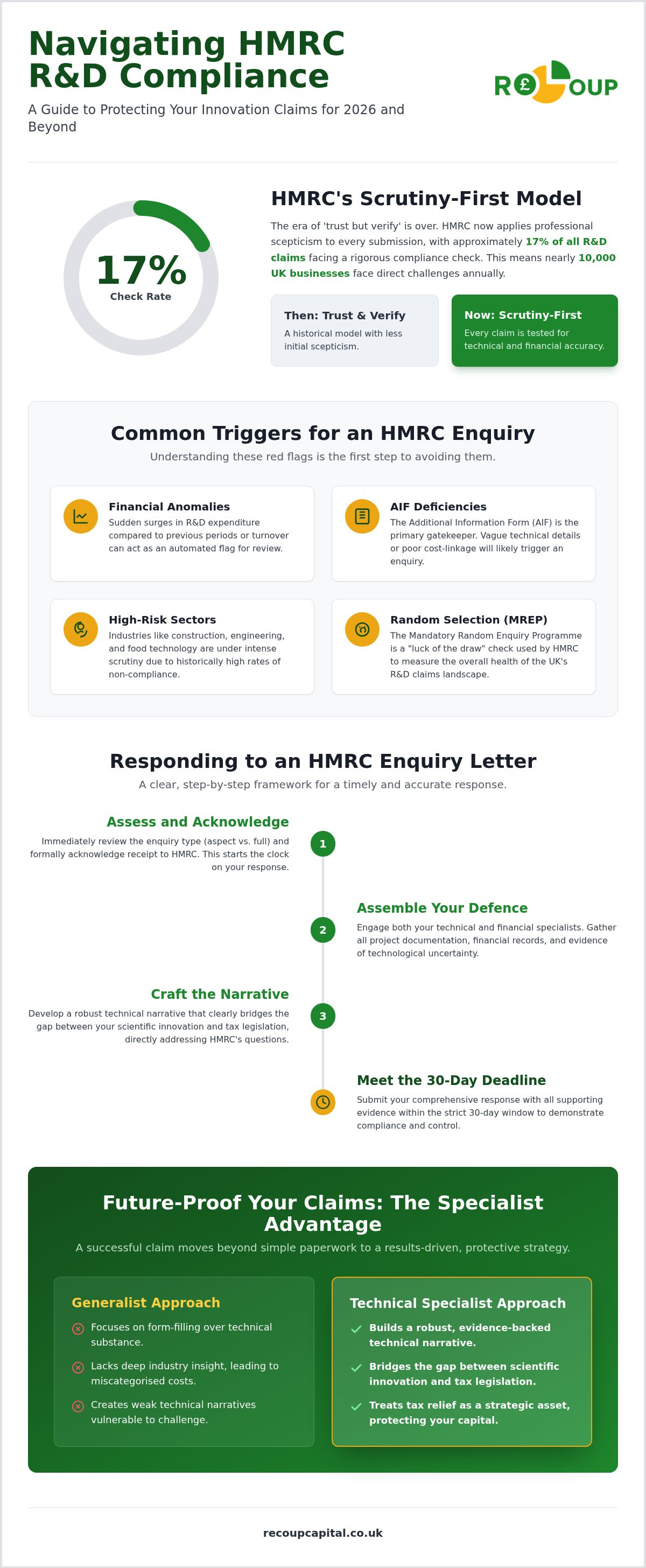
HMRC has fundamentally repositioned its approach to innovation relief. The era of 'trust but verify' has been replaced by a scrutiny-first model where every submission is treated with professional scepticism. In 2026, a compliance check isn't merely a request for more information; it's a rigorous test of your technical narrative and financial methodology. HMRC currently maintains a compliance check rate of approximately 17%, meaning nearly one in five claims faces a direct challenge during the 2023/24 tax year cycle.
The Additional Information Form (AIF) acts as the primary gatekeeper for every submission. If this digital form lacks sufficient technical detail or fails to link costs directly to scientific advances, it likely triggers an enquiry. These range from aspect enquiries, which target specific costs like software or staffing, to full compliance reviews that dissect every project in the claim. Understanding the R&D tax incentive framework is essential, but being able to defend your interpretation of it under pressure is what protects your capital.
The Rise of the Volume Approach
HMRC's Incentives & Reliefs units have expanded significantly, moving R&D oversight into the Wealthy & Mid-sized Business Compliance (WMBC) team. This isn't just about human caseworkers. The Revenue now uses sophisticated AI tools like 'Co-Pilot' and an 'R&D Summariser' to automatically flag anomalies during the CT600 filing process. The 2024 merger of the SME and RDEC schemes has streamlined the rules, but it's also raised the bar for documentation. Many businesses stumble into common mistakes in R&D tax credit claims by failing to update their internal record-keeping to match these heightened 2026 standards. Accuracy whilst filing is no longer optional; it's the only way to ensure your claim is processed within the standard 40-day target.
Why Compliance Matters for Innovation
We believe tax relief should be treated as a strategic asset, not just a cash refund. A successful, unchallenged claim builds a history of reliability with HMRC. On the other hand, a rejected claim can 'brown-mark' your company, potentially triggering enquiries into other areas of your tax affairs for years to come. Maintaining forensic project records doesn't just protect your current claim; it also strengthens your wider corporate finance strategy. When your innovation is backed by robust documentation, it provides tangible evidence of value to potential investors and increases the overall transparency of your business operations. Robust compliance is the foundation of long-term innovation growth.
Common Triggers for HMRC R&D Scrutiny
HMRC's risk-profiling software is highly sensitive to financial volatility. A sudden surge in R&D expenditure compared to previous accounting periods often acts as an automated red flag. While business growth is a positive metric, the Revenue wants to ensure these figures represent genuine technical activity rather than inflated labour costs or miscategorised overheads. They look for consistency between your payroll data, turnover, and the scale of the innovation you're claiming for.
Certain sectors now face significantly heightened attention. Industries like construction, engineering, and food technology are under the microscope because HMRC has identified high rates of non-compliance in these specific areas. If you're operating in these fields, simply "improving a product" isn't enough to qualify. Your submission must strictly adhere to the Official HMRC guidance to withstand a potential challenge. Caseworkers are increasingly looking for evidence that you've moved beyond standard industry practice to solve a specific technological uncertainty.
The Mandatory Random Enquiry Programme (MREP)
Sometimes, a check has nothing to do with your claim's quality. The MREP is a "luck of the draw" initiative where HMRC selects claims purely at random to measure the overall health of the UK's innovation landscape. These checks provide the Revenue with essential data on the prevalence of error and fraud across different industries. While a random enquiry can be stressful, it shouldn't be feared if your documentation is in order. Having a robust technical narrative ready at all times ensures you can justify your position quickly and return to your core operations without delay.
Technical Narrative Red Flags
One of the most common mistakes in R&D tax credit claims is relying on vague, marketing-led language. Phrases like "bespoke solution" or "innovative platform" mean very little to a technical caseworker without specific proof of a scientific or technological uncertainty. You must define the technological baseline clearly. HMRC needs to know what the industry's standard state of knowledge was before your project began. If you can't prove that your solution wasn't readily deducible by a competent professional, the claim will likely be rejected.
Subcontractor costs are another frequent pain point. HMRC often identifies claims where routine services are mislabelled as qualifying R&D. If you can't distinguish between a contractor providing a standard service and one contributing to a genuine technical breakthrough, your claim is at risk. It's often beneficial to assess your project eligibility with a specialist who understands these nuances before you submit. This proactive step helps you identify and rectify potential red flags before they ever reach an inspector's desk.
The Technical Narrative: Specialist vs Generalist Approaches
Generalist accountants are indispensable for day-to-day fiscal management, yet they often lack the technical depth required to defend a claim against an engineer-led HMRC enquiry. One of the common mistakes in R&D tax credit claims is treating the technical report as a secondary appendix rather than the heart of the submission. Whilst a generalist might focus on the final balance sheet, a specialist dives into the specific technical hurdles your team faced. This distinction is vital because HMRC's caseworkers now include technical experts who look specifically for scientific or technological advances, not just business improvements.
Success requires a forensic level of evidence. You can't simply state that a project was difficult; you must prove it through staff timesheets, project commit logs, and prototype iterations. According to HMRC's official compliance approach, documentation must be contemporaneous. This means records should be created at the time the work was performed, rather than reconstructed months later. To ensure your evidence meets these standards, it's helpful to learn more about the R&D tax credits process and how to structure your internal data from the outset.
Defining Scientific or Technological Uncertainty
Articulating uncertainty is an art form that satisfies inspectors by showing where the industry's standard knowledge ended and your innovation began. In sectors like construction, this might involve resolving structural challenges in contaminated land remediation projects where standard piling techniques failed. In food technology, it could be the development of novel chemical compositions to extend shelf life without compromising texture. These aren't just "better products"; they're solutions to problems that a competent professional in the field couldn't solve without a period of experimentation and testing.
The Role of Forensic Accounting
The days of using a flat "20% of time" estimate for staff cost allocation are over. HMRC now expects a granular breakdown of how every pound was spent. Specialist consultants identify qualifying indirect activities (QIAs), such as technical administration or maintenance of R&D equipment, which generalists often overlook. There's also a significant synergy between innovation claims and Capital Allowances for commercial property. By surveying your physical assets alongside your technical projects, you can often unlock additional capital that a standard tax return would miss. This dual approach ensures no qualifying expenditure is left on the table whilst maintaining a robust, enquiry-proof position.
How to Respond to an HMRC R&D Enquiry Letter
Receiving an enquiry letter from HMRC can be a jarring experience for any business owner. It's vital to stay calm and act with precision. You typically have a strict 30-day window to provide a comprehensive response. This deadline is non-negotiable. Use this time to meticulously review your original submission against the specific queries HMRC has raised. Many businesses find that common mistakes in R&D tax credit claims, such as vague project boundaries or poorly documented staff costs, become apparent only under this level of scrutiny. Reviewing your filing against the original Additional Information Form (AIF) is the first step in building a robust defence.
Once you've identified the focus of the enquiry, gather every shred of supplementary evidence. This goes beyond simple receipts. You need contemporaneous records like technical drawings, testing logs, and even internal emails that document the failures and iterations of your project. Proving that a project failed is often as valuable as proving it succeeded, as it demonstrates genuine technological uncertainty. If you're feeling overwhelmed by the technical requirements, now is the time to engage a specialist. A partner who understands the nuances of HMRC liaison can protect your interests and ensure your response is both accurate and persuasive.
Analysing the Enquiry Letter
Decoding the language in an HMRC letter is essential. Are they simply asking for clarification, or are they suggesting a "careless" or "deliberate" inaccuracy? The difference is massive. Clarification requests are often routine, but suggestions of negligence can lead to significant financial penalties. If you disagree with HMRC's final decision, you have the right to request a Statutory Review by an officer not previously involved in the case. Should a resolution still prove elusive, the Tax Tribunal offers a formal path to challenge the Revenue's position and protect your innovation assets.
Preparing for a Meeting with HMRC
If HMRC requests a meeting, identifying your "Competent Professional" is the most critical step. This person should be the technical lead who lived through the project's uncertainties. Their role is to demonstrate technical leadership by explaining the hurdles faced without getting lost in impenetrable industry jargon. They must be able to articulate why the solution wasn't readily deducible to a competent professional in the field. You can see our FAQs on HMRC enquiries for more detail on what to expect during these discussions.
If you've received a letter and need immediate support, speak with our technical specialists to help manage your correspondence and safeguard your claim.
Future-Proofing Your Claims with Recoup Capital
Recoup Capital operates on a simple principle: your innovation deserves protection. We don't just process paperwork; we act as a proactive partner in your long-term growth. Our success-based fee model ensures our interests are perfectly aligned with yours. If we don't deliver results, there is no cost to your business. This approach removes the financial risk of exploring potential claims whilst ensuring every submission is handled with forensic precision. By taking over the end-to-end liaison with HMRC, we allow your leadership team to remain focused on driving technical breakthroughs.
Identifying common mistakes in R&D tax credit claims is only half the battle; the real value lies in building a submission that prevents those errors from occurring in the first place. We help you move beyond reactive claiming toward a strategy of long-term capital recovery. This involves setting up robust internal systems that capture data in real-time, making future compliance checks a routine formality rather than a source of stress. Our goal is to transform your tax relief from a yearly administrative task into a predictable, strategic asset.
Our Protective Guide Philosophy
We act as a protective guide through the complexities of UK tax legislation. By pairing chartered tax accountants with industry-specific technical experts, we bridge the gap between financial compliance and scientific reality. This dual perspective is particularly vital in challenging sectors like construction and engineering, where the line between standard practice and genuine innovation is often thin. We've successfully defended numerous claims in these fields by translating complex site activities into the precise technical language HMRC inspectors expect to see.
Your Next Steps for a Compliant Claim
The best time to secure your claim is before you submit it. We offer a no-cost introductory assessment to identify potential risks in your current processes and highlight opportunities for capital recovery you might have missed. This isn't a traditional sales pitch; it's a demonstration of value. We'll show you how to reframe your tax returns as strategic assets that can be reinvested directly into your next project. If you're ready to ensure your innovation is fully protected, we invite you to explore Why choose Recoup Capital for your R&D claim? and see how our partnership-led approach can support your business goals.
Don't let the fear of an enquiry stifle your ambition. With the right technical support, you can submit every claim with the confidence that it is robust, accurate, and ready for any level of scrutiny. Let's work together to protect the future of your innovation.
Protecting Your Innovation Assets for the Long Term
HMRC's shift toward a scrutiny-first model means that robust documentation is no longer optional. It's the foundation of every successful submission. By moving away from generalist estimates and focusing on a technical, evidence-led narrative, you protect your business from the stress of lengthy compliance checks. You've seen how identifying common mistakes in R&D tax credit claims early can save your team from the 30-day pressure of an enquiry letter.
Our team of chartered tax accountants and technical specialists, with deep expertise in the construction and engineering sectors, acts as your protective guide through these regulatory complexities. We believe that your financial returns should be treated as strategic assets for future growth. Because we operate on a success-based fee model, our goals are always aligned with your bottom line. This partnership ensures your technical breakthroughs receive the professional defence they deserve.
It's time to transform your approach to capital recovery. You can secure your innovation with a specialist R&D compliance review from Recoup Capital today. Let's work together to ensure your hard-earned innovation remains fully protected and ready to fund your next breakthrough.
Frequently Asked Questions
What is the most common reason for an HMRC R&D compliance check?
HMRC usually initiates a check because of financial anomalies or vague technical descriptions. If your R&D expenditure spikes suddenly without a corresponding change in payroll or turnover, it often triggers an automated red flag. Additionally, failing to define a specific technological uncertainty in your Additional Information Form (AIF) suggests a lack of scientific rigour. Providing granular detail from the start is the most effective way to satisfy the Revenue’s scrutiny-first model.
How long does an HMRC R&D enquiry typically last?
An enquiry can last anywhere from three to nine months, depending on the complexity of the technical challenges raised. While HMRC aims to process claims within 40 days, a formal compliance check requires a deeper dive into your project records. Delays are often caused by incomplete initial responses or a lack of contemporaneous evidence. Providing a comprehensive, specialist-led reply at the first opportunity is the best way to reach a swift resolution.
Can HMRC issue penalties for an incorrect R&D claim even if it was an honest mistake?
Yes, HMRC can issue penalties for inaccuracies even if they believe you didn't intend to mislead them. They often categorise errors as "careless" if they feel you haven't taken reasonable care in your submission. These penalties can reach up to 30% of the potential tax lost. Avoiding common mistakes in R&D tax credit claims through a specialist review ensures you meet the necessary standards of care and protects your business from unnecessary financial hits.
What documents should I keep to prove my R&D activities are genuine?
You should keep a detailed trail of contemporaneous evidence, including staff timesheets, project logs, and technical drawings. HMRC values records created at the time of the work, such as testing results or prototypes that demonstrate failure. Internal emails discussing technical hurdles and meeting minutes are also vital for proving technological uncertainty. These records provide a transparent view of your innovation, making it much easier to defend your claim if the Revenue requests more detail.
Is it possible to appeal an HMRC decision on an R&D tax credit claim?
You have the right to appeal if you disagree with a decision made by an HMRC officer. The process typically begins with a Statutory Review, where an independent officer not previously involved in your case examines the facts. If this doesn't resolve the dispute, you can take your case to a Tax Tribunal. Having a specialist who understands both tax law and technical innovation ensures your appeal is built on a solid, authoritative foundation.
How far back can HMRC go when checking previous R&D claims?
HMRC typically looks back at the previous four years if they suspect a careless error has occurred. However, if they have reason to believe an inaccuracy was deliberate, this window can extend to 20 years. For most businesses, compliance checks focus on the most recent accounting period. Maintaining robust, forensic records for every claim you submit ensures you're always prepared to justify your historical innovation expenditure, regardless of how far back the Revenue chooses to look.
Does receiving a compliance check mean I am being investigated for fraud?
No, a compliance check is a routine part of the tax system and doesn't imply you're being investigated for fraud. Most enquiries are simply requests for more information to verify that the technical work meets the qualifying criteria. HMRC also conducts random checks through the Mandatory Random Enquiry Programme (MREP) to monitor the health of the UK's innovation landscape. While the process is rigorous, it's designed to ensure accuracy rather than to uncover criminal behaviour.
Will a specialist R&D consultant help me avoid future compliance checks?
A specialist consultant significantly reduces the likelihood of an enquiry by ensuring your submission is robust and accurate from day one. By identifying and eliminating common mistakes in R&D tax credit claims, they build a technical narrative that satisfies HMRC’s scrutiny-first approach. This proactive strategy includes setting up better record-keeping systems and linking every cost to a specific technical advance. Over time, this builds a history of reliability that helps protect your future innovation submissions.


