

Grant advisers may charge a fixed fee, a day rate or include a success element. Compare the fee model and work covered, not just the headline cost. Eligibility and competition rules matter too: a funding route only makes sense if your project meets its criteria and you can make a competitive application.
It’s understandable to want a clear figure before committing time to a funding application. But comparing advisers means looking beyond the fee to how it is structured, what support it covers and whether the funding opportunity fits your business. This guide explains the main pricing models, factors affecting eligibility and how competition can shape your choice. You’ll have a practical way to compare options and decide what to explore next.
Key Takeaways
- Compare adviser fees by structure and scope of work, then clarify how cancellation and payment terms fit your needs.
- Accounting-period dates and qualifying R&D costs can affect which tax-relief scheme applies, so assess eligibility separately from grant funding.
- Weigh funding opportunities against their eligibility criteria and competition, and use a consistent scorecard to compare advisers.
- Where R&D tax relief is relevant, Recoup Capital can help businesses assess and pursue a claim as a separate route from grant funding.
What should you check in an adviser’s contract, cancellation rules and payment schedule?
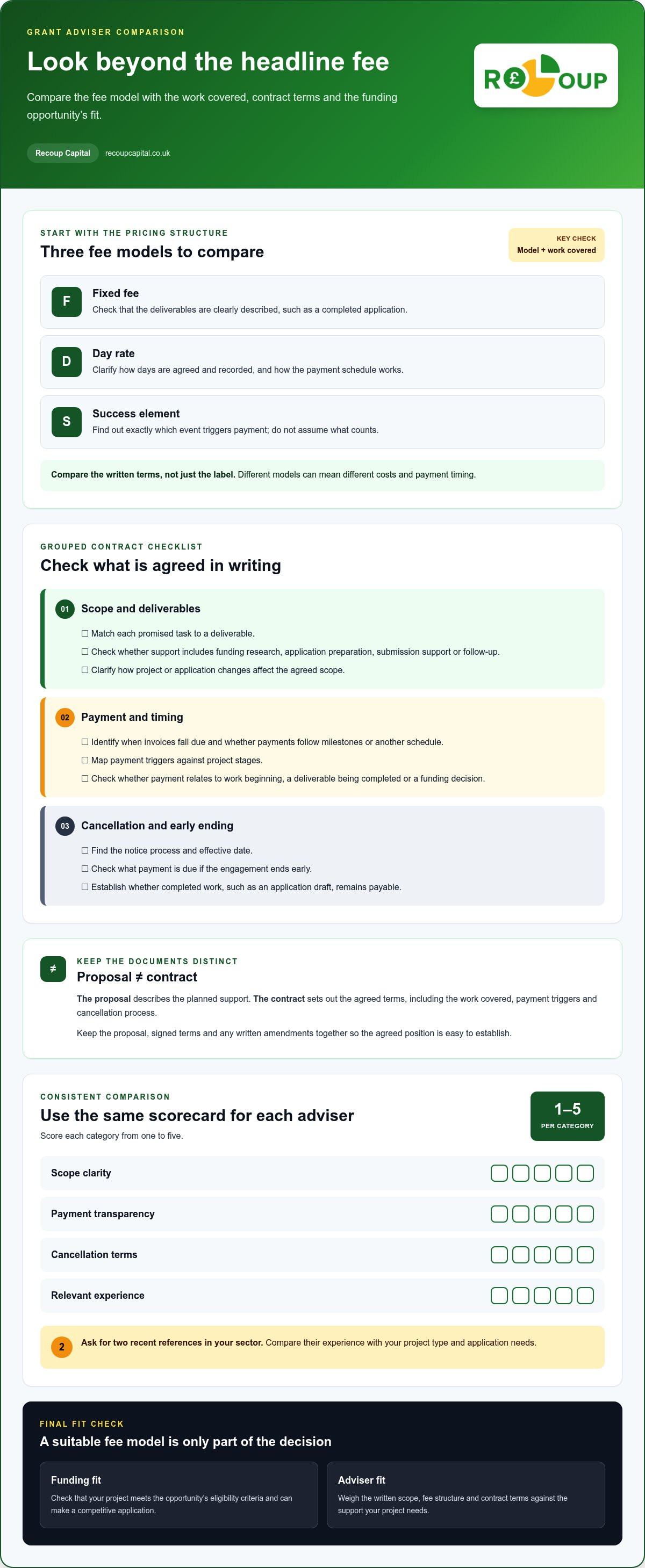
Grant advisers may charge a fixed fee, a day rate or include a success element. These models affect when costs arise and how they relate to the work. Compare each fee model alongside the written contract, rather than judging by its label alone. The contract should explain the work covered, payment triggers, cancellation process and any costs due if the engagement ends early.
Separate the proposal from the contract before comparing them. The proposal describes the planned support; the contract sets out the agreed terms. Check whether the work covers funding research, application preparation, submission support or follow-up. For example, a fixed fee needs a clear description of deliverables, while a day rate should explain how days are agreed and recorded. A success element should specify what event triggers payment.
- Scope: Match each promised task to a deliverable, such as a completed application.
- Payment: Identify when invoices fall due and whether payments follow milestones or another schedule.
- Cancellation: Find the notice process, effective date and treatment of work already completed.
- Additional work: Check how changes to the project or application affect the agreed scope.
Cancellation wording matters if a funding opportunity closes, your project changes or you decide not to proceed. Check the contract for notice requirements and any payment obligations after termination. For example, if an application has already been drafted, establish whether that completed work remains payable. Keep the proposal, signed terms and any written amendments together so the agreed position is easy to establish.
Payment timing can also affect cash flow. A fixed fee, day rate and success element can each produce a different schedule, so map the stated payment triggers against your project stages. Note whether the agreement refers to work beginning, a deliverable being completed or a funding decision. These are points to clarify in the contract, not assumptions about any particular adviser’s terms.
Use a consistent comparison rather than relying on impressions. Score each adviser from one to five for scope clarity, payment transparency, cancellation terms and relevant experience. Before appointing a funding adviser, request two recent references in your sector. Compare their experience with your project type and application needs. This gives you a practical basis for weighing contract terms alongside the proposed fee model.
Are GrantTree fees affected by recent UK R&D tax relief scheme changes?
Changes to UK R&D tax relief affect which scheme applies and how a claim is assessed. They don’t, by themselves, establish how an adviser sets fees. GrantTree pricing should be considered separately from the relief rate: the applicable scheme depends on the company’s accounting-period start date and eligibility.
For accounting periods starting on or after 1 April 2024, the merged R&D expenditure credit scheme can provide up to 16.2% of expenditure. Enhanced R&D intensive support (ERIS) can provide up to 26.97% of qualifying expenditure for eligible companies. A UK company must spend at least 30% of its total expenditure on qualifying R&D costs to qualify as R&D intensive.
- From 1 April 2024: the merged scheme rate is up to 16.2% of expenditure.
- ERIS: eligible R&D-intensive companies may receive up to 26.97% of qualifying expenditure.
- Earlier accounting periods: SME R&D Tax Relief could provide up to 33.35%, while old RDEC could provide up to 15%, for periods starting before 1 April 2024.
These rates aren’t interchangeable. For example, a company with an accounting period starting after 1 April 2024 should consider the merged scheme or ERIS, rather than applying an earlier-period rate. The R&D-intensive threshold also makes expenditure composition relevant. Establish the accounting-period start date, identify qualifying R&D costs, then assess whether the 30% test is met.
HMRC administers R&D tax relief separately from grant funding in the UK. A grant application and an R&D claim therefore involve distinct funding routes and criteria. Changes to tax-relief rules don’t automatically change grant-adviser fees. When assessing an adviser engagement, consider the work needed, such as determining eligibility, preparing evidence or supporting an application.
To understand how a proposed fee relates to the work, first identify whether it concerns a grant application or an R&D claim. Then match the accounting period to the relevant scheme and assess the qualifying costs. Finally, compare the adviser’s written scope with the work your case requires. This separates changes to potential relief from the contractual basis for paying an adviser.
Since its launch in 2000, the UK R&D Tax Relief scheme has paid over £40 billion in tax relief and cash credits across more than 500,000 claims. Historical rates also varied by period: the old UK RDEC scheme provided relief at a rate of 10.5% for costs incurred before 1 April 2023, and at 15%-16.2% for costs incurred in accounting periods starting before 1 April 2024, after 1 April 2023.
For profitable UK companies, the SME scheme provides relief ranging from 16.34% - 24.7%; for UK companies breaking even, it provides relief ranging from 8.6% - 18.85%. These rates show why a headline percentage alone cannot establish the value of a particular claim or determine an adviser’s fee. The relevant scheme and company circumstances matter when considering potential relief, while the adviser’s written scope sets out the work covered. A fee discussion should therefore focus on the tasks required for the claim and the contractual basis for payment, rather than treating a change in relief rates as an automatic change to the adviser’s charge.
Working with a grant adviser
Before comparing grant advisers, separate the funding opportunity from the adviser’s commercial model. Advisers may charge a fixed fee, a day rate or a success element. Each approach allocates payment differently, so compare the work covered and payment trigger alongside the proposal. Don’t assume one model is automatically cheaper: the total depends on the work required and the agreed terms.
A fixed fee can make the agreed scope easier to budget for, provided the deliverables are clear. With a day rate, the amount payable depends on time spent, so understand how work is planned and reported. A success element links some payment to an outcome defined in the agreement. For each proposal, note what happens if the application is unsuccessful, changes direction or needs extra work.
Funding eligibility and competition are separate tests. Eligibility asks whether the applicant, project and costs meet the scheme’s criteria. Competition asks how the application compares with other eligible bids. A business can meet the entry rules and still need a stronger case to stand out. Assess an adviser’s contribution against the actual application tasks, not a general promise of funding.
- Eligibility: Match each scheme criterion to evidence about your business, project and planned costs.
- Competition: Identify how the application will explain the project’s need, outcomes and fit with the fund’s aims.
- Scope: Connect each proposed adviser task to a clear application deliverable.
- Payment trigger: Record when each charge becomes due and how any outcome-linked element is defined.
For example, if a scheme requires evidence of a project’s expected impact, establish whether application preparation includes developing that case. If evidence gathering remains your responsibility, factor in the time your team must commit. This makes proposals easier to compare because you can see which tasks are included and which remain with your business.
Create a comparison sheet with one row for each adviser and columns for fee model, scope, eligibility assessment, competition support and payment trigger. Record the wording from each proposal rather than relying on call summaries. Then identify gaps: an unclear deliverable or undefined payment trigger makes a proposal harder to evaluate, regardless of its fee structure.
Let your funding objective guide the decision. If you need help with a competitive grant application, focus on relevant application work and clear contractual terms. If you’re comparing a grant with another form of business funding, distinguish the routes before weighing adviser costs. This keeps eligibility, competition and commercial terms in view without treating them as the same decision.
Recoup Capital: R&D Tax Credits
Recoup Capital helps limited companies assess and claim R&D Tax Credits for qualifying innovation, a separate route from grant funding. If your business has developed or improved products, processes or services, reviewing its project activities and costs can help clarify whether an R&D claim may be relevant. The key distinction is the funding route: grants involve scheme eligibility and competition, while R&D tax relief is claimed through the UK tax system.
Recoup Capital’s specialists and chartered tax accountants guide businesses through the R&D claim process, helping identify relevant work and prepare a claim. Other relevant incentives may include Capital Allowances, Land Remediation Relief and Patent Box, depending on the business activity and circumstances.
If you’re weighing grant funding against tax relief, contact Recoup Capital to discuss which route may fit your business.
Turn your funding decision into a practical next step
Use your funding and advisory cost comparison to shape a wider funding plan, not simply to choose an adviser. Consider what your business needs next: support for innovation, investment in assets or work involving previously developed land. Matching the funding route to that priority can help focus attention on the right financial questions.
Recoup Capital offers R&D Tax Credits, Capital Allowances and Land Remediation Relief. These incentives address different business activities, so start with the project or expenditure you want to understand. A focused discussion can help you consider whether one of these routes belongs alongside your funding plans.
Contact Recoup Capital for support with exploring relevant business tax incentives. A clear next step can make complex funding choices easier to approach and help you plan confidently for what comes next.


