

The right structure can protect value as much as the headline price. To decide how to structure a corporate finance deal for a tech firm, align the transaction with its funding needs, ownership goals, intellectual property and future cash flow. Options include a merger, share sale or asset sale, with deferred consideration such as an earn-out or rollover equity where appropriate.
It’s understandable to focus first on valuation, but structure determines what transfers, which liabilities remain and how much of the price depends on future performance. This guide explains how funding choices differ, how UK M&A deals are shaped, and when share or asset sales, earn-outs and rollover equity may suit a technology business. It also covers how due diligence, tax and the terms agreed between buyer and seller fit together.
Key Takeaways
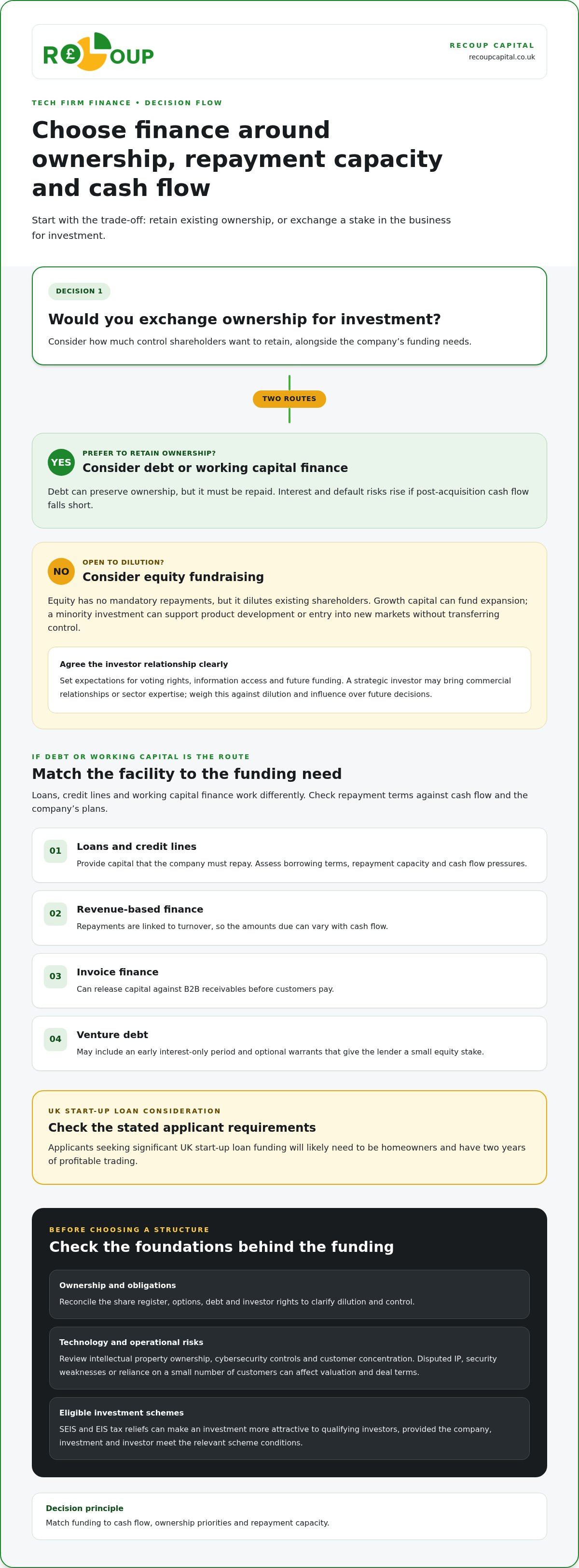
- Match funding to cash flow, ownership priorities and the company’s plans, weighing repayment commitments against potential dilution.
- Build an M&A deal around a credible valuation, clear heads of terms and focused due diligence on technology, intellectual property and liabilities.
- Use earn-outs or rollover equity to link some consideration to future performance or keep sellers invested in the business after completion.
- Compare share and asset sales by what transfers, which liabilities remain and the tax implications; HM Revenue & Customs states stamp duty on UK share transfers is payable at 0.5%.
Capital structure and funding strategies
Technology firms can combine equity, debt and working capital finance to fund development, expansion or an acquisition. How to structure a corporate finance deal for a tech firm depends on cash flow, ownership priorities and repayment capacity.
Capitalisation and financial diligence
Capitalisation and financial due diligence examine ownership, funding obligations and the reliability of a company’s financial records. Before investment or a sale, reconcile the share register, options, debt and investor rights to clarify dilution and control. Review intellectual property ownership, cybersecurity controls and customer concentration too. Disputed IP, security weaknesses or reliance on a small number of customers can affect valuation and deal terms.
Growth capital and minority investment
Growth capital funds expansion, while a minority investment gives investors a stake without transferring control. It can support product development or entry into new markets, but shareholders should agree voting rights, information access and expectations for future funding. How do UK SEIS and EIS tax reliefs affect eligible technology company fundraising? They can make an investment more attractive to qualifying investors, provided the company, investment and investor meet the relevant scheme conditions.
For a deep-tech firm, valuation can reflect its technology, intellectual property, value proposition and market potential, not just current revenue. A strategic investor may also bring commercial relationships or sector expertise. Weigh that contribution against dilution and any influence over future decisions when considering how to structure a corporate finance deal for a tech firm.
Loans, credit lines and fundraising
Loans and credit lines provide capital that the company must repay, whereas equity fundraising exchanges ownership for investment. Revenue-based finance links repayments to turnover, so amounts due can vary with cash flow. Invoice finance can release capital against B2B receivables before customers pay, while brokers such as Lending Box can help UK businesses navigate and compare suitable borrowing facilities. Venture debt may include an early interest-only period and optional warrants giving the lender a small equity stake.
Debt can preserve ownership, but interest and default risks rise if post-acquisition cash flow falls short. Equity has no mandatory repayments, though it dilutes existing shareholders. Applicants seeking significant UK start-up loan funding will likely need to be homeowners and have two years of profitable trading. A corporate finance adviser can help assess structures against growth plans and shareholder objectives.
How are M&A deals structured?
UK corporate finance fees depend on mandate scope, deal structure and work required. Legal, tax and accounting costs also reflect diligence findings. Due diligence typically takes 30 to 90 days. A private acquisition can close in two to three months; public mergers may take six to 18 months.
Advisory for buyers and sellers
Entrepreneurs, corporates and private equity investors use advisers to assess strategic fit, value and transaction risks. In deep-tech M&A, sector expertise helps identify the value of technology, intellectual property, market potential and possible synergies. An acquisition memorandum can present the target’s financials, operations, technology and market position, giving interested parties a clearer basis for discussion.
Preparing an acquisition dossier can take management time. An adviser can organise materials and coordinate due diligence, helping leaders maintain business operations. Buyers may examine ownership records, customer contracts, cybersecurity and financial forecasts, alongside the target’s assets and liabilities.
Negotiation and deal terms
A sound valuation gives shareholders a basis for negotiation and a mandate for discussions. Heads of terms then set out the proposed deal, including price, conditions, exclusivity and completion arrangements. As highlighted by boutique investment bank Versailles Group in guidance on preliminary agreements, they are largely non-binding, but clear drafting helps both parties understand what is agreed and which issues remain open.
Advisers can lead negotiations while balancing buyer and seller interests. They can also help address competition and employment requirements, and assess whether Competition and Markets Authority approval may be needed. Cross-border deals can add tax treaties, withholding taxes and transfer pricing to the workstream.
Debt advice and working with advisers
Debt advisers assess repayment capacity, borrowing terms and cash flow pressures. If existing debt threatens viability, restructuring may involve revising repayment schedules or considering how liabilities affect a sale. Connect interest costs to forecasts so financing does not undermine the transaction’s strategic purpose.
Agree responsibilities early: assign financial, legal and tax diligence to the relevant specialists, then keep decisions and documents coordinated. For support aligning transaction terms with shareholder objectives, explore corporate finance advisory.
Deferred consideration, earn-outs and rollover equity
A tech transaction can combine cash at completion with payments or investment linked to future performance. The consideration mix affects seller proceeds, buyer risk and the target’s incentives after completion.
Consideration mix and deferred payments
Deferred consideration postpones part of the purchase price, while an earn-out makes payment depend on the business’s future performance. This can help bridge a valuation gap when buyer and seller differ on growth prospects. Define the performance measure, period, reporting access and decision-making controls clearly. For a software target, an earn-out might relate to recurring revenue or customer retention, with definitions agreed before signing.
Enterprise value reflects the value of a business before accounting for its financing; equity value adjusts for items such as debt and cash. How are software and technology companies valued in UK M&A and fundraising deals? Buyers and investors assess financial performance alongside recurring revenue, growth prospects, customer concentration, intellectual property and the strength of the technology.
Private equity and rollover equity
Private equity investment provides capital in exchange for an ownership stake, often supporting expansion or a change in ownership. Rollover equity lets selling shareholders reinvest part of their proceeds into the buyer or combined business. It can keep founders aligned with future value creation, but also leaves them exposed to the new company’s performance and governance.
How should a tech firm choose between equity, venture debt, bank loans and convertible finance? Compare cash flow, repayment capacity, dilution and control: equity avoids mandatory repayments, debt preserves ownership but creates interest obligations, and convertible finance postpones the final equity valuation. Mezzanine and other structured finance can combine debt-like returns with equity-linked features, so the specific terms matter.
For each transaction, model how the consideration changes under different outcomes. A specialist can help reconcile enterprise and equity value, test earn-out measures and show how financing affects ownership after completion. Private equity investors may also negotiate governance rights that shape strategic decisions, making those provisions part of the valuation discussion, not just legal detail.
M&A deal structures: mergers, stock sales and asset sales
A merger combines businesses, while a share or asset sale transfers ownership in different ways. The choice affects what the buyer acquires, which obligations continue and how the transaction is implemented.
Mergers and share sales
A merger brings businesses together, while a share sale transfers the target company’s shares to the buyer. In a share purchase, the buyer acquires the company with its assets and liabilities rather than selecting individual items. This can preserve existing contracts, licences and operational continuity, which may matter to a technology startup that relies on customer agreements or software licences.
For shareholders, a share sale is generally treated as a capital gain, whereas an asset sale is taxed within the company and may create another charge when proceeds are extracted. The choice can affect net proceeds as well as control. Map shareholder approvals, liabilities and contracts before settling the purchase structure.
Asset purchases and asset sales
An asset purchase lets the buyer select specific assets, such as software, equipment or intellectual property, while leaving some liabilities behind. A share purchase instead transfers the entire company, including its obligations. Asset sales require careful planning for each transfer: contracts may need novation, and employees transfer under TUPE.
This distinction can shape operational continuity. A buyer acquiring selected technology assets may need separate arrangements for customer relationships, staff and operating systems. A seller should consider how the company will manage any retained debts or legal claims after the sale.
Equipment leasing and asset finance can fund servers, testing equipment or other business assets without making them part of an M&A purchase. Compare existing finance terms with the proposed transaction, since leased equipment and credit obligations may affect what transfers or needs to be settled.
Stamp duty on UK share transfers is payable at 0.5%, according to HM Revenue & Customs. For help assessing how a transaction structure fits shareholder objectives and business assets, discuss corporate finance deal structuring.
Recoup Capital: R&D Tax Credits
Recoup Capital helps technology companies assess R&D Tax Credits when they’re reviewing funding needs or preparing for a transaction. For firms investing in innovation, a well-supported claim can help identify funds to reinvest in development and growth. The team also advises on Capital Allowances, Land Remediation Relief and Patent Box, where these incentives fit a company’s activities.
Bring relevant project and financial records together early. Clear documentation can explain the technical work behind an innovation claim and support informed discussions about the company’s financial position. This can be useful during fundraising, acquisition planning or wider growth reviews, when decision-makers need a clearer view of available resources.
Contact Recoup Capital to discuss your company’s situation, or visit the Recoup Capital website.
Turn your deal strategy into a practical next step
Deciding how to structure a corporate finance deal for a tech firm is also an opportunity to examine how its tax position supports future plans. Before making a major funding or ownership decision, consider how innovation activity, qualifying assets and business premises fit into the wider financial picture. That preparation can help leadership direct capital towards the company’s strategic priorities.
Recoup Capital offers R&D Tax Credits, Capital Allowances and Land Remediation Relief. These may be relevant as a technology company reviews investment plans, considers a transaction or looks for ways to support growth. Start with your company’s priorities and the evidence behind its activities.
Ready to explore the next step for your business? Discuss your deal with Recoup Capital, and move forward with a clearer view of your options.
Frequently Asked Questions
What is corporate finance?
Corporate finance is how a business plans and manages funding, investment and financial risk. For a technology company, it can include raising capital for product development, managing working capital, financing equipment or planning an acquisition. It also helps directors assess how choices affect ownership and cash flow. The aim is to direct financial resources towards the company’s strategy while understanding the commitments involved.
What are the main stages of structuring a corporate finance deal for a UK technology company?
Start by defining the commercial objective, such as funding expansion or acquiring a software business. Then prepare financial forecasts, assess valuation and compare funding or transaction structures. Agree the proposed terms, complete financial, legal and technical due diligence, and document the final agreement. For a cross-border acquisition, consider tax and regulatory issues early, as they can influence structure and completion planning.
What financial and operational information should a tech firm prepare for due diligence?
Prepare management accounts, cash flow forecasts, revenue analysis and details of debt, funding and shareholder ownership. Operational evidence should cover product development, software architecture, intellectual property ownership, cybersecurity procedures, customer contracts and supplier dependencies. For example, a company whose revenue relies heavily on one large customer should explain that exposure and its plans to diversify. Consistent records make it easier to explain how the business operates.
What deal terms should founders negotiate, including valuation, dilution, liquidation preferences and investor rights?
Founders should assess valuation alongside the percentage of equity issued, including the effect of existing options and future fundraising. A liquidation preference sets how investors receive proceeds in a sale or winding-up before other shareholders. Check whether it is participating or non-participating, and how it interacts with other share classes. Investor rights may cover board representation, reserved decisions, information access and approval of future share issues.
What UK legal, tax and regulatory rules affect technology company financing and acquisitions?
The relevant framework depends on the deal, company structure and parties involved. UK acquisitions may need to consider the Companies Act, the Takeover Code, competition law and employment obligations; some transactions may require Competition and Markets Authority approval. Tax planning can include VAT, stamp duty and inheritance tax. Cross-border deals may also involve tax treaties, withholding taxes and transfer pricing, so map these issues against the transaction structure.
How should earn-outs, warranties, indemnities and escrow be structured in a UK tech acquisition?
Define an earn-out using measurable performance criteria, such as revenue from a specified product, and document how results are calculated and reported. Warranties are contractual statements about the company; indemnities allocate responsibility for specified losses. An escrow can hold part of the consideration to meet agreed claims. Set out claim procedures, limits, time periods and who controls decisions affecting earn-out performance to reduce ambiguity after completion.


