

A patent alone doesn’t make a UK Patent Box claim straightforward. To understand how to avoid common patent box pitfalls, first confirm that your company legally owns a qualifying patent or holds an exclusive licence to commercially utilise it. The patent must be granted by the UK Intellectual Property Office, the European Patent Office or a designated EEA nation. If development is split across a group, the Nexus fraction reflects the development activity linked to the qualifying profits.
It’s easy to focus on the patent and overlook the details around it. Ownership, licence arrangements and the connection between development work and income from patented products can all affect a claim. Clear records and a sound understanding of how the patent is described and used help bring these details into view.
This article covers four practical pitfalls, from ownership and exclusive licences to patent attorney support, clear patent descriptions and development activity. You’ll see how each issue can affect eligibility and the Nexus fraction, and how careful planning can help protect the value of a potential Patent Box claim.
Key Takeaways
- Trace who owns the qualifying patent and review any exclusive licence so the company’s right to benefit is clear.
- Use patent attorney expertise to shape a filing strategy and address the legal and technical detail involved.
- Make patent descriptions precise, consistent and detailed enough to explain how the invention works.
- Keep development activity and related records organised so the Nexus fraction reflects how the qualifying profits were generated.
1. Qualifying patent ownership and exclusive licences
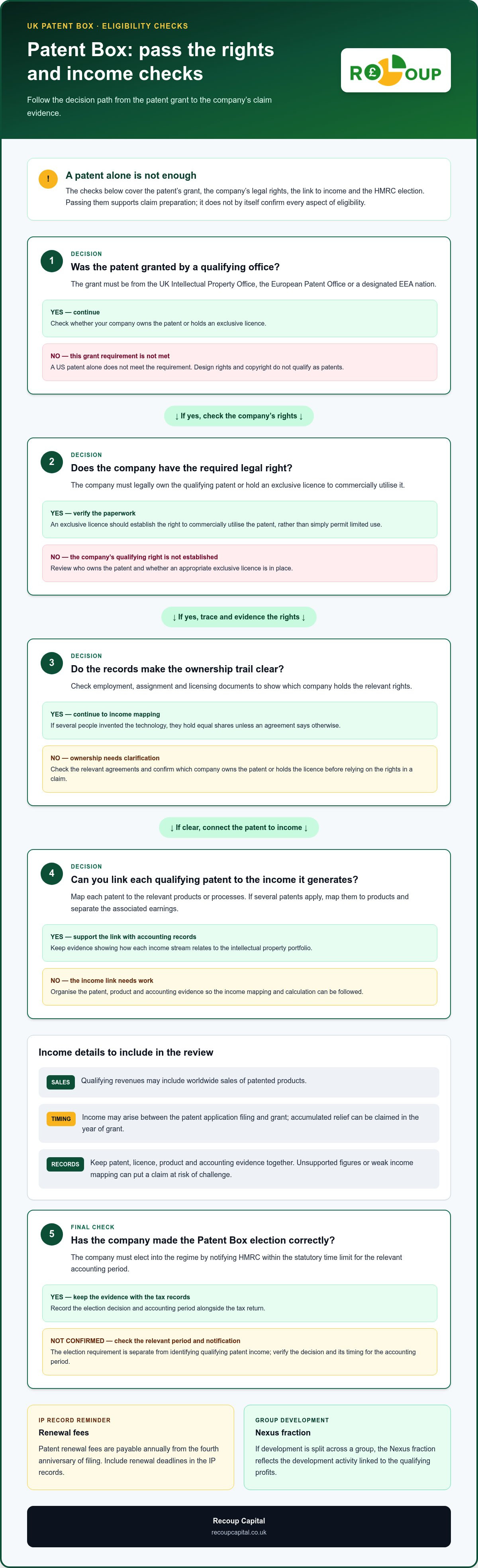
Start with the patent and your company’s legal relationship to it. For UK Patent Box eligibility, the patent must be granted by the UK Intellectual Property Office, the European Patent Office or a designated EEA nation. A company may qualify through legal ownership or an exclusive licence to commercially utilise the patent. A US patent alone does not meet this requirement, and design rights or copyright do not qualify.
Check the ownership trail before preparing a claim. If several people invented the technology, they hold equal shares unless an agreement says otherwise. Confirm that employment, assignment and licensing documents show which company holds the relevant rights. For example, an exclusive licence should establish the company’s right to commercially utilise the patent, rather than simply allowing limited use. The UK Intellectual Property Office says patent renewal fees are payable annually from the fourth anniversary of filing, so include renewal deadlines in the IP records.
The UK Patent Box provides corporation tax relief on qualifying profits from patented inventions. Unlike R&D tax credits, which relate to qualifying research and development, Patent Box focuses on income linked to eligible intellectual property. Your company must elect into the regime by notifying HMRC within the statutory time limit for the relevant accounting period. Record the election decision and period alongside the tax return.
Identify relevant IP income by linking each qualifying patent to the products or processes that generate income. Where several patents apply, map them to products and separate the associated earnings. Keep accounting records showing how each income stream relates to the intellectual property portfolio. Qualifying revenues may include worldwide sales of patented products, as well as income earned between the patent application filing and grant, with accumulated relief claimed in the year of grant.
Incorrect ownership records, weak income mapping or unsupported figures can put a claim at risk of challenge. Keep patent, licence, product and accounting evidence together so the calculation is clear. Review the claim before filing, especially if ownership or commercial arrangements have changed.
2. Using a qualified patent attorney
Involve a patent attorney while the invention is still taking shape. Their legal and technical expertise can help match protection to the invention’s commercial role. For example, a manufacturing improvement may need different protection from confidential process know-how. Patents and trade secrets serve different purposes, so the choice affects what your business must disclose.
Before filing, ask the attorney to assess a prior art search against the proposed claims. Relevant material can include existing patents, published applications, scientific papers and commercial products. Prior art isn’t limited to patent documents. A search can assess novelty and non-obviousness, then identify claims that need tighter definition. This can help prevent avoidable weaknesses in the filing.
Patent claims define the protection sought, so they need precise drafting. Overly broad claims may overlap prior art, while claims tied to excessive detail can exclude useful variations from the intended scope. An attorney can connect each claim to the description and explain technical terms consistently. For example, describe how a component works rather than relying on an internal engineering label.
Disclosure timing matters. A trade-show demonstration, investor pitch or online post can make an invention public before filing. Discuss confidentiality with the attorney before sharing technical details with employees, partners or potential investors. A non-disclosure agreement can help preserve confidentiality during discussions. The attorney can help plan what to disclose, to whom and when, while keeping the application’s supporting detail aligned with the invention.
Use the attorney’s review at key stages: define the invention, assess prior art, draft the claims and description, then respond to examination correspondence. If a search report raises objections, review each cited document and consider whether revised claims address the issue without losing meaningful protection. Professional input is especially valuable when technical language, ownership arrangements or planned commercial use intersect; working with experienced specialists like Exy Intellectual Property can help businesses manage filing strategies and protect key assets across different markets.
3. Clear and accurate patent descriptions
A patent application needs enough detail to explain the invention, not just its intended result. Describe its features, functionality, use and technical context in language the patent office can follow. For a complex manufacturing process, explain each stage, including how one component affects the next. Steps that seem obvious to an inventor may not be clear to an examiner or another technical reader.
Use specific examples to support general statements. If an innovation uses a sensor to adjust a machine, explain what the sensor detects and how that information changes the machine’s operation. Include real-world uses and relevant variations, such as different materials or operating conditions, where they form part of the invention. This detail supports each element in the claims instead of leaving readers to infer how it works.
Keep terminology consistent from the description through to the claims. Calling the same part a “control unit”, “processor” and “module” in different passages can make its role harder to understand. Claims define which aspects are protected, so check that every term has clear support in the description. Illustrations can clarify a structure or sequence, but they supplement rather than replace written explanations.
Before filing, review the draft against the working prototype, design records and process documentation. Confirm that every claimed feature is explained and that diagrams match the written description. Avoid internal shorthand that a patent examiner may not recognise. A European patent application also needs a description that makes the claimed technical contribution understandable in its relevant context.
Insufficient disclosure can lead to an application being rejected or a granted patent being invalidated. Information cannot be added after filing, so omissions may leave important variations unprotected. As a final check, ask whether a technically skilled reader could follow the described steps and understand how to use the invention without private explanations from its inventors.
4. Development activity and the Nexus fraction
The Nexus fraction links qualifying profits to development activity, so your evidence should show how the technical work contributed to the patented invention. For each relevant project, record which group company carried out the work, who directed it and how the results fed into the product. This helps explain the relationship between development expenditure and income included in the calculation.
Keep records that let someone follow this relationship without relying on informal explanations. Useful evidence includes project plans, technical reports, staff or contractor records, group agreements, patent documents and product-level sales records. A dated note explaining a change in project responsibility can distinguish work completed by one company from work undertaken by another. These records make it easier to trace how the calculation was prepared.
If qualifying income or development activity changes during an accounting period, update the analysis to reflect the change. For example, a group agreement may transfer development responsibilities, or a product update may change which patented technology generates income. Record when the change took effect, which activities it affected and the impact on the period’s figures. This is more traceable than carrying forward a prior year’s calculation unchanged.
Common errors include treating every patent-related sale as qualifying income, overlooking a shift in development work, or using inconsistent figures in the calculation and supporting evidence. To understand how to avoid common patent box pitfalls, reconcile product income, patent links and development records for each accounting period. Review assumptions when products, group arrangements or project responsibilities change instead of automatically relying on past workings.
Patent Box calculations bring together technical development, income allocation and group agreements. If you’re reviewing how development activity affects the Nexus fraction, explore Patent Box support as a practical next step.
Recoup Capital: R&D Tax Credits
Recoup Capital can help businesses assess Patent Box eligibility and understand how ownership, income allocation and development records affect a claim. Its specialists and chartered tax accountants provide guidance on Patent Box and R&D Tax Credits, which address different aspects of innovation: Patent Box relates to qualifying profits from patented inventions, while R&D Tax Credits support qualifying research and development activity.
Consider speaking with Recoup Capital when reviewing a potential claim, reorganising intellectual property arrangements or updating evidence after development activity changes. Clear records of patents, product income and technical work can make the claim process more structured and support informed decisions about relief.
Contact Recoup Capital to discuss your Patent Box position.
Make your next decision with confidence
Patent Box planning can shape more than a tax claim. A clear view of your intellectual property and commercial plans can help you decide what evidence to maintain, how to organise future development and when to review your position. This practical discipline is central to understanding how to avoid common patent box pitfalls as your business and technology evolve.
Where innovation activity spans different projects, consider how each incentive applies to its own qualifying activity. Recoup Capital offers R&D Tax Credits, Capital Allowances and Land Remediation Relief alongside Patent Box support, helping businesses consider relevant tax reliefs in the context of their wider plans. Take the next step with a focused discussion about your company’s circumstances and the records behind its claim.
Contact Recoup Capital to discuss Patent Box support and take a considered step towards putting your intellectual property to work for your business.
Frequently Asked Questions
What are the most common patent problems?
Common patent problems include public disclosure before filing, weak descriptions, claims that overlap prior art, unclear ownership and missed renewal deadlines. Showing a product at a trade event before filing can affect novelty; an expired or disputed right can undermine later commercial plans. Keep dated design records, inventor assignments and application correspondence together, and log changes in ownership or product use.
Which UK patents and profits qualify for Patent Box relief?
UK Patent Box eligibility requires a patent granted by the UK Intellectual Property Office, the European Patent Office or a designated EEA nation. A company must legally own it or hold an exclusive licence to commercially utilise it. Relief relates to qualifying profits linked to patented inventions, including income from worldwide sales of patented products. Copyright and design rights alone don’t meet the patent requirement.
How does the UK Patent Box Nexus fraction work, including R&D expenditure?
The Nexus fraction adjusts qualifying profits to reflect development activity where work is split across a group. R&D expenditure records help explain the work behind each patent, but connect them to the project, company and accounting period rather than relying on a consolidated total. Separate internal project records and group agreements can show who performed technical work and when responsibilities changed.
How does Patent Box relief interact with R&D tax relief and other tax incentives?
Patent Box and R&D tax relief relate to different aspects of innovation: Patent Box concerns qualifying profits from patented inventions, while R&D tax relief concerns qualifying research and development activity. Keep the evidence and calculations for each relief distinct. For a project involving a patented product, don’t assume that qualifying R&D activity automatically means its profits qualify for Patent Box relief.
What are the risks, penalties and HMRC enquiry triggers for incorrect Patent Box claims?
Incorrect ownership records, weak income mapping or unsupported figures can put a Patent Box claim at risk of challenge. Keep patent, licence, product and accounting evidence together; the material gives no specific penalties or HMRC enquiry triggers.


