

A loss-making year doesn’t automatically rule out R&D tax relief. To understand how to recoup R&D costs in the UK, start with eligible project costs: these may include staff salaries, employer National Insurance and pension contributions, subcontractor costs, development software, consumable materials and certain cloud computing costs. For accounting years beginning on or after 1 April 2024, eligible companies can claim a 20% tax credit on qualifying R&D costs under the merged scheme.
It’s understandable to assume a company must be profitable to benefit, but qualifying loss-making businesses may also receive relief. What matters is whether the work and expenditure meet the rules for the relevant accounting period, not whether the project succeeded or the business made a profit.
This guide explains which activities and costs may qualify, how company size and project arrangements affect a claim, and how relief can work for loss-making businesses. You’ll also learn what evidence links the technical work to the costs claimed, helping you assess the opportunity more clearly.
Key Takeaways
- Assess whether your project sought to resolve scientific or technological uncertainty; routine development alone may not meet the R&D test.
- For accounting periods starting on or after 1 April 2024, HM Revenue & Customs defines an R&D-intensive loss-making company as one whose qualifying R&D expenditure is at least 30% of its total expenditure.
- Trace eligible expenditure to the period when the project was working to resolve uncertainty, and keep evidence of the work and costs involved.
- Explore how relief may support cash flow in a loss-making year, and how other tax reliefs could fit your wider innovation plans.
What costs qualify for R&D tax credits?
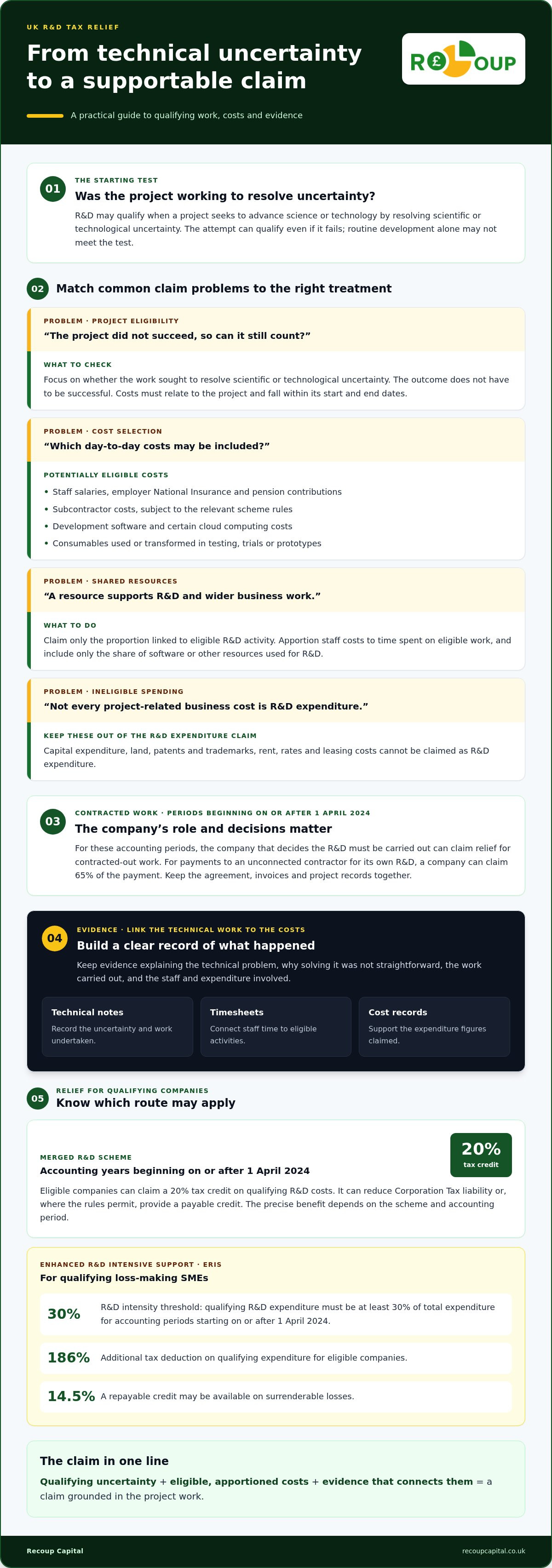
UK R&D qualifies when a project seeks to advance science or technology by resolving uncertainty. The work may qualify even if the attempt fails. Eligible costs must relate to the project and fall within its start and end dates.
Common qualifying expenditure includes staff salaries, employer National Insurance and pension contributions, subcontractor costs, development software, consumables used in testing, and certain cloud computing costs. Only the proportion linked to R&D should be claimed where a resource serves wider business activities. Capital expenditure, land, patents and trademarks, rent, rates and leasing costs cannot be claimed as R&D expenditure.
For accounting years beginning on or after 1 April 2024, eligible companies can claim a 20% tax credit under the merged R&D scheme. This combines aspects of the former SME and RDEC schemes. The credit can reduce a company’s Corporation Tax liability or, where rules permit, provide a payable credit. The precise benefit depends on the scheme and accounting period.
Rates have changed over time. For SME expenditure up to 31 March 2023, a 130% uplift produced a stated 24.7% net benefit for profitable companies. From 1 April 2023, an 86% uplift produced a stated 21.5% benefit. RDEC’s headline rate was 13% up to 31 March 2023, then 20% from 1 April 2023.
Enhanced R&D intensive support, or ERIS, can help qualifying loss-making SMEs. HM Revenue & Customs sets the intensity threshold at 30% of total expenditure for accounting periods starting on or after 1 April 2024. Eligible companies can claim an additional tax deduction of 186% on qualifying expenditure; a repayable credit may be available at 14.5% of surrenderable losses.
Other routes may suit different needs: Corporate Finance can support funding, while Patent Box and Land Remediation Relief address separate tax-relief opportunities. HM Revenue & Customs states that Patent Box applies a 10% rate of Corporation Tax to profits from qualifying intellectual property. Property-related tax matters, including stamp duty land tax, are separate from R&D expenditure.
Which companies can claim R&D tax relief?
A UK company may claim when it undertakes activities that seek to resolve scientific or technological uncertainty. The sector alone does not decide eligibility: construction, engineering and other industries can qualify when their project involves genuine technological problem-solving. For accounting periods starting on or after 1 April 2024, HM Revenue & Customs defines a loss-making company as R&D-intensive if qualifying expenditure is at least 30% of its total expenditure.
Contracted work also needs careful consideration. For accounting periods beginning on or after 1 April 2024, the company that decides the R&D must be carried out can claim relief for contracted-out work. The company’s role, project arrangements and technical decisions therefore matter, not simply which business performed the activities. A company should connect its claim to the uncertainty, work undertaken, staff involved and costs incurred.
Claims are made through the company’s Corporation Tax return, the CT600. Generally, a company must claim within one year after its accounting period ends. It has a further 12 months after that deadline to amend its return and make or amend a claim. In some cases, a company must notify HMRC in advance, particularly when claiming for the first time or after a gap in claims.
Some claims also require an Additional Information Form. Pharmaceutical R&D claims require this form, which gives HMRC details about the projects and costs. Keep records explaining the scientific or technological problem, why solving it was not straightforward, the work carried out, and the staff and expenditure involved. Timesheets, technical notes and cost records can link the claim figures to the activities undertaken.
HMRC may review a claim and ask for supporting information. If the evidence does not support the activities or expenditure, the claim may be challenged and adjusted; inaccurate submissions can also create penalty exposure depending on the circumstances. A technical review tests whether the work meets the R&D criteria, while a financial review checks cost calculations and accounting records. A clear R&D claim submission process helps bring both strands together.
Qualifying R&D expenditure
Eligible expenditure must relate directly to R&D addressing scientific or technological uncertainty. The accounting period and project activities help determine which costs can be included.
Eligible expenditure categories
Qualifying expenditure is revenue spending on resources used in the R&D work. Staff costs can include salaries, employer National Insurance and pension contributions, apportioned to the time spent on eligible activities. Consumables may qualify when used or transformed in testing, trials or prototypes. Software costs can be included for the share used in R&D, alongside qualifying development software and cloud computing costs.
Subcontractor payments may also count, subject to scheme rules and the work’s connection to the company’s R&D. For accounting periods beginning on or after 1 April 2024, a company can claim 65% of payments to an unconnected contractor for its own R&D. Keep the agreement, invoices and project records together so the expenditure can be related to the technical work.
Location and external R&D costs
Revenue expenditure is day-to-day spending, while capital expenditure buys or improves an asset. Capital expenditure cannot be claimed as R&D tax relief, although qualifying R&D capital spending may receive a 100% first-year deduction through Research and Development Allowances. Classifying each item correctly avoids mixing distinct reliefs.
Can UK companies claim for subcontractors, externally provided workers or overseas R&D? Yes, but location, contract terms and accounting-period rules affect eligibility. For periods beginning on or after 1 April 2024, externally provided worker costs must generally be subject to UK PAYE and National Insurance, with limited exceptions. Subcontracted work generally needs to be performed in the UK, also subject to exceptions. Overseas subcontracting may qualify when necessary conditions exist overseas but not in the UK, and replicating them here would be wholly unreasonable.
For the merged scheme, most overseas R&D costs are disallowed unless qualifying overseas-expense conditions are met. Data and cloud computing costs for indirect activities cannot be claimed for accounting periods beginning on or after 1 April 2024. Separate each cost by activity and location before calculating the eligible claim.
Benefits for loss-making companies
For businesses considering how to recoup R&D costs in the UK, a loss-making year doesn’t automatically rule out tax relief. An eligible company may receive a payable tax credit rather than simply reduce its Corporation Tax bill, supporting continued investment in scientific work.
For accounting periods starting on or after 1 April 2024, HM Revenue & Customs treats a company as R&D-intensive when qualifying expenditure reaches at least 30% of its total expenditure. Such companies may use enhanced R&D intensive support, or ERIS. It gives qualifying loss-making SMEs an additional deduction, with a repayable credit potentially available against surrenderable losses. The intensity test uses expenditure for the relevant period, making accurate accounts important.
For ERIS, the credit rate is 14.5% of surrenderable losses. The payable credit is subject to a cap: £20,000 plus 300% of the company’s total PAYE and National Insurance liability for the period. Payroll obligations can therefore affect the cash amount available, even where the company has incurred substantial eligible R&D expenditure.
Loss-making companies outside ERIS may still qualify under the merged scheme. Its credit may provide value even when there is no Corporation Tax bill to reduce, although the calculation and payment route depend on the company’s circumstances and claim. Keep evidence linking staff time, consumables and other eligible costs to work addressing scientific or technological uncertainty. This helps distinguish genuine R&D from routine business activity.
To understand how to recoup R&D costs in the UK, plan around the claim period, expenditure records and relevant PAYE and National Insurance figures. A projected credit is not cash already received, so avoid relying on it as an advance. For help assessing the claim route and its financial effect, review R&D tax credit claims.
Recoup Capital: R&D Tax Credits
Recoup Capital helps limited companies assess and prepare R&D tax credit claims, connecting technical project work to eligible expenditure and the rules for the relevant accounting period. Its support can be useful if your business is loss-making, has contracted work, or needs to distinguish qualifying research from routine development.
Clear records are central to a well-supported claim. Recoup Capital’s specialists help businesses review the technical narrative and financial evidence so the claim reflects the work undertaken and costs incurred. Depending on your wider circumstances, Capital Allowances, Land Remediation Relief and Patent Box may also be relevant, each with its own criteria.
If you’re considering a claim or need support reviewing its evidence and calculations, contact Recoup Capital to discuss your business’s R&D tax relief position.
Turn eligible R&D into a clearer business decision
For businesses considering how to recoup R&D costs in the UK, the next step is to assess how potential relief fits into wider plans. A well-supported claim can do more than calculate tax relief: it can inform decisions about future investment, project priorities and working capital.
Before moving ahead, bring the technical and financial picture together. Consider how your innovation work supports the company’s objectives, what evidence explains the decisions made, and how any resulting funds could be used productively. This gives you a stronger basis for assessing the opportunity and its role in your business plans.
Recoup Capital can help you assess an R&D tax relief claim and related tax relief opportunities. Contact Recoup Capital about R&D relief to discuss your next step and make informed plans for continued innovation.
Frequently Asked Questions
What R&D tax relief is available?
UK companies may claim relief through the merged R&D scheme, or use enhanced R&D intensive support (ERIS) if they meet its conditions. Relief can reduce Corporation Tax or provide a payable credit for eligible loss-making companies. For example, a qualifying business with no Corporation Tax liability may still benefit through a credit rather than a reduction in its tax bill.
What costs can be claimed?
Potentially eligible costs include staff salaries, employer National Insurance and pension contributions, subcontractor expenditure, software, certain cloud computing costs and consumable materials used in R&D. A clinical trial may also include qualifying volunteer payments. Match each cost to the work it supported: prototype materials used in testing may qualify, but consumables sold or transferred after use in R&D cannot be included.
What is qualifying R&D expenditure?
Qualifying expenditure is revenue spending linked to work that seeks to resolve scientific or technological uncertainty. A project may qualify even if the attempt fails, provided the work meets the R&D criteria. For instance, a company testing different engineering approaches to overcome a technical limitation should link records of the problem and experiments to the staff time and other costs claimed.
When can you claim R&D tax credits?
A company generally needs to claim within one year after its accounting period ends. It has a further 12 months after the basic deadline to amend its Corporation Tax return and make or change a claim. Some companies must notify HMRC in advance, including certain first-time claimants or businesses that have not claimed recently. Establish the relevant accounting period before planning submission dates.
What UK R&D tax relief schemes are available in 2025/26?
For accounting periods beginning on or after 1 April 2024, the main route is the merged R&D tax relief scheme. Loss-making, R&D-intensive SMEs may instead qualify for ERIS, subject to its eligibility tests. The accounting period’s start date matters: older SME and RDEC rules apply to periods beginning before 1 April 2024, so the company’s year-end alone does not identify the scheme.
How much R&D tax relief or credit can UK companies claim under each scheme?
Under the merged scheme, eligible companies receive a 20% taxable credit on qualifying R&D costs. Its effective benefit can vary with Corporation Tax, including 15% for companies taxed at 25% and 16.2% at the 19% small companies’ rate. ERIS offers a 186% additional deduction, with a possible cash credit at 14.5% of surrenderable losses. Actual value depends on eligible costs and the company’s tax position.


