

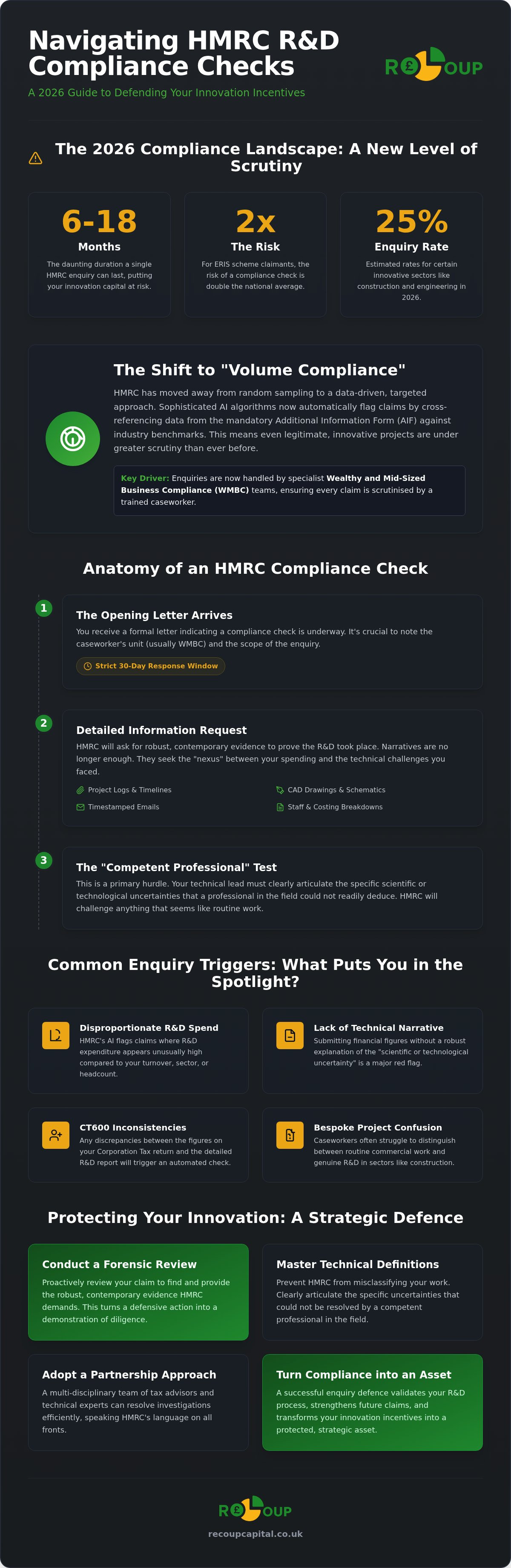
Did you know that if you're claiming under the Enhanced R&D Intensive Support (ERIS) scheme in 2026, your risk of facing a compliance check is double the national average? Receiving a letter from HMRC regarding your R&D tax relief is a stressful experience that can stall your business growth and create months of financial uncertainty. It's a daunting prospect. An hmrc r&d enquiry can now last anywhere from 6 to 18 months, which is a long time to have your innovation capital at risk.
We understand that the fear of repaying credits is a heavy burden for any growing firm. This guide will show you exactly how to defend your innovation incentives and manage a compliance check with professional authority and strategic clarity. We'll break down the complex technical "uncertainty" definitions that caseworkers look for and provide a roadmap to resolve investigations whilst future-proofing your business. By the end, you'll have the tools to turn a rigorous validation into a long-term asset for your company's future growth.
Key Takeaways
- Understand the shift toward "Volume Compliance" and how AI-driven flagging is increasing the frequency of compliance checks for innovative firms in 2026.
- Learn the essential timeline for managing an hmrc r&d enquiry, including how to handle the initial information request and the critical 30-day response window.
- Master the specific technical definitions required to prevent HMRC from misclassifying your bespoke engineering or construction projects as routine work.
- Discover how to conduct a forensic review of your claim to provide the robust, contemporary evidence needed to retain your credits and avoid penalties.
- Explore how a multi-disciplinary partnership approach can resolve investigations efficiently and turn your R&D incentives into a protected strategic asset.
Why HMRC R&D Enquiries are Increasing in 2026
An hmrc r&d enquiry is a formal compliance check into a company's Corporation Tax return. It isn't necessarily an accusation of wrongdoing; it's a rigorous validation process. In 2026, the tax landscape has shifted dramatically. HMRC has moved toward "Volume Compliance," using sophisticated AI to flag claims that deviate from industry norms. This data-driven approach means that even legitimate innovation in the construction and engineering sectors is now under the microscope. The introduction of the mandatory Additional Information Form (AIF) has provided HMRC with a wealth of digital data, making it easier for them to identify perceived inconsistencies before a human caseworker even opens the file.
The 2026 Compliance Landscape
HMRC has bolstered its specialist units with a significant budget increase, specifically targeting the error and fraud gap. The move from random sampling to targeted risk profiling is now complete. In 2026, industry estimates suggest that enquiry rates for certain sectors have climbed to between 20% and 25%. This aggressive stance was partly fueled by the rise of "shadow" R&D boutiques. These unqualified advisors often submitted aggressive claims without technical substance, leading HMRC to view all high-value submissions with increased scepticism. Today, compliance enquiries are handled by the Wealthy and Mid-Sized Business Compliance (WMBC) teams, ensuring that every R&D Tax Credits claim is scrutinised by a named caseworker with specialized training.
Understanding the Risk Factors
Several triggers can put your business in the spotlight. HMRC's AI algorithms compare your claim value against industry benchmarks for your specific sector. If your R&D spend appears disproportionately high compared to your turnover or headcount, a check is likely. Other common risk factors include:
- Lack of Technical Narrative: Submitting financial figures without a robust explanation of the "scientific or technological uncertainty" you faced.
- CT600 Inconsistencies: Discrepancies between the figures on your main tax return and the detailed R&D report.
- Bespoke Project Confusion: In construction and engineering, HMRC often struggles to distinguish between routine commercial work and genuine innovation.
Understanding these triggers is the first step in protecting your claim. If you want to dive deeper into the mechanics of the scheme itself, you can find more details in our guide on R&D tax credits explained. It’s better to be proactive. Ensuring your documentation is "enquiry-ready" from day one is the most effective way to manage your long-term tax risk whilst continuing to invest in your company's growth.
The Anatomy of an HMRC Compliance Check
The process begins when a brown envelope arrives containing a formal opening letter. This document outlines that HMRC is conducting a compliance check into your Corporation Tax return, specifically the R&D claim. You usually have a strict 30-day window to respond. It's vital to identify whether it's a "check of a specific item" or a full-scale enquiry. In 2026, most letters will name a caseworker from the Wealthy and Mid-Sized Business Compliance (WMBC) team. Acknowledging this letter immediately is essential, but don't rush your technical response. You can often request a short extension whilst you gather your records.
The Initial Letter: What to Look For
Don't panic when the letter arrives. Read it carefully to see which accounting period is under scrutiny. In 2026, HMRC often uses the data from your mandatory Additional Information Form (AIF) to pinpoint specific areas of concern. This form has become the primary trigger for modern investigations. If the letter asks for very specific project details, it's likely their AI flagged a discrepancy between your technical narrative and your industry sector's typical innovation profile. Identifying the specific unit handling your case will help you understand the level of technical expertise you're up against.
Typical Information Requests
HMRC's first move is a detailed information request. In years past, a simple narrative might have sufficed. Today, they demand contemporary evidence. This includes project logs, CAD drawings, and timestamped emails that prove work was happening when you said it was. They're looking for the "nexus" between your spending and the technical challenges. According to HMRC's internal manual, the "Competent Professional" test is a primary hurdle. Your technical lead must be able to explain why the solution wasn't readily deducible to another experienced professional in the field.
If the written evidence doesn't satisfy them, HMRC may request a technical interview or a site visit. This is the "expert to expert" challenge. Your engineers will need to speak the language of R&D tax legislation, not just commercial project management. They'll be asked to define the specific "scientific or technological uncertainty" they encountered. A site visit allows the caseworker to see the innovation in situ, though many of these are now conducted via video link for efficiency.
The final stage is the closure notice. This document confirms HMRC's final decision. If successful, your claim is accepted as filed. If not, they may issue an amendment to your tax return, which could result in repaying credits or facing penalties. If you're feeling overwhelmed by a recent notice, reviewing our FAQs can help you understand the standard timelines and what to expect next. Managing an hmrc r&d enquiry is a marathon, but with the right evidence, it’s a hurdle your business can clear.
Addressing Technical Uncertainties in Construction and Engineering
Construction and engineering firms face a unique uphill battle during an hmrc r&d enquiry. The core issue lies in the interpretation of "routine engineering." Caseworkers often argue that complex site challenges are simply part of a skilled professional's daily job. However, genuine R&D exists where a solution isn't available in the public domain. For instance, developing a new modular cladding system that exceeds current fire safety standards through novel material bonding isn't routine; it's an advance. You must prove that your team moved beyond standard industry practice to overcome a specific technical bottleneck.
Claiming for bespoke construction projects requires precision. Just because a building is unique doesn't mean the work qualifies as R&D. You need to isolate the specific scientific or technological uncertainty from the wider commercial project. This involves documenting the "trial and error" phase. HMRC expects to see evidence of failed prototypes, revised calculations, or abandoned methodologies. This narrative proves that the outcome wasn't a foregone conclusion. The official Corporation Tax: Research and Development (R&D) relief guidance emphasises that the advance must be in the field of science or technology, not just an aesthetic or commercial improvement.
Common Pitfalls in Construction Claims
Many firms fall into predictable traps that trigger scrutiny. Avoid these common errors:
- Standard Material Use: Claiming for using high-spec materials in ways they were already designed for.
- Failure to Isolate: Including the entire project cost rather than just the R&D-specific activities.
- Commercial Success Bias: Arguing that because the project was "innovative" for the client, it must be R&D for the taxman.
HMRC's AI flags claims where these distinctions are blurred. If your original submission lacked a clear separation between construction and innovation, you'll need to rectify this during the enquiry. Providing a granular breakdown of staff time spent on technical problem-solving versus standard installation is often the key to a successful resolution.
The "Competent Professional" Argument
Your technical lead is the most important witness in an hmrc r&d enquiry. They must demonstrate that they possess the relevant qualifications and experience to be considered a "competent professional" in their field. General accountants often struggle here because they lack the technical vocabulary to defend engineering decisions. You need to articulate why the problem was a genuine uncertainty rather than a routine difficulty.
In an engineering context, technical uncertainty exists when the knowledge of whether a specific objective is scientifically possible or technologically feasible, or how to achieve it in practice, is not readily available or deducible by a competent professional working in the field.
Proving this requires more than just a CV. It requires showing that your expert searched for existing solutions and found them lacking. This proactive documentation transforms a vulnerable claim into a robust strategic asset, ensuring your business is protected against further checks.
Strategic Steps to Respond and Resolve an Enquiry
Responding to an hmrc r&d enquiry requires more than just defensive posturing. It's about taking control of the narrative from the very first response. The moment that formal opening letter arrives, the clock starts on your 30-day window. Before you contact the caseworker, you need an internal audit. This is about professional authority and strategic clarity. You must ensure that your technical and financial data are perfectly aligned before they are subjected to external scrutiny.
The Forensic Review Process
Don't assume your original claim was perfect. Even if you worked with an advisor, the 2026 compliance environment is far more rigid than in previous years. You must conduct a forensic review of the submitted files. Look for weaknesses in the technical narrative. Did you clearly define the "scientific or technological uncertainty" as it's understood today? If the original submission was thin on detail, you need to quantify the risk of a partial or full rejection immediately. This proactive stance helps you decide whether to stand your ground or concede on minor points to protect the bulk of your credit. You can learn more about how to prepare for an HMRC R&D inquiry by reviewing the core requirements of the scheme.
Evidence is the lifeblood of your defence. HMRC caseworkers are trained to look for "contemporary" documentation. They want to see what was happening during the project, not a retrospective summary written months later. Project logs, CAD revisions, and timestamped internal communications are invaluable. If you can show a clear timeline of technical failures and subsequent iterations, you've already won half the battle. This evidence proves the work wasn't routine.
Dealing with HMRC Disagreements
Deadlocks happen. If HMRC issues a "View of the Matter" letter, it means they've reached a formal conclusion you likely disagree with. At this stage, you have several paths. You can request an Independent Review. This involves a fresh pair of eyes within HMRC, someone entirely separate from the original enquiry team. If that doesn't break the impasse, Alternative Dispute Resolution (ADR) is a powerful tool. It uses a neutral mediator to help both parties reach a settlement without the time and expense of a court case. A Tax Tribunal is the final resort. It's a public and costly process, so it's usually avoided unless the financial stakes are exceptionally high and the technical grounds are indisputable.
Managing communication is vital to prevent "scope creep." Don't give HMRC more information than they've requested, but ensure that every document you do provide is bulletproof. If you're currently facing a compliance check, our specialists can help you defend your innovation incentives and manage the process with professional confidence. Transforming a stressful investigation into a successful resolution is possible with the right strategic partner by your side.
Protecting Your Innovation: The Partnership Approach
Facing an hmrc r&d enquiry doesn't have to be a purely defensive exercise. Whilst the initial letter often triggers anxiety, it's more productive to view the process as a rigorous validation of a strategic business asset. A successful resolution doesn't just protect your current tax credit; it establishes a benchmark for all future innovation incentives. This is where a partnership approach becomes invaluable. Instead of treating the enquiry as a one-off hurdle, we reframe the R&D tax credit as a reliable tool for capital reinvestment and long-term growth.
Specialists vs. Generalists
Your year-end accountant is essential for general bookkeeping and standard tax returns. However, they often lack the technical depth required to defend a complex engineering claim during a compliance check. In 2026, HMRC caseworkers are increasingly specialised, and your defence must match that expertise. The real value lies in having chartered tax accountants and technical engineers in the same room. This multi-disciplinary approach ensures that every "scientific uncertainty" is articulated with professional authority. You can explore why choose a specialist for your R&D claim to understand how this specific technical expertise protects your bottom line.
Long-term Innovation Strategy
The feedback received during an hmrc r&d enquiry is a goldmine for future-proofing your business. By understanding exactly what triggered the 2026 check, you can build a "Compliance First" culture within your team. This involves setting up robust record-keeping systems that capture technical challenges in real-time, rather than relying on retrospective accounts. Contemporary evidence is the most effective shield against future scrutiny. Every failed prototype and revised calculation should be documented as it happens.
Using the enquiry as a learning tool ensures that your future claims are even higher in quality and lower in risk. It shifts the narrative from a mere refund to a protected strategic asset. If you're currently managing a compliance check and need a partner to help you navigate the complexities, you can speak to a Recoup Capital specialist about your HMRC enquiry. We focus on delivering value through results, ensuring that your firm can continue to innovate with confidence whilst we handle the technical heavy lifting of HMRC compliance.
Secure Your Innovation for the Long Term
Receiving a notification regarding an hmrc r&d enquiry is a significant event, yet it shouldn't stall your momentum. Success in 2026 requires a shift in perspective. By treating a compliance check as a rigorous validation of your technical achievements, you can secure your tax relief as a long-term strategic asset. The key lies in matching HMRC’s scrutiny with professional authority and robust, contemporary evidence that proves the value of your work.
Recoup Capital provides the specialised support needed to navigate these investigations with confidence. Our team, comprising chartered tax accountants and technical specialists, bridges the gap between complex engineering and tax legislation. With a success-based fee structure and nationwide coverage, we ensure your interests are always protected. We're here to transform a stressful regulatory hurdle into a clear path for continued business growth and reinvestment.
Protect your innovation and defend your claim with Recoup Capital. You've done the hard work of innovating; now let us handle the complexities of defending it so you can focus on building what comes next.
Frequently Asked Questions
How long does an HMRC R&D enquiry usually take to resolve?
An hmrc r&d enquiry typically takes between 6 and 18 months to reach a final resolution. This is a significant increase compared to standard claim processing, which HMRC aims to complete within 40 days for 85% of cases. The duration depends heavily on the complexity of your technical "uncertainties" and how quickly you can provide contemporary evidence. Being proactive with documentation can help move the process toward the quicker end of that scale.
Can HMRC fine me for an incorrect R&D tax credit claim?
Yes, HMRC can issue financial penalties if they find errors in your submission. These fines are categorised based on your behaviour, with different regimes for "careless" errors versus "deliberate" inaccuracies. If an error is deemed careless, the penalty is usually a percentage of the tax revenue lost. However, if you can demonstrate that you took "reasonable care" when preparing the claim, you may avoid penalties entirely even if the credit is reduced.
What is the "Additional Information Form" and why does it matter for enquiries?
The Additional Information Form (AIF) is a mandatory digital submission required for all R&D claims. It requires detailed technical narratives and a granular breakdown of costs across specific projects. In 2026, it is the primary tool HMRC uses to flag high-risk claims for an hmrc r&d enquiry. A poorly completed AIF that fails to articulate technical challenges clearly is often the leading trigger for a formal compliance check into your company's tax return.
Will an enquiry into one year of R&D lead to checks on previous years?
It is possible, as HMRC has the authority to extend their check into previous accounting periods if they find systemic errors in the year under review. Typically, the enquiry window is 12 months from the filing date; however, this can be extended to four years if they suspect a careless or deliberate mistake. Ensuring your current defence is robust and evidence-led is the best way to prevent the investigation from widening into earlier successful claims.
What happens if I cannot provide contemporary evidence for my R&D claim?
If you lack contemporary evidence like project logs, CAD drawings, or timestamped emails, HMRC is likely to reject the qualifying costs for those specific projects. They often view retrospective summaries with scepticism, as these don't prove that technical uncertainties existed at the time of the work. In such cases, we work to find alternative supporting data, such as internal version-controlled code or meeting minutes, to substantiate your technical journey and protect your credit.
Is it possible to withdraw an R&D claim once an enquiry has started?
You can choose to withdraw or amend your R&D claim after an enquiry has opened, but this doesn't automatically close the compliance check. HMRC may still investigate the reasons for the original submission to determine if penalties for "careless" or "deliberate" behaviour are applicable. Withdrawing a claim is a significant strategic move that should only be done after a forensic review of your technical position and potential financial exposure to the business.
How much does it cost to hire an expert to defend an R&D enquiry?
The cost of professional defence varies, but many specialists, including Recoup Capital, operate on a success-based fee structure. This means the fee is often a percentage of the tax credit successfully retained or recovered, aligning the consultant’s goals with your own. This approach ensures you aren't facing high upfront costs during a stressful investigation. It allows you to access chartered tax accountants and technical engineers without immediate financial strain on your cash flow.
Can I still claim R&D tax credits if I have had an enquiry in the past?
Yes, a previous enquiry does not prevent you from making future claims. In fact, a successfully resolved enquiry can act as a blueprint for future submissions by clarifying what HMRC accepts as a "technological advance" in your specific field. However, you should expect continued scrutiny. Building a "compliance-first" culture and using feedback from the previous check will ensure your future claims are robust and less likely to be flagged by AI risk profiling.


