

Could your commercial property be hiding thousands of pounds in unclaimed tax relief simply because it's locked within the walls and floors? Many UK business owners view tax as an unavoidable drain on growth, yet the reality is that your physical assets are often strategic tools for capital recovery. Understanding how to claim capital allowances uk in 2026 is no longer just a task for the year-end accounts; it's a vital move for any firm looking to offset the recent reduction in the main rate Writing Down Allowance to 14%.
It's frustrating to watch high corporation tax liabilities stifle your expansion plans, especially when HMRC eligibility criteria feel like a labyrinth of technical jargon. You deserve a clear path to certainty. This guide will show you how to unlock these hidden incentives, master the permanent full expensing rules, and utilise the new 40% first-year allowance to transform your tax bill into reinvestment capital.
We'll break down the 2026 regulatory shifts, from the £1 million Annual Investment Allowance to the nuances of forensic surveying for embedded fixtures, ensuring your business remains compliant whilst maximising every penny of available relief.
Key Takeaways
- Secure 100% first-year relief by utilising the permanent £1 million Annual Investment Allowance for qualifying machinery and equipment.
- Learn exactly how to claim capital allowances uk to offset the 2026 reduction in main rate Writing Down Allowances and maintain vital liquidity.
- Uncover significant "hidden" tax savings within commercial property by identifying embedded fixtures that standard accounting often misses.
- Avoid costly compliance errors by correctly distinguishing between revenue repairs and capital expenditure whilst aligning your claims with R&D tax credit opportunities to maximise recovery.
- Reframe tax recovery as a strategic asset for growth through forensic surveying and a results-driven partnership model.
What are Capital Allowances and Why Do They Matter in 2026?
At its most fundamental level, a Capital allowance is the UK's mechanism for providing tax relief on business assets. Whilst most businesses are familiar with the concept of depreciation in their annual accounts, HMRC views these figures differently. Accounting depreciation is an internal estimate of how an asset loses value over time, and because it varies between companies, it's usually disallowed for tax purposes. Instead, businesses must use capital allowances to write off the cost of qualifying assets against their taxable profits.
The distinction between revenue expenditure and capital expenditure is the first hurdle in understanding how to claim capital allowances uk. Revenue costs are your day to day operational expenses, such as utility bills or staff wages, which are fully deductible in the year they occur. Capital expenditure involves investments in long term assets like machinery, equipment, or commercial property fixtures. These investments are designed to drive innovation and productivity, making them a cornerstone of the UK's strategy to encourage business growth.
The Core Benefit: Transforming Tax into Cash Flow
Capital allowances act as a powerful lever for your bottom line. By deducting the cost of qualifying assets from your taxable profits, you directly reduce your corporation tax liability. This isn't just about administrative compliance; it's about capital recovery. The tax you save represents liquid cash that can be immediately reinvested into the business.
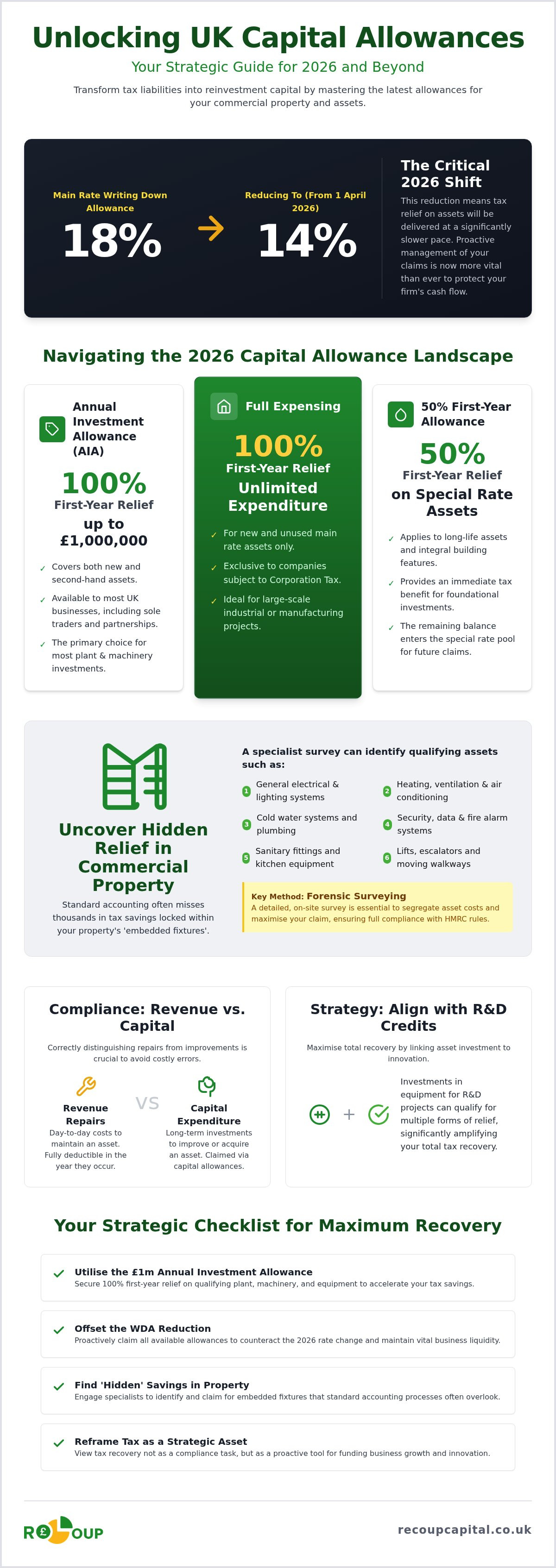
For many forward thinking firms, these savings provide the necessary funding for R&D tax credits projects or further infrastructure upgrades. The year 2026 is a critical turning point for this strategy. With the main rate of Writing Down Allowance (WDA) falling from 18% to 14% on 1 April 2026, businesses that fail to review their asset registers risk seeing their tax relief delivered at a significantly slower pace. Proactive management ensures you aren't leaving vital cash on the table.
Who Can Claim? Eligibility Criteria for UK Companies
The ability to claim is available to limited companies, partnerships, and sole traders chargeable to UK tax. However, the rules vary depending on your accounting structure. If you're a sole trader using the cash basis, your ability to claim capital allowances is generally restricted to business cars, as most other equipment is treated as a simple business expense.
For companies using the accruals basis, the scope is much broader. You can claim for both new and second hand assets, though the specific relief rate depends on the asset type and when it was purchased. Mastering how to claim capital allowances uk requires a clear understanding of these boundaries, ensuring that every qualifying piece of kit, from a new delivery van to the complex electrical systems in your office, is working to lower your tax bill.
Navigating the 2026 Landscape: Types of Capital Allowances
The 2026 capital allowance regime is designed to reward businesses that invest in their future. At the heart of this system is the Annual Investment Allowance (AIA), which remains a permanent fixture of the UK tax landscape. The AIA provides 100% tax relief on qualifying plant and machinery expenditure up to a limit of £1,000,000 per year. For companies with larger investment appetites, "full expensing" offers an unlimited 100% first-year relief on new and unused main rate assets. Understanding these distinctions is the first step in mastering how to claim capital allowances uk whilst protecting your firm's cash flow.
Annual Investment Allowance (AIA) vs Full Expensing
Whilst both mechanisms offer immediate relief, they serve different strategic purposes. The AIA is exceptionally flexible, covering both new and second-hand equipment, making it the primary choice for smaller capital investments or growing firms. Full expensing, however, is a permanent incentive exclusive to companies subject to corporation tax. It's particularly effective for large-scale industrial or manufacturing projects where expenditure exceeds the £1 million AIA threshold. Businesses can also utilise a 50% first-year allowance for special rate assets, ensuring that even long-life investments provide an immediate tax benefit.
| Feature | Annual Investment Allowance (AIA) | Full Expensing |
|---|---|---|
| Relief Rate | 100% | 100% |
| Annual Limit | £1,000,000 | No Limit |
| Asset Status | New or Second-hand | New and Unused only |
| Entity Type | Companies, Partnerships, Sole Traders | Companies only |
The 2026 40% First-Year Allowance Explained
A significant shift in the 2026 landscape is the introduction of a targeted incentive for assets that might not qualify for full expensing. A new 40% FYA was introduced from 1 January 2026 for qualifying main rate plant and machinery. This allowance is available to both companies and unincorporated businesses, such as sole traders, providing a vital bridge for those purchasing assets for leasing or those who cannot access full expensing. It acts as a proactive measure to encourage continuous investment despite the wider changes to pool rates.
When assets don't qualify for first-year incentives, they fall into the Writing Down Allowance (WDA) pools. From 1 April 2026, the main rate of WDA is reduced from 18% to 14%, whilst the special rate pool for integral building features remains at 6%. This reduction means that identifying every possible first-year claim is more important than ever to avoid a slower rate of capital recovery. Official guidance on How to claim capital allowances outlines the basic filing process, but a specialist capital allowance review can ensure you're categorising assets in the most tax-efficient pool possible to maximise your immediate returns.
Unlocking Hidden Relief: Capital Allowances on Commercial Property
Commercial property owners often overlook the significant tax relief sitting right under their noses. When you purchase a building, you aren't just buying bricks and mortar; you're acquiring complex systems that qualify for relief. These "embedded" capital allowances for commercial property include everything from electrical cabling and plumbing to sophisticated security systems. Understanding how to claim capital allowances uk on these assets is the difference between a standard purchase and a strategic investment. Standard property valuations frequently miss up to 25% of these claimable assets amongst fixtures because they focus on market value rather than forensic tax eligibility.
Forensic Surveying: The Specialist Advantage
General accountants do a fantastic job with day-to-day books. However, they aren't trained as surveyors. Identifying assets embedded within the building fabric requires a forensic approach that goes beyond the ledger. Recoup Capital uses a blend of chartered tax accountants and specialist surveyors to document fixtures that are often hidden behind walls or under floors. This dual expertise identifies savings that traditional methods typically overlook. We don't just process paperwork; we act as a protective guide through the regulatory landscape to uncover capital you didn't know you had.
Structures and Buildings Allowance (SBA)
If you've constructed a new building or renovated an existing non-residential structure, the SBA provides an additional route for relief. For 2026, the SBA rate remains at 3% per year on a straight-line basis over a 33⅓ year period. This is distinct from the plant and machinery pools discussed earlier. It applies to the structural elements, such as walls and floors, that don't qualify as integral fixtures. Effectively managing Capital allowances for property ensures that both the "brains" of the building, like lighting and cooling systems, and the "bones" of the structure contribute to lowering your tax liability.
Maximising Compliance and Avoiding Common Pitfalls
The R&D and Capital Allowance Overlap
Innovation often requires significant physical infrastructure. Assets used for pioneering research can often qualify for both R&D tax credits and capital allowances. Strategic planning is essential here to ensure you maximise your recovery without double claiming on the same specific expenditure. Consider a laboratory fit-out as a prime example. The high-specification climate control systems and specialised power supplies qualify as integral features for capital allowances. Simultaneously, the costs associated with designing these bespoke environments to solve technical uncertainties can often be captured within an R&D claim, creating a powerful synergy of tax incentives.
Preparing for HMRC Scrutiny
HMRC has increased its focus on the quality of technical evidence. A simple spreadsheet showing costs is no longer enough to satisfy a detailed enquiry. You need a comprehensive pack that provides forensic evidence for every pound claimed. This documentation should include:
- Detailed invoices and proof of payment dates.
- Section 198 elections for any property acquisitions.
- Technical descriptions explaining why an asset qualifies as plant or machinery.
- Forensic surveying reports for embedded fixtures that aren't visible to the naked eye.
Technical reports provide the "why" behind the numbers, acting as a shield against potential challenges. The rigorous compliance standards HMRC expects for R&D claims are the same benchmarks applied to capital allowance submissions to ensure all relief is backed by factual evidence. This forensic approach transforms a simple tax filing into a robust strategic asset for your business.
Maintaining this level of detail can be daunting for busy finance teams. Working with a specialist ensures your documentation meets the highest professional standards whilst you focus on your core operations. To see how we can safeguard your claim and improve your cash flow, you can request a no-cost introductory assessment of your current asset register.
Strategic Growth: Partnering with Recoup Capital
Navigating the 2026 tax landscape requires more than just a list of assets; it requires a partner who understands the intersection of tax law and business growth. Recoup Capital provides a unique blend of forensic surveying and specialised accounting. Our approach to how to claim capital allowances uk is rooted in corporate finance strategy, ensuring that every claim aligns with your long term commercial goals. We operate on a success-based fee model, meaning we only win when you successfully recover capital. This results-driven philosophy ensures our interests are perfectly aligned with your business's success, moving away from traditional sales pressure toward a relationship built on evidence and results.
For UK limited companies, the journey begins with a no-cost introductory assessment. This initial review allows our specialists to identify potential opportunities within your asset register or property portfolio without any upfront financial commitment. We believe in demonstrating value first, providing you with the clarity needed to make informed decisions about your tax strategy. By acting as a protective guide through the complexities of HMRC regulations, we ensure that your claims are both maximised and robustly defended.
Beyond the Refund: Reinvesting in Innovation
We reframe tax recovery as a strategic asset rather than a simple rebate. Identifying savings is only the first step in a broader partnership. For many of our clients, these recovered funds become the catalyst for the next phase of business expansion or high-value R&D projects. Our team looks at the bigger picture, often identifying land remediation relief opportunities alongside property-based capital allowances. By uncovering these multiple streams of relief, we help you build a solid financial foundation for future innovation, turning historical expenditure into active capital utility.
Your Journey to Capital Recovery
Mastering how to claim capital allowances uk shouldn't be a burden on your internal resources. We manage the technical heavy lifting, allowing your finance team to focus on core operations. Our streamlined journey consists of four clear stages designed for efficiency and transparency:
- Initial Discovery: A thorough, no-cost assessment to pinpoint unclaimed relief in your business.
- Forensic Surveying: Our experts conduct on-site or remote forensic analysis to identify embedded fixtures.
- Technical Documentation: We prepare robust reports that meet the highest HMRC compliance standards.
- Capital Realisation: We support the submission process to ensure the recovered funds reach your cash flow.
This proactive approach ensures that no stone is left unturned in your pursuit of capital recovery. If you're ready to transform your business assets into vital cash flow, speak to a Recoup Capital specialist today to begin your assessment.
Secure Your Financial Future Through Strategic Capital Recovery
The 2026 fiscal landscape presents a unique window for UK businesses to turn physical investments into strategic growth assets. From navigating the permanent £1 million AIA threshold to identifying hidden fixtures within your building's fabric, the opportunity for capital recovery is substantial. Understanding how to claim capital allowances uk is no longer a mere compliance task; it's a vital component of your broader corporate finance strategy.
Recoup Capital acts as your protective guide, combining a specialist forensic surveying team with chartered tax accountants who possess deep HMRC expertise. Our success-based fee structure ensures that we only deliver value when you see results. We're here to help you reframe tax recovery as a tool for long-term innovation rather than a one-off rebate, providing the certainty you need to reinvest with confidence.
Don't let your business's potential remain locked in its infrastructure. Maximise your tax relief with a no-cost capital allowances assessment and transform your tax liability into a catalyst for innovation today.
Frequently Asked Questions
What are capital allowances and how do they work for UK businesses?
Capital allowances are the UK's version of tax depreciation, allowing businesses to deduct the cost of qualifying assets from their taxable profits before corporation tax is calculated. They work by replacing internal accounting depreciation with statutory rates set by HMRC. This mechanism ensures that investments in equipment and property fixtures provide tangible tax relief, directly improving your company's cash flow whilst incentivising long-term innovation and infrastructure development.
Can I claim capital allowances on a second-hand commercial property?
Yes, you can claim on second-hand commercial properties, though the process requires forensic surveying to identify embedded fixtures. It's vital to establish what the previous owner has already claimed to avoid double-dipping. Identifying these "hidden" assets, such as electrical systems or air conditioning, is a key part of how to claim capital allowances uk effectively. A Section 198 election is typically required to fix the value of these fixtures during the purchase.
What is the Annual Investment Allowance (AIA) limit for 2026?
The Annual Investment Allowance (AIA) limit for the 2026/27 tax year is £1,000,000. This permanent limit allows businesses to claim 100% tax relief on qualifying plant and machinery expenditure in the year of purchase. It applies to most assets, including second-hand kit, but excludes cars. If your annual investment exceeds this £1 million threshold, you may still be able to utilise full expensing or the 50% first-year allowance for special rate assets.
How do capital allowances differ from standard accounting depreciation?
Standard accounting depreciation is an internal estimate of an asset's loss in value, which HMRC disallows for tax purposes to ensure national consistency. Capital allowances are the statutory alternative that actually reduces your tax bill. Whilst depreciation is a non-cash accounting entry, capital allowances provide a direct reduction in taxable profit. This distinction is crucial because it transforms a theoretical loss into a strategic asset that preserves your business's liquid capital.
What qualifies as plant and machinery for tax relief purposes?
Plant and machinery is a broad category including most items used for business functions, from computers and vans to specialised manufacturing equipment. For property owners, it also covers "integral features" like lifts, heating systems, and external solar shading. To qualify, the item must be necessary for your trade and not part of the building's setting. Forensic surveying often uncovers qualifying machinery that general accounting overlooks, such as complex cabling or security infrastructure.
Can I claim capital allowances and R&D tax credits on the same project?
You can certainly claim both incentives on the same project, provided you don't claim twice for the same specific pound of expenditure. For instance, the design costs of a new laboratory might qualify for R&D tax credits, whilst the physical benches and ventilation systems qualify for capital allowances. Integrating these two reliefs requires a coordinated strategy to ensure you're maximising your total recovery without breaching HMRC's compliance standards for double-claiming.
What is a Section 198 election and why is it important when buying property?
A Section 198 election is a formal agreement between a buyer and seller that fixes the tax value of fixtures within a commercial property at the point of sale. It's vital because it provides certainty for both parties and prevents future disputes with HMRC. Without this election, you might lose the ability to claim on those assets entirely. It's a protective measure that ensures the capital relief remains available for the new owner.
What happens to my capital allowances if I sell a business asset?
When you sell a business asset, you must calculate a "balancing adjustment" to reconcile the tax relief already claimed with the sale price. If you sell the asset for more than its remaining tax value, you'll incur a balancing charge, which effectively adds to your taxable profit. Conversely, if you sell it for less, you may receive a balancing allowance. This process ensures that the total relief you've received matches the actual cost of ownership.


