

What if the technical problem-solving happening on your factory floor right now is actually a hidden financial asset? Many UK manufacturers assume R&D is reserved for white-coated scientists in sterile labs, yet the reality of manufacturing randd often involves the grit of the production line. If you've spent time optimising a bespoke jig, testing new alloys, or integrating automation to combat rising labour costs, you're likely sitting on unclaimed capital.
It's understandable to feel cautious about the administrative burden, especially with HMRC's stricter 2026 compliance requirements. You've worked hard to build your business, and the last thing you need is a time-consuming documentation process that distracts from your output. This guide will show you how to identify qualifying activities and maximise your tax relief whilst ensuring total HMRC compliance. We'll walk through the current 20% merged scheme rates, explain the mandatory notification rules, and demonstrate how to transform these financial returns into strategic assets for your next phase of growth.
Key Takeaways
- Learn how to identify manufacturing randd by focusing on the resolution of technical uncertainties within your daily production processes rather than just laboratory research.
- Discover the range of qualifying activities that trigger relief, from developing bespoke tooling and jigs to testing advanced new materials and coatings.
- Understand which costs are eligible for recovery, including staff gross salaries, employer NI contributions, and materials consumed during the testing phase.
- Ensure total HMRC compliance by understanding the 2026 requirements for the mandatory Additional Information Form (AIF) and the necessity of a robust Technical Report.
- Reframe your tax relief as a strategic asset to be reinvested into new plant, machinery, or specialist talent to drive long-term competitive growth.
What is Manufacturing R&D? Defining Innovation on the Factory Floor
Innovation in the UK manufacturing sector isn't confined to high-tech laboratories or sterile cleanrooms. For the vast majority of businesses, manufacturing randd is found in the grit and sweat of the factory floor, hidden within the daily struggle to make things better, faster, or more resilient. It's the technical problem-solving that happens when standard methods fail to deliver the required results.
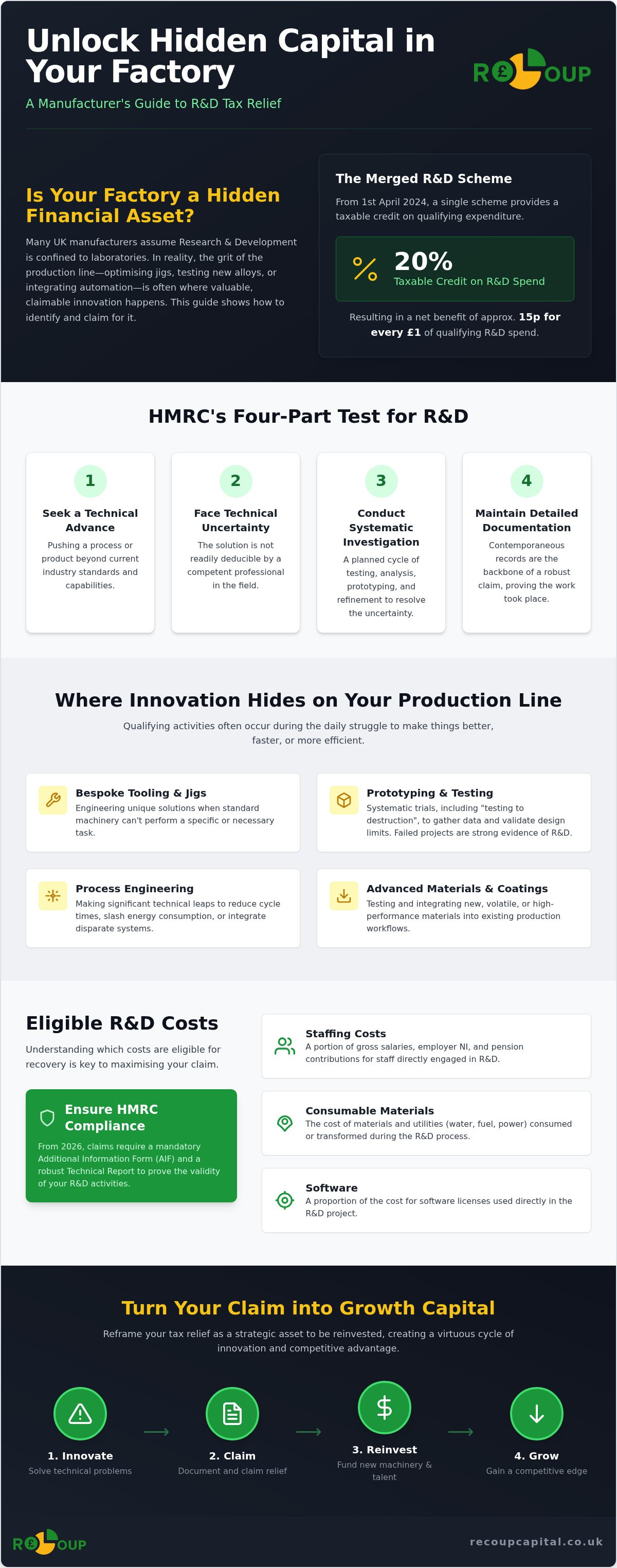
At its core, HMRC defines R&D as the pursuit of an advance in science or technology through the resolution of technical uncertainty. This doesn't require a team of white-coated specialists. If your engineers are battling to make a production line more efficient or trying to integrate automation into an old system, you're likely innovating. Since 1 April 2024, the landscape has changed with the introduction of a single Merged Scheme. This provides a taxable credit of 20% on qualifying expenditure. For a company paying the main corporation tax rate of 25%, this results in a net benefit of approximately 15p for every £1 of R&D spend. You can find more details on the history and structure of R&D tax credits to see how the UK compares globally.
It's vital to distinguish between genuine innovation and routine copycatting. Simply setting up a standard production line or following a manufacturer's manual isn't R&D. However, if you're adapting that equipment to handle a volatile new composite or redesigning a workflow to solve a specific technical bottleneck, you've crossed the threshold into qualifying activity.
The Four-Part Test for Manufacturing R&D
To ensure your claim is robust, your project must meet four specific criteria. First, you must seek a Technical Advance, meaning you're pushing a process or product beyond current industry standards. Second, you must face Technical Uncertainty. If a competent professional in your field can't easily deduce the solution, the uncertainty is real. Third, you must conduct a Systematic Investigation, which involves a planned cycle of testing, analysis, and prototyping. Finally, your documentation must be detailed. Contemporaneous records are the backbone of claiming R&D tax credits, as they prove the work happened in real-time.
Common Misconceptions in the Manufacturing Sector
A frequent myth amongst manufacturers is that R&D only counts if you've created a brand-new product. In reality, process improvements often yield the most significant claims. If you've spent months reducing waste on a line or increasing the speed of a bespoke assembly process, that's often qualifying work. Another misconception is that "failed" projects don't count. In the eyes of HMRC, a project that didn't meet its technical goals is often the strongest evidence of R&D. It proves that the uncertainty was genuine and the solution wasn't a foregone conclusion.
Qualifying Activities: Where Innovation Hides in Your Production Line
Identifying qualifying projects requires looking past the finished item and into the iterative failures of the production line. Many manufacturers don't realise that the struggle to make a product viable is where the true value lies. When a standard machine can't handle a specific task, the engineering of bespoke tooling or jigs becomes a primary driver for a manufacturing randd claim. This isn't just about routine maintenance; it's about creating a technical solution that didn't exist before.
Prototyping isn't merely a step toward production; it's a systematic investigation. By engaging in "testing to destruction," you're gathering data on the physical limits of your design whilst building a robust case for HMRC. This empirical evidence is exactly what the regulator requires to prove technical uncertainty. According to an IET report on UK manufacturing, this level of technical agility is essential for staying competitive in a global market. If you're unsure if your latest shop-floor fix counts, it's worth seeing why other manufacturers choose to claim.
Process Engineering and Efficiency Gains
Reducing cycle times or slashing energy consumption isn't just a matter of turning down a dial. It often requires significant technical leaps. You might be integrating disparate systems that were never designed to work together, such as linking legacy hydraulic presses with modern IoT sensors. The landscape of manufacturing randd in 2026 is increasingly dominated by this type of automation. Bespoke process integration acts as a key R&D driver in 2026, representing the custom engineering required to bridge the gap between physical hardware and advanced digital control systems. If the solution wasn't available off-the-shelf and required trial and error to perfect, it likely qualifies for relief.
Material Science and Product Development
The push for sustainability has forced many UK firms to experiment with recycled plastics or bio-composites. These materials often behave unpredictably under standard manufacturing conditions, requiring you to redesign moulds or adjust thermal profiles to maintain structural integrity. Similarly, lightweighting components for aerospace or automotive applications often pushes the boundaries of what's physically possible with current alloys. You can explore how R&D tax credits are explained for these sectors to see how your specific material challenges might translate into recovered capital.
Calculating the Value: Eligible R&D Costs in Manufacturing
Once you've identified your qualifying projects, the focus shifts to quantifying the expenditure. For many UK firms, the largest portion of a manufacturing randd claim is found in staff costs. You can include the gross salary, employer National Insurance contributions, and pension contributions for any employee directly involved in the R&D process. This isn't limited to dedicated researchers; it includes shop-floor engineers, production managers, and quality control specialists who spend time resolving technical uncertainties. If a manager spends 40% of their month overseeing the trial of a new assembly method, 40% of their total cost is eligible for relief.
Consumables also play a vital role in the manufacturing sector. Any materials transformed or "consumed" during the R&D process can be included. If you've produced fifty prototypes to test the structural integrity of a new casing, the raw materials used for those prototypes are qualifying costs. Similarly, you can claim for the proportion of utilities used during these activities. When you're running a furnace specifically to test a new alloy's thermal properties, the fuel, power, and water consumed during that run are direct R&D expenses.
Under the Merged Scheme introduced in April 2024, the rules for subcontractors and externally provided workers (EPWs) have been streamlined. Generally, the company that decides to initiate the R&D and bears the financial risk is the one entitled to claim. This means if you hire a specialist engineering firm to solve a specific technical problem on your line, you can likely include a percentage of their invoice in your claim.
The Synergy Between R&D and Capital Allowances
It's vital to understand that R&D tax credits and Capital Allowances are two sides of the same coin. Whilst R&D relief covers revenue expenditure, such as wages and materials, Capital Allowances focus on the physical assets and machinery required for your operations. Manufacturers often overlook "embedded" relief within their factory facilities, such as specialized electrical systems or climate control required for sensitive production. You can learn more about identifying hidden savings through Capital Allowances to ensure you aren't leaving money on the table when upgrading your plant.
Software Licences and Cloud Computing
Modern manufacturing relies heavily on digital tools. You can claim for software licences used directly in R&D, such as CAD/CAM packages used for design and simulation or specialist testing software. If you're utilizing AI-driven manufacturing models, the associated cloud computing and data hosting costs are also eligible. However, you must exclude purely administrative software, such as your accounting or payroll systems, as these don't contribute to the resolution of technical uncertainty.
Ensuring Compliance: Navigating HMRC Enquiries and Transparency
HMRC has significantly increased its scrutiny of claims, moving toward a much stricter compliance environment. Since the introduction of the mandatory Additional Information Form (AIF), every manufacturing randd submission must be digitally filed with granular detail before the Corporation Tax Return is submitted. This isn't just a box-ticking exercise. It's a rigorous standard designed to ensure that only genuine innovation receives relief. A common fear amongst manufacturers is that claiming will trigger an audit, but the reality is quite the opposite. A well-prepared, transparent claim acts as a shield, demonstrating to HMRC that you understand the regulations and have applied them with precision.
The heart of a successful claim is the Technical Report. This document allows you to tell the story of your innovation, moving beyond the spreadsheets to explain the specific technical uncertainties your team faced. HMRC prioritises the perspective of a "competent professional," such as your lead engineer or production head. Their ability to explain why a solution was not readily deducible to others in the industry provides the necessary weight to your narrative. If you're feeling uncertain about the current standards, you can find answers in these commonly asked questions about R&D compliance.
The Risks of Inaccurate Claims
The rise of "R&D boutiques" has created a landscape where some providers prioritise volume over validity. Using a service with a poor compliance record can put your business at significant risk when claiming for manufacturing randd. Inaccurate or "careless" errors can lead to substantial financial penalties and may damage your relationship with HMRC for years to come. This is why we believe in a partnership-oriented approach. Recoup Capital uses in-house chartered tax accountants to oversee every submission, ensuring that every figure is defensible and every technical description meets the 2026 standards. To ensure your business is fully protected, you can speak with our chartered tax team today about a risk-free assessment.
Best Practices for Documentation
Reliable documentation should be contemporaneous rather than retrospective. Don't wait until the end of the year to gather evidence. Organise a simple system to track R&D hours amongst your engineering team on a weekly or monthly basis. Small habits can make a huge difference during a potential enquiry. You should also retain the following items:
- Test logs and data from failed design iterations.
- Photos of prototypes or bespoke jigs.
- Email chains where technical hurdles and potential solutions were discussed.
- Invoices for materials consumed specifically during testing phases.
By keeping these records in real-time, you transform your claim process from a stressful year-end task into a strategic asset that reflects your company's technical growth.
Strategic Reinvestment: Turning Your Claim into Growth Capital
The completion of a successful manufacturing randd claim shouldn't be viewed as the end of a bureaucratic process. Instead, it's the start of a new investment cycle. By reframing these financial returns as a strategic asset, you can transform a tax benefit into a powerful engine for growth. Whether you choose to reinvest in high-spec machinery, hire specialist engineers, or expand your factory footprint, this recovered capital provides the liquidity needed to stay ahead of global competitors. It’s about more than just a refund; it’s about fueling the next generation of UK industry.
Our success-based fee model is designed to align perfectly with your business goals. We don't believe in traditional sales pitches; we prefer to demonstrate our value through the capital we recover for you. This approach significantly lowers the barrier to entry for manufacturers, ensuring that you only pay when you see tangible results. It encourages a continuous cycle where innovation leads to recovery, which in turn fuels further manufacturing randd. By treating these credits as a recurring part of your financial planning, you ensure that your technical problem-solving pays for itself.
Leveraging the Patent Box Scheme
If your R&D efforts result in a new invention or a unique technical process, the benefits can extend far beyond a one-off tax credit. By securing a patent for your manufacturing IP, you may qualify for the Patent Box scheme. This allows you to apply a lower effective corporation tax rate of 10% to profits earned from its exploitation. It’s a powerful way to protect your market position whilst significantly reducing your long-term tax liability. Positioning your business as a leader in UK innovation isn't just about prestige; it’s about building a robust, tax-efficient foundation for the future.
Partnering for Long-Term Success
A partnership-oriented approach beats a one-off transaction every time. We act as proactive guides, looking beyond the immediate claim to identify other opportunities for capital recovery that you might have overlooked. For instance, many manufacturers are unaware they can claim Land Remediation Relief if they’ve developed on brownfield sites or dealt with contaminated land during a factory expansion. By looking at your business through a wider lens, we help you uncover every available incentive. If you're ready to see how your technical challenges can become financial opportunities, you can start your R&D assessment with Recoup Capital today.
Securing the Future of Your Production Line
The path to recovering capital for your business begins with recognising that your daily technical hurdles are actually opportunities for growth. From the development of bespoke tooling to the integration of complex automation, manufacturing randd is the engine driving the UK's industrial resilience. By understanding the 20% benefit available under the current merged scheme and maintaining robust records, you can transform these technical efforts into a powerful strategic asset.
You don't have to navigate the complexities of HMRC compliance alone. Our team brings deep expertise in engineering claims and provides direct HMRC liaison to ensure your submission is both maximised and protected. Because we operate on a success-based fee model, there are no upfront costs to explore your eligibility. We're here to act as your protective guide, turning regulatory procedures into approachable opportunities for innovation.
Ready to see what your innovation is worth? Book a free R&D assessment with our manufacturing specialists and take the first step toward reinvesting in your company's future. We look forward to building a long-term partnership that supports your vision for growth.
Frequently Asked Questions
Can I claim R&D tax credits if my manufacturing project failed?
Yes, you can absolutely claim if a project failed to meet its technical objectives. In fact, failure is often the most compelling evidence of technical uncertainty required for manufacturing randd. It proves that the solution wasn't readily deducible to a competent professional. HMRC rewards the attempt to innovate, not just the successful outcome, provided you can document the systematic investigation and the technical hurdles you couldn't overcome.
How far back can I claim for manufacturing R&D activities in the UK?
You can typically claim for the previous two completed accounting periods. The statutory deadline is exactly two years after the end of the period in which the expenditure occurred. However, if you haven't claimed in the last three years, you must submit a Claim Notification Form within six months of the period end. This makes it vital to review your recent projects quickly to avoid missing these strict regulatory windows.
What is the difference between R&D Tax Credits and Capital Allowances for manufacturers?
The primary difference lies in the type of expenditure. R&D tax credits target revenue costs like staff wages, consumables, and software used during the innovation process. Capital Allowances apply to capital investment in physical assets, such as new production machinery or factory plant. Combining both allows you to recover costs from the initial "brain power" phase all the way through to the physical equipment required for full-scale production.
Do I need a dedicated R&D department to qualify for tax relief?
No, a dedicated R&D department isn't necessary to qualify for relief. Most manufacturing randd occurs in the middle of daily production when engineers and shop-floor staff are forced to iterate on processes or solve technical bottlenecks. As long as your team is resolving scientific or technological uncertainties, their activities qualify regardless of their official job titles or whether you have a laboratory on-site.
How long does it typically take to receive the R&D tax credit from HMRC?
HMRC typically aims to process claims within 28 to 40 days of submission. However, this timeline can fluctuate depending on the complexity of your claim and the volume of submissions HMRC is currently handling. Ensuring your Additional Information Form (AIF) is meticulously completed before filing your CT600 is the best way to prevent administrative delays and ensure your funds are released as quickly as possible.
Can I claim for the time my factory staff spent on problem-solving?
Yes, you can claim for the proportion of time your factory staff spent on qualifying activities. This includes gross salaries, employer National Insurance, and pension contributions. If your production manager spent 30% of their month troubleshooting a new automated line, 30% of their total cost can be included in your claim. Keeping contemporaneous logs of these hours is essential for building a robust and compliant submission.
What happens if HMRC decides to enquire into my manufacturing R&D claim?
If HMRC opens an enquiry, they'll request further technical or financial evidence to validate your claim. This isn't necessarily a sign of wrongdoing, as HMRC often conducts random checks or targets specific sectors. Having a specialist partner to manage this liaison is crucial. They'll help you present the technical narrative clearly and ensure your competent professionals are positioned correctly to defend the innovation during the enquiry process.
Is the R&D tax credit taxable income for my manufacturing company?
Under the Merged Scheme introduced in 2024, the 20% R&D tax credit is treated as "above the line" income. This means the credit itself is subject to Corporation Tax. For a company paying the 25% main rate, the net benefit is approximately 15p for every £1 spent. Whilst it's taxable, it remains a significant strategic asset that can be reinvested directly back into your manufacturing operations to fuel further growth.


