

Could a single calculation error be the difference between a transformative cash injection and a stressful HMRC enquiry? With the recent transition to the Merged Scheme and Enhanced R&D Intensive Support (ERIS), many UK directors feel understandably lost amongst the shifting goalposts of tax compliance. You've likely spent months pushing technical boundaries, yet the challenge of how to calculate r&d tax credits under the latest rules often feels like a barrier to actually receiving your entitlement. It's frustrating to see your innovation overshadowed by complex legislation and the looming worry of a technical audit.
We're here to turn that complexity into a strategic asset for your business growth. This guide provides a clear, step-by-step framework to master the 20% Merged Scheme rate and the 30% intensity threshold required for ERIS. You'll learn how to distinguish your gross credit from your actual net benefit whilst confidently identifying every qualifying cost, from data licences to subcontracted labour. We'll walk through the specific formulas needed to move from confusion to a precise, maximised claim figure that stands up to scrutiny.
Key Takeaways
- Identify exactly which costs qualify for relief, including staff NICs, pension contributions, and the latest rules regarding overseas subcontractors.
- Determine whether your company meets the 30% intensity threshold for ERIS or falls under the standard 20% Merged Scheme.
- Master a robust, step-by-step methodology on how to calculate r&d tax credits to ensure your final claim figure is both accurate and maximised.
- Understand the critical importance of the Mandatory Additional Information Form (AIF) in protecting your business from HMRC scrutiny.
- Learn how to reframe your tax credit as a strategic asset that provides the capital utility needed for future innovation.
Identifying Your Qualifying R&D Expenditure (The Ingredients)
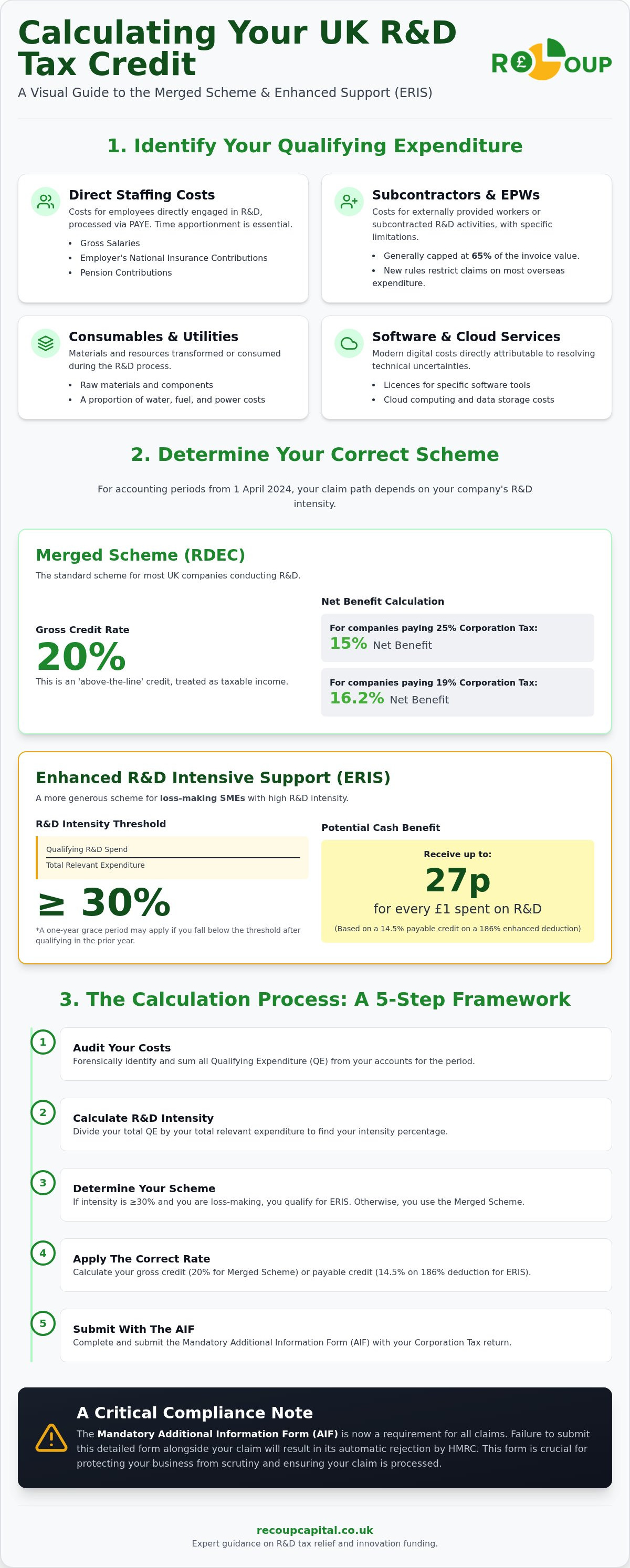
Success begins with a forensic audit of your accounts. Before you can master the specific formula for how to calculate r&d tax credits, you must accurately isolate your qualifying expenditure (QE). HMRC expects a precise list of costs that directly contribute to resolving technical uncertainties. Looking back at the history of R&D tax credits, the categories have expanded significantly to include modern essentials like cloud computing and data licences.
Your ingredients for a claim typically fall into four primary buckets:
- Direct Staffing: This includes gross salaries, employer NICs, and pension contributions.
- Subcontractors and EPWs: Externally Provided Workers (EPWs) and subcontractors are generally capped at 65% of the relevant invoice. Note that new restrictions now limit relief on overseas expenditure to encourage UK-based innovation.
- Consumables and Utilities: Materials transformed or consumed during the R&D process qualify, alongside a proportion of your water, fuel, and power.
- Software and Cloud: Costs for data licences and cloud storage used specifically for R&D projects are now eligible.
Staff Costs: The 'Time Apportionment' Method
You can't rely on guesswork when documenting staff involvement. It's essential to track the specific hours employees spend on technical problem-solving. This means excluding time spent on general administration or commercial activities. It's also vital to remember that dividends don't count; HMRC only recognises costs processed through PAYE. Time apportionment is the bedrock of a defensible HMRC claim.
Sector-Specific Qualifying Costs
Every industry has unique hidden costs. In construction, you might find R&D in the development of bespoke engineering solutions for difficult sites or the trial of sustainable, low-carbon materials. For those in food tech, qualifying spend often relates to extending shelf-life or improving a product's nutritional profile whilst maintaining texture. Software companies must distinguish between routine maintenance and projects that truly advance technological knowledge. Understanding these nuances is a key part of how to calculate r&d tax credits effectively for your specific business model. If you're unsure where your costs fit, our guide on how R&D tax credits work provides further clarity on these eligibility boundaries.
Choosing the Correct Scheme: Merged Scheme vs. ERIS
Identifying your costs is only half the battle. Now you must decide which legislative path your company follows. For accounting periods beginning on or after 1 April 2024, the landscape has shifted into two distinct channels. Most companies now fall under the Merged Scheme, whilst those with a heavy focus on innovation may qualify for Enhanced R&D Intensive Support (ERIS). Determining your scheme is the first hurdle in mastering how to calculate r&d tax credits accurately for your specific business model.
The Merged Scheme (RDEC) Explained
The Merged Scheme operates as an 'above-the-line' expenditure credit. This means the 20% gross credit is treated as taxable income, which simplifies how it appears on your profit and loss account. Because it's taxable, the actual cash benefit you receive depends on your Corporation Tax rate. If you're paying the main rate of 25%, your net benefit is 15% of your qualifying expenditure. For those on the small profits rate of 19%, the benefit increases slightly to 16.2%. Learn more about how R&D tax credits are explained to see how this transition affects your specific financial reporting and cash flow forecasting.
Qualifying for ERIS Support
ERIS is designed specifically for loss-making SMEs that are truly R&D intensive. To qualify, your qualifying R&D expenditure must be at least 30% of your total relevant expenditure for the accounting period. This calculation is a critical step in how to calculate r&d tax credits for high-growth tech or life sciences firms. If you meet this threshold, you can claim a more generous 14.5% payable tax credit on an enhanced deduction of 186%. This can result in a cash benefit of up to 27p for every £1 spent on innovation.
HMRC understands that innovation spend can fluctuate. Consequently, they provide a one-year grace period. If your company met the 30% threshold in the previous period but falls slightly below it this year, you might still be able to claim under ERIS. This protection ensures that temporary shifts in operational costs don't strip away your vital funding. If you are unsure which scheme provides the best return for your current project, you can speak with our specialist team to ensure no capital is left on the table. Choosing the right scheme is a strategic decision that turns a simple refund into a powerful business tool.
Step-by-Step: How to Calculate Your R&D Tax Credit
Translating your technical innovation into a quantitative figure requires precision. Whilst the headline rates seem straightforward, the actual cash benefit often varies based on your company's profitability and tax bracket. To understand how to calculate r&d tax credits effectively, you must follow a structured four-step process that accounts for both the gross credit and the eventual tax liability.
- Step 1: Aggregate your Qualifying Expenditure (QE). Total every eligible cost identified in the previous sections, including apportioned staff time, consumables, and software.
- Step 2: Identify your enhancement path. Confirm whether you are applying the 20% Merged Scheme credit or the 186% ERIS deduction.
- Step 3: Calculate the gross credit. For the Merged Scheme, multiply your QE by 20%. For ERIS, multiply your QE by 1.86 to find the total enhanced deduction.
- Step 4: Determine the net cash benefit. Deduct Corporation Tax from your gross credit or surrender your enhanced loss for a payable credit to find the final liquid asset value.
Example Calculation: Merged Scheme (Profitable Company)
Imagine a company with £100,000 in qualifying R&D spend that is paying the main 25% Corporation Tax rate. Under the Merged Scheme, the gross credit is £20,000. However, because this is an 'above-the-line' credit, it's treated as taxable income. HMRC will therefore retain 25% of that £20,000 (which is £5,000) as Corporation Tax. This leaves the company with a final net tax reduction of £15,000. Why claiming correctly is vital for your bottom line becomes clear when you realise that even small calculation errors can lead to thousands of pounds in lost capital. It's not just about the refund; it's about the strategic utility of that cash.
Example Calculation: ERIS (Loss-making SME)
For an R&D intensive SME with £100,000 in spend and a significant trading loss, the return is even more substantial. The company first applies an 86% enhancement, bringing the total deduction to £186,000. If the company chooses to surrender this loss, they receive a payable tax credit of 14.5%. This results in a cash injection of £26,970. The surrender mechanism allows a company to trade their tax losses for an immediate cash payment from HMRC rather than carrying those losses forward against future profits. This process is a cornerstone of how to calculate r&d tax credits for businesses that prioritise immediate liquidity to fuel further innovation. By converting a paper loss into liquid capital, you're effectively funding your next development cycle without diluting equity. If these calculations feel daunting, our specialists are ready to help you secure your capital recovery with forensic accuracy.
Common Pitfalls and HMRC Compliance Requirements
Calculating your figure is only the beginning of the process. HMRC's focus has shifted heavily toward compliance, meaning your methodology for how to calculate r&d tax credits must be backed by rigorous evidence. The most critical requirement is the Mandatory Additional Information Form (AIF). Since August 2023, every claim must be accompanied by this digital submission. Without it, HMRC will simply remove your R&D claim from your Company Tax Return, rendering your calculations invalid regardless of their accuracy.
One frequent pitfall involves the 'mixed-use' trap. It's tempting to include the full salary of a staff member who occasionally assists with technical projects, but you must only claim for the proportion of time spent on qualifying activities. Over-claiming on administrative or commercial staff is a significant red flag that often triggers a forensic audit. Similarly, if your project received grant funding, your calculation method might change. Whilst the Merged Scheme has simplified some aspects, previous rules regarding 'notified state aid' can still impact how you treat specific costs in your accounts.
Avoiding HMRC Enquiries
Enquiries often stem from simple calculation errors. Including ineligible costs like employer NICs for non-qualifying staff or trying to claim for capital expenditure (which should be handled through Capital Allowances instead) are common mistakes. HMRC also looks for the input of 'competent professionals', individuals with the relevant expertise to justify why a project represents a genuine technological uncertainty. If your report lacks this professional perspective, the validity of your entire claim is at risk. For more clarity on staying compliant, explore our commonly asked questions about R&D compliance.
Documenting the 'Why' Behind the Numbers
Your financial ledger tells only half the story. HMRC's primary interest lies in the 'scientific or technological advance' you've achieved. You must link specific ledger entries directly to technical milestones within your report. If you've spent £50,000 on materials, you need to show exactly which phase of the prototype development consumed those resources. Organising your records now ensures you can withstand a retrospective audit years down the line. If you're concerned about your documentation, our team can review your technical narrative to ensure it meets the latest HMRC standards. This proactive approach transforms a simple filing into a robust strategic asset.
Maximising Your Claim with Recoup Capital
Whilst understanding the mechanics of how to calculate r&d tax credits is essential, the execution requires a level of forensic detail that general accounting often cannot provide. Many businesses in construction and engineering miss out on significant capital because their qualifying costs are buried in day-to-day problem solving. We look beyond the surface. Our team identifies the technical uncertainties that standard bookkeeping overlooks, ensuring that every minute of staff time and every consumable material is accounted for in your final figure.
We operate on a success-based fee model. This ensures our goals are perfectly aligned with yours; we only win when your business successfully recovers its capital. By combining chartered tax accountants with technical specialists, we handle the entire process from the initial assessment to the final HMRC liaison. This end-to-end support minimises disruption to your team, allowing you to focus on innovation whilst we handle the regulatory complexities and the technical narrative required for a successful claim.
The Value of Specialist R&D Consultants
Identifying 'hidden' R&D requires more than just a spreadsheet. It requires a deep understanding of industry-specific challenges, such as bespoke engineering solutions or sustainable material trials. We don't just process paperwork. We build a robust technical narrative that justifies every pound of your claim to HMRC. If the authorities have questions, we act as your protective guide, resolving queries quickly and professionally. Start your R&D tax credit claim with our specialists to ensure your technical narrative is as strong as your financial data.
A Partnership for Long-Term Growth
We view your tax credit as more than just a refund. It's a strategic asset designed for reinvestment into your next breakthrough project. This relationship-first approach means we support your business through every stage of the innovation cycle, from the first spark of an idea to the final capital recovery. We're invested in your future, not just your current claim. By reframing these returns as strategic tools, we help you build a sustainable pipeline for growth and technological advancement.
Transforming your innovation into liquid capital shouldn't be an intimidating process. It should be a streamlined opportunity for growth. We invite you to book a no-obligation consultation to precisely determine how to calculate r&d tax credits for your specific circumstances. Let us show you the value we can uncover whilst you continue to push the boundaries of what's possible in your industry. Our commitment is to demonstrate value through results, helping you turn technical challenges into financial strength.
Secure Your Innovation's Future
Mastering how to calculate r&d tax credits is about more than just filling in a form; it's about reclaiming the capital your business needs to grow. We've explored the necessity of precise cost identification and the critical impact of choosing between the Merged Scheme and ERIS. With HMRC's heightened focus on compliance and the mandatory Additional Information Form, your technical narrative must be as forensic as your financial data to withstand scrutiny.
Our team of specialist chartered tax accountants brings deep expertise in construction and engineering to every assessment. We act as your proactive guide, ensuring no qualifying cost is overlooked whilst protecting your business from the risks of an enquiry. Because we operate on a success-based fee model, our interests are entirely aligned with your success. We're ready to help you reframe your tax relief as a powerful strategic asset for long-term innovation.
Ready to discover the true value of your technical breakthroughs? Request a professional R&D assessment from Recoup Capital today. Your next project deserves the best possible start; let's secure the funding to make it happen.
Frequently Asked Questions
Can I calculate R&D tax credits myself or do I need an accountant?
You can calculate your R&D tax credits internally, but the complexity of modern HMRC compliance makes professional support a strategic advantage. Whilst a general accountant handles your day-to-day books, they may lack the forensic technical knowledge required to identify all qualifying activities. Using a specialist ensures your claim is maximised and defensible. Recoup Capital provides this expertise on a success-based fee model, ensuring your final submission is accurate without upfront financial risk or sales pressure.
What is the current R&D tax credit rate for SMEs in 2026?
For accounting periods beginning on or after 1 April 2024, the standard rate under the Merged Scheme is a taxable 20% expenditure credit. This typically results in a net benefit of 15% to 16.2% depending on your Corporation Tax rate. If your business qualifies for Enhanced R&D Intensive Support (ERIS), you can claim an enhanced deduction of 186%. This allows loss-making, intensive SMEs to receive a payable tax credit of up to 14.5% of their surrenderable loss.
How do I calculate R&D intensity for the ERIS scheme?
To qualify for the ERIS scheme, your qualifying R&D expenditure must be at least 30% of your company's total relevant expenditure for the period. You calculate this by dividing your total qualifying R&D costs by your total expenditure as recorded in your accounts. Note that 'total expenditure' is the figure before any R&D enhancement is applied. This threshold is a key part of how to calculate r&d tax credits for high-growth tech and engineering firms.
What happens if my R&D tax credit calculation is incorrect?
An incorrect calculation can trigger a formal HMRC enquiry, potentially leading to significant delays, rejected claims, and financial penalties. If HMRC believes the error was careless or deliberate, they may apply a percentage-based penalty on the over-claimed amount. This is why forensic accuracy is vital. Our chartered tax accountants act as a protective guide, reviewing every ledger entry to ensure your submission aligns perfectly with the latest legislative requirements and technical guidelines for innovation funding.
Can I claim R&D tax credits if my company is making a loss?
Yes, loss-making companies can still benefit significantly from R&D tax relief. Under the Merged Scheme, the credit is payable even if you have no tax liability to offset. For those qualifying for ERIS, the benefit is even more substantial; you can surrender your enhanced tax losses for an immediate cash injection. This cash payment provides vital capital utility, allowing you to reinvest in further innovation whilst your business works toward future profitability and commercial success.
How far back can I go when calculating my R&D tax claim?
You can generally submit a claim for any accounting period that ended within the last two years. This means you have a 24-month window from the end of your financial year to identify qualifying costs and submit your report to HMRC. If you've never claimed before, this retrospective window allows you to recover significant capital from previous projects. It's an excellent opportunity to turn past technical challenges into current strategic assets for your business growth.
What is the difference between RDEC and the SME scheme calculation?
The distinction has changed since the introduction of the Merged Scheme in April 2024. Previously, the SME scheme offered an additional deduction whilst RDEC provided an 'above-the-line' credit for large companies. Now, most UK businesses use the Merged Scheme, which adopts the RDEC-style 20% taxable credit model. This simplifies the process for many, though intensive SMEs must still understand how to calculate r&d tax credits under the more generous ERIS framework to maximise their returns.
Do I need to submit a technical report alongside my calculation?
Yes, you must provide a detailed technical narrative to support your figures. Since August 2023, every claim must include a Mandatory Additional Information Form (AIF) submitted digitally to HMRC. This form requires you to explain the scientific or technological advance you've sought and the uncertainties you've encountered. Without this narrative, your financial calculation is considered invalid. Our specialists handle this technical writing on your behalf, linking your project milestones directly to your qualifying expenditure.


