

What if the technical obstacles your team overcame this year were actually untapped capital waiting to be reclaimed? For many innovative firms, securing an r and d tax credit claim manchester feels like a regulatory minefield, especially with the recent transition to the merged scheme and heightened HMRC scrutiny. It's natural to worry about the administrative burden of the mandatory Additional Information Form or the risk of missing the six-month Advance Notification deadline whilst your focus remains on core operations.
This guide will show you how to transform those technical uncertainties into a robust, compliant claim that serves as a strategic asset for your business. We'll explore the 20% expenditure credit, the 186% deduction for R&D-intensive SMEs, and how a specialist partnership can streamline your path to capital recovery. You'll learn how to navigate the new 30% intensity threshold and ensure your documentation meets 2026 standards, allowing you to reinvest in growth with absolute confidence.
Key Takeaways
- Understand how R&D tax credits function as strategic innovation capital, providing either a reduction in Corporation Tax or a direct cash credit to reinvest in your business.
- Identify qualifying activities across your entire operation, ensuring your r and d tax credit claim manchester includes often-overlooked costs like software, consumables, and subcontracted work.
- Navigate the complexities of the new Merged R&D Scheme with confidence by learning how to prepare for increased HMRC compliance checks and enquiries.
- Discover a forensic two-step methodology for structuring submissions that pairs technical project scoping with rigorous financial analysis for maximum claim value.
- See why aligning with a specialist who operates on a success-based fee model ensures a streamlined, risk-free process that generalist accountants often cannot match.
Understanding the R&D Tax Credit Claim Process
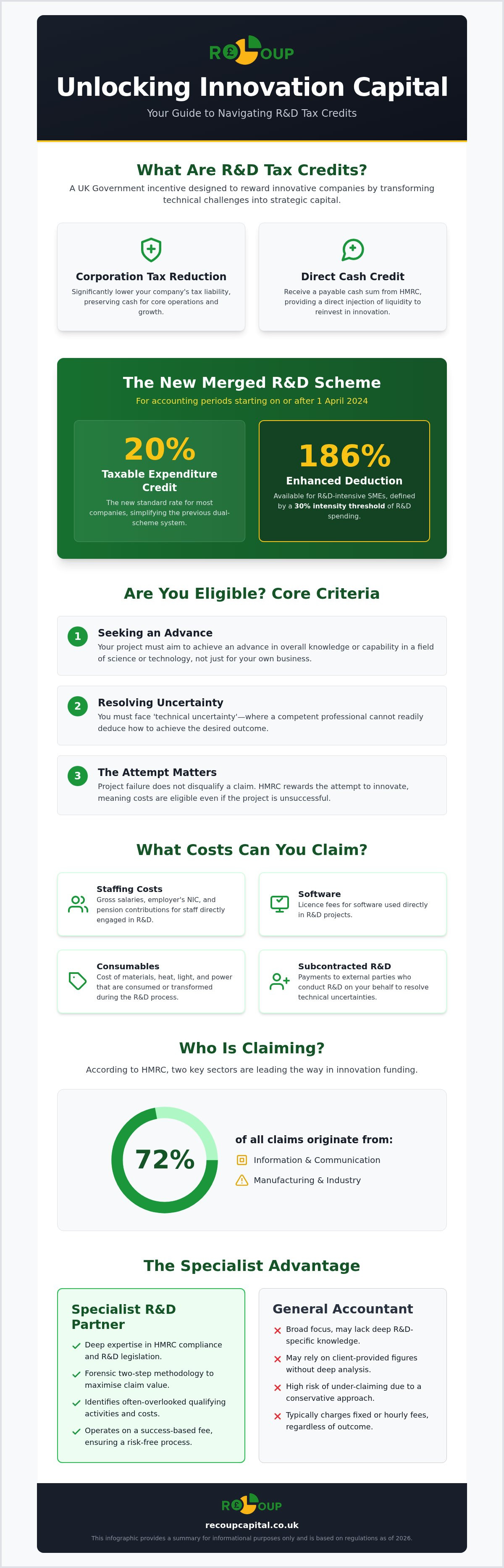
The UK's R&D tax incentive is a government-backed scheme designed to reward limited companies for resolving technical challenges. It's a powerful tool for growth. For firms pursuing an r and d tax credit claim manchester, this relief provides a vital injection of liquidity through either a reduction in Corporation Tax or a direct cash credit. Whilst the scheme is national, certain urban centres serve as primary hubs for the Information & Communication and Manufacturing sectors, which collectively accounted for 72% of all claims according to HMRC's September 2025 report.
As of 2026, the landscape has shifted significantly. Most businesses now operate under a single merged scheme, offering a 20% taxable expenditure credit for accounting periods beginning on or after 1 April 2024. This change simplifies the process but demands higher precision in documentation. It's no longer just about the refund; it's about building a robust, compliant narrative that stands up to scrutiny whilst ensuring every eligible pound is recovered.
How R&D Tax Credits Function as Strategic Capital
Think of your refund as more than a simple tax rebate; it's "Innovation Capital". By reframing these funds as a dedicated investment pot, you can fuel future technical projects without diluting equity. For mid-market firms, this capital recovery directly improves cash flow, creating a more resilient balance sheet for long-term growth. We see a clear link between a successful r and d tax credit claim manchester and broader corporate finance opportunities. A success-based fee model ensures that the specialist's interests are perfectly aligned with your long-term capital recovery and business stability.
The Core Eligibility Criteria for Limited Companies
Eligibility hinges on demonstrating a "scientific or technological advance". This doesn't require a laboratory or white coats. It simply means your project aimed to achieve an improvement in overall knowledge or capability in a field of science or technology. You must identify "technical uncertainty", which is the point where a competent professional cannot easily say how to achieve the desired outcome or which path to take.
Crucially, project failure doesn't disqualify you from claiming. HMRC rewards the attempt to innovate, not just the successful result. If your team spent time and money trying to solve a problem that remained unsolved, those costs are often still eligible for relief. This ensures that the financial risk of ambitious projects is partially mitigated, encouraging firms to push the boundaries of what's possible in their respective sectors without the fear of wasted investment.
Identifying Qualifying Activities: Beyond the Laboratory
Many directors assume innovation requires a sterile environment and high-tech equipment. This misconception often prevents firms from pursuing a valid r and d tax credit claim manchester. In reality, R&D is frequently found in the iterative process of solving technical problems on a factory floor or a construction site. To ensure compliance, businesses should consult the official government guidance on R&D relief, which clarifies that qualifying activities must seek a technological advance through the resolution of scientific or technological uncertainty.
Qualifying costs extend far beyond simple research expenses. You can typically claim for:
- Staffing costs: Gross salaries, Class 1 NICs, and pension contributions for those directly involved.
- Software: Licenses used specifically for R&D purposes.
- Consumables: Materials or utilities transformed or used up during the R&D process.
- Subcontracted R&D: Costs paid to external partners to help resolve technical uncertainties.
Identifying these costs requires a forensic approach. It's not enough to guess percentages at the end of the financial year. You must document the specific time staff spent overcoming technical hurdles. This granular detail is what transforms a standard tax filing into a robust r and d tax credit claim manchester that can withstand HMRC scrutiny. If you're uncertain which of your day-to-day operations qualify, exploring your eligibility with a specialist can uncover significant hidden value.
Innovation in Construction and Engineering
Construction firms often innovate out of necessity rather than design. Developing bespoke building materials to meet new environmental standards or solving unique structural challenges on complex brownfield sites are prime examples of qualifying work. These projects involve high levels of technical risk and uncertainty. You can learn more about R&D in construction to see how these practical solutions translate into strategic capital for your firm.
Software and Digital Development Breakthroughs
In the digital space, the line between routine development and R&D is often thin. Standard web design or building a basic e-commerce platform rarely qualifies. However, creating new algorithms or improving legacy system interoperability often does. AI and machine learning challenges are particularly strong candidates if they push the boundaries of existing technology. The key is proving that the solution wasn't readily deducible by a competent professional in the field.
Navigating the Merged R&D Scheme and HMRC Compliance
The transition to the merged R&D scheme represents the most significant regulatory shift in a decade. For any firm preparing an r and d tax credit claim manchester, the calculation now centres on a 20% taxable expenditure credit for accounting periods starting on or after 1 April 2024. This unified approach replaces the previous SME and RDEC silos, though loss-making, R&D-intensive SMEs can still access the Enhanced R&D Intensive Support (ERIS) if their innovation spending hits the 30% threshold. This new framework demands absolute transparency in your CT600 filing. HMRC now requires a mandatory Additional Information Form (AIF) for every submission, making compliance a front-and-centre priority.
Start-ups and smaller firms can mitigate risk through Advance Assurance. This allows eligible businesses, typically those with a turnover under £2 million and fewer than 50 employees, to secure HMRC’s agreement on their R&D status for three years. It provides a predictable foundation for future claims and reduces the likelihood of future enquiries. Aligning your technical narrative with HMRC's definition of R&D is no longer optional; it is the baseline for compliance in 2026.
HMRC Scrutiny: Protecting Your Business from Enquiries
HMRC enquiries have become more frequent as the tax office targets error and fraud. Common red flags include inconsistent cost-to-staff ratios or vague project descriptions. A robust technical report is your primary defence. It acts as a compliance shield, translating complex engineering challenges into the specific language HMRC expects. By using in-house chartered tax accountants, you ensure that your r and d tax credit claim manchester is defended by specialists who understand the forensic requirements of a modern enquiry.
The Importance of Accurate Record Keeping
Moving from estimation to evidence-based tracking is vital. Gone are the days of "best-guess" percentages at year-end. Successful claimants now organise project notes, technical specifications, and real-time time tracking throughout the year. An annual R&D audit helps capture innovation as it happens. This proactive documentation ensures that when it comes time to file, your evidence is irrefutable and your recovery is secured.
How to Structure a Robust R&D Tax Relief Submission
Structuring a robust r and d tax credit claim manchester is a precise exercise in both engineering and accounting. It's not enough to simply identify innovation; you must package it in a way that aligns with HMRC's 2026 compliance standards. A successful submission follows a disciplined five-step methodology that ensures every qualifying pound is captured whilst protecting your firm from unnecessary scrutiny. This process transforms technical hurdles into Innovation Capital, providing a clear path from project discovery to capital recovery.
- Technical Scoping: Identify projects that meet the criteria for technological advance.
- Financial Analysis: Perform a forensic review of all associated costs.
- Technical Narrative: Draft a report that translates complex work into HMRC's specific terminology.
- CT600 Integration: Embed the claim data accurately within your Corporation Tax return.
- HMRC Liaison: Manage all ongoing communication with the tax office until the credit is secured.
The Scoping Session: Finding the "Hidden" R&D
The most valuable R&D often hides in plain sight. During a scoping session, we interview your lead engineers and developers to uncover the technical uncertainties they faced. We look for projects that were particularly difficult, required multiple iterations, or even those that ultimately failed. HMRC rewards the attempt to innovate, so a "failed" project is often a goldmine for a valid r and d tax credit claim manchester. You can explore our methodology for claiming R&D tax credits to see how we dig deeper than generalist accountants.
Financial Analysis: Maximising Your Allowable Costs
Precision in financial data is your best defence against an enquiry. This stage involves calculating the exact proportion of utility bills, software licenses, and staff time dedicated to R&D. Under the merged scheme rules, handling subcontracted R&D has become more complex, requiring a careful review of who holds the "decision-maker" status. We ensure every Class 1 NIC and pension contribution is included in your staff cost calculations. If you want to ensure your claim is both maximised and compliant, booking a technical scoping session is the most effective first step.
Once the data is gathered, the technical narrative becomes the bridge between your innovation and the tax credit. It must clearly articulate the "baseline" of technology you started with and the "advance" you sought to achieve. This document is what provides the compliance shield, ensuring that HMRC inspectors understand the technical merit of your claim from the outset. This forensic approach ensures your claim is processed efficiently, allowing you to reinvest the recovered capital into your next phase of growth.
Why a Specialist Partnership Maximises Your Innovation Capital
Whilst your general accountant is essential for annual compliance and bookkeeping, they often lack the technical depth required to identify every eligible activity within a complex r and d tax credit claim manchester. A specialist partnership bridges the gap between technical engineering and forensic tax accounting. This synergy ensures that your claim isn't just a set of numbers on a spreadsheet, but a robust technical narrative that accurately reflects your firm's innovation. By employing a team of in-house chartered tax accountants and sector-specific experts, you can secure the maximum possible recovery whilst maintaining total peace of mind regarding HMRC's 2026 standards.
Our success-based fee model perfectly aligns our interests with yours. It provides a risk-free way to explore your eligibility without upfront costs, shifting the focus from simple paperwork to actual results. This relationship-first approach transforms the process from a yearly chore into a strategic business tool. We don't just process a refund; we help you build "Innovation Capital" that can be reinvested to drive your next technical breakthrough. This long-term collaboration ensures your business remains resilient and competitive in an increasingly complex regulatory landscape.
Specialists vs Generalists: The Forensic Difference
Generalist accountants often take a conservative approach, frequently leaving 20-30% of a claim's potential value on the table. They might miss subtle qualifying costs in process optimisation or bespoke software development that a specialist would instantly recognise. Conversely, there is a risk of "over-claiming" without a specialist technical review, which can trigger an HMRC enquiry. A forensic approach identifies the precise boundaries of your R&D, ensuring your claim is both maximised and defensible. You can see why choosing Recoup Capital for your claim provides the necessary technical rigour that generalists simply cannot match.
Unlocking Holistic Tax Relief
A specialist doesn't look at R&D in isolation. We view it as a core component of a wider tax strategy. For instance, linking R&D credits with Capital Allowances for commercial property can significantly enhance your overall tax position. Innovative firms with patented technology can also utilise the Patent Box scheme to further lower their Corporation Tax rate. This holistic view is a key part of our Corporate Finance advisory, where we help you reframe financial returns as strategic assets. By integrating these various reliefs, you create a powerful engine for capital recovery that supports every facet of your business growth.
Transform Your Innovation into Strategic Capital
Securing a robust r and d tax credit claim manchester is more than a tax exercise; it's a strategic move to fuel your firm's future growth. We've explored how identifying qualifying activities in sectors like construction and engineering, whilst navigating the 2026 Merged Scheme, can unlock significant liquidity. Precision is vital. By moving from simple estimations to forensic, evidence-based submissions, you protect your business against increasing HMRC scrutiny.
Recoup Capital acts as your proactive guide. We combine the expertise of chartered tax accountants with technical specialists who understand your industry's unique hurdles. Our success-based fee model ensures our interests are perfectly aligned with yours, offering a risk-free path to capital recovery. With a proven track record in technical sectors, we're ready to help you reframe your tax returns as strategic assets. Book a no-obligation R&D consultation with Recoup Capital today to discover the true value of your innovation. Your next technical breakthrough starts with the right financial foundation.
Frequently Asked Questions
Is R&D tax credit still available for UK SMEs in 2026?
Yes, R&D tax relief remains a cornerstone of UK innovation policy. For accounting periods starting on or after 1 April 2024, most SMEs now claim under the merged scheme. However, loss-making, R&D-intensive SMEs can still access the Enhanced R&D Intensive Support (ERIS) if their qualifying expenditure meets the 30% threshold. This ensures that smaller, innovative firms continue to receive vital capital to fuel their technical projects.
How long does it typically take to receive an R&D tax credit refund?
HMRC typically processes most claims within 28 to 40 days, though this timeline can vary depending on the complexity of the submission. If your r and d tax credit claim manchester is well-documented and includes a mandatory Additional Information Form (AIF), the process is generally smoother. You'll receive the benefit either as a reduction in your Corporation Tax bill or as a direct cash payment into your business bank account.
Can I claim R&D tax relief if my project was a technical failure?
You can absolutely claim for projects that didn't achieve their technical goals. HMRC's criteria focus on the attempt to achieve a scientific or technological advance by resolving uncertainty. The fact that your team couldn't overcome the hurdle actually proves that technical uncertainty existed, which is a core requirement for eligibility. Failed projects often provide some of the strongest evidence for a successful claim.
What is the new Merged R&D Scheme and how does it affect my claim?
The Merged R&D Scheme combines the previous SME and RDEC paths into a single framework for accounting periods starting on or after 1 April 2024. It offers a taxable credit of 20% on qualifying expenditure. This change aims to simplify the system whilst introducing stricter compliance measures, such as the requirement for an Additional Information Form. It's essential to understand how these new rules impact your specific cost calculations.
What are the most common qualifying costs in an R&D claim?
The most frequent qualifying costs include gross staff salaries, employer Class 1 National Insurance contributions, and pension payments for those directly involved in innovation. You can also include software license fees, consumables like heat and light, and payments to subcontractors. A specialist review ensures you capture all eligible costs whilst excluding non-qualifying expenditure to maintain compliance with current HMRC standards.
Do I need a specialist R&D consultant if I already have an accountant?
Whilst general accountants handle standard filings well, they often lack the technical expertise to identify every qualifying activity. Specialist consultants employ chartered tax accountants and engineers who can draft the detailed technical reports HMRC now expects. Using a specialist often results in identifying 20% to 30% more qualifying expenditure whilst providing a compliance shield that protects your business from potential errors or omissions.
What happens if HMRC decides to enquire into my R&D claim?
If HMRC opens an enquiry, they will request further evidence to support the technical and financial aspects of your r and d tax credit claim manchester. This process involves a detailed review of your project documentation and cost breakdowns. Having a specialist partner who offers success-based fees means you have expert support to manage all HMRC correspondence and defend the validity of your innovation without additional upfront costs.
Can I claim R&D tax credits retrospectively for previous years?
You can claim retrospectively for the two previous accounting periods. The statutory deadline for submitting or amending a claim is strictly two years from the end of the relevant accounting period. This allows businesses to recover capital for innovation that has already taken place. It's a valuable opportunity to inject "Innovation Capital" back into your firm to support future development and strategic growth.


